
Core logic: Gradually increase positions under the premise of profit, with decreasing position sizes, which amplifies trend gains while controlling the risk of additional positions, avoiding excessive losses during trend reversals, suitable for mild/clear one-sided trend markets (e.g., BTC rising after breaking key resistance levels, ETH continuously declining driven by favorable policies).
1. Preliminary preparation: Clarify core parameters (must-have)
Account risk threshold: The total loss of a single strategy should not exceed 2%-5% of the account principal (strictly control total risk under perpetual contract leverage). Example: Account principal 10000USDT, maximum allowable loss for a single strategy = 200-500USDT.
Leverage multiplier lock: Fixed low / medium leverage throughout (recommended 3-5 times, avoid high leverage increasing the risk of position expansion), not adjusted according to market conditions.
Trend judgment criteria: Predefine 'effective trend' (avoid adding positions in a choppy market), options:
Technical aspect: Price breaks through the 20-day EMA / key resistance level + trading volume increases by more than 30%;
News aspect: Clear positive / negative news materializes (e.g., ETF approval, regulatory policy issuance) and the price has confirmed the direction.
II. First position opening: Small position trial and error (basic position)
Opening ratio: 40%-50% of the planned total position (total position = funds available for this strategy in the account, excluding reserved margin). Example: Planned total position 2000USDT (20% of account), first position opening = 800-1000USDT (40%-50%).
Opening trigger conditions: Meet the previously defined 'effective trend' (e.g., BTC breaks through the 45000USDT resistance level + trading volume increases), direction is consistent with the trend (long / short).
First stop loss setting:
Stop loss point: Opening price reverse fluctuation 3%-5% (or break below / breakthrough key support / resistance level before opening);
Stop loss amount: 5%-8% of the first position opening amount, and not exceeding 50% of the account's total risk threshold (Example: First position opening 1000USDT, stop loss amount = 50-80USDT, corresponding price stop loss point).
Operation: Immediately place stop loss order after opening position (for perpetual contracts, it is recommended to use 'conditional stop loss order' to avoid missing monitoring).
III. Conditions and operations for adding positions (core link)
1. Prerequisites for adding positions (all must be met)
First position opening has made a profit (floating profit ≥ 1.5 times the first position opening stop loss amount, ensure there is a safety margin before adding positions);
Trend has not reversed (price is still moving in the direction of the first position opening and has not touched the reverse signal of trend judgment, such as breaking below the 20-day EMA);
Margin adequacy ratio ≥ 150% (to avoid insufficient margin triggering forced liquidation after adding positions in perpetual contracts).
2. Adding position batches and scale (gradually decreasing)
Pyramid replenishment divided into 2-3 batches (maximum of 3 batches, avoid excessive position expansion), each batch's scale = 50%-70% of the previous batch:
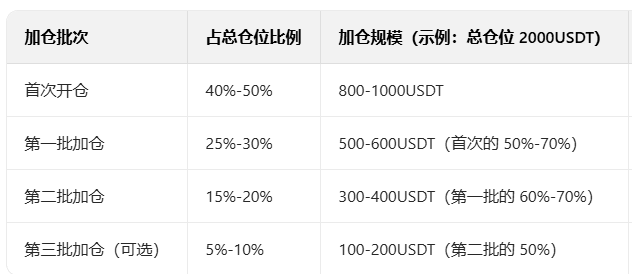
3. Adjusting stop loss for adding positions (dynamic upward / downward movement)
After completing each batch of adding positions, immediately adjust the overall stop loss level (covering all opened positions):
Long: Move the stop loss up to 'latest added position price reverse fluctuation 2%' or 'cost line of the previous batch's added position' (take the higher position);
Short: Move the stop loss down to 'latest added position price reverse fluctuation 2%' or 'cost line of the previous batch's added position' (take the lower position);
Core: Ensure the overall stop loss level is always above 'current floating profit covering all position transaction fees + 1% safety margin', to avoid triggering losses due to slight reversals after adding positions.
IV. Closing rules (taking profit securely)
1. Take profit and close (take profit in batches, avoid missing out)
First batch take profit: Overall floating profit reaches 3 times the first position opening stop loss amount, close 50% of total position (locking in core profit);
Second batch take profit: Increase floating profit by 20% (relative to the first batch's take profit price), close 40% of the remaining position;
Remaining 10% position: Set 'trailing take profit' (immediate liquidation when price reverses by 2%), aiming for profits at the end of the trend.
2. Stop loss and close (trigger immediately, do not hesitate)
Triggered overall stop-loss level: Immediately liquidate all positions, terminate the strategy, do not add positions, do not hold positions;
Trend reversal signal appears (e.g., price breaks below the 20-day EMA + trading volume increases): Even if the stop loss has not been triggered, close 50% of the position and move the stop loss of the remaining position to the cost line.
V. Practical example (BTC perpetual contract long strategy)
Account principal 10000USDT, total position 2000USDT (20%), leverage 5 times, trend judgment: BTC breaks through the 45000USDT resistance level + trading volume increases (effective bullish trend).
First position opening: 1000USDT (50% of total position), opening price 45000USDT, stop loss point 43250USDT (reverse fluctuation 3.9%, stop loss amount ≈ 80USDT, accounting for 0.8% of the account);
First batch of adding positions: BTC rises to 46350USDT (floating profit 3%), add 600USDT (30% of total position, 60% of the first), overall stop loss level moves up to 45450USDT (first batch's added position price reverse 2%);
Second batch of adding positions: BTC rises to 47740USDT (relative to the first batch's added position floating profit 3%), add 300USDT (15% of total position, 50% of the first batch), overall stop loss level moves up to 46680USDT;
Take profit and close:
BTC rises to 49120USDT (overall floating profit ≈ 9%, floating profit amount ≈ 180USDT = 2.25 times the first stop loss), close 50% of the position (1000USDT corresponding position);
BTC continues to rise to 50090USDT (floating profit increases by another 2%), close the remaining 40% of the position (800USDT corresponding position);
Remaining 10% position sets trailing take profit, when the price falls to 49090USDT (reverse 2%) close the position, final overall profit ≈ 12%.
VI. Taboos and precautions
Prohibited to add positions when in loss (pyramid strategy only applies to profitable additions; adding in loss is essentially Martingale, risk is uncontrolled);
Prohibited to exceed 3 batches of position additions (the more additions, the larger the loss when the trend reverses);
Absolutely stop using in choppy markets (when prices are oscillating, it is easy to stop loss on the first position opening, and the conditions for adding positions cannot be triggered);
Reserve sufficient margin: After each batch of adding positions, the margin adequacy ratio should be ≥ 150% (the forced liquidation line for perpetual contracts is usually 100%-120%).
Follow me@币圈罗盘 , next time I will take you through the underlying logic of contract strategies, helping you avoid detours and earn real money! #ETH走势分析 $BTC $ETH

