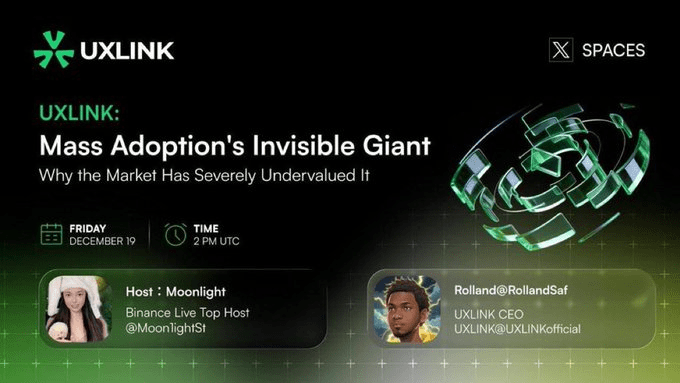
After watching UXLINK CEO Rolland's sharing at the AMA hosted by Moonlight, I felt quite touched. I have been paying attention to this project, UXLINK @UXLINK Official for a long time; I have always thought it belongs to that type of 'hidden but actually supporting the entire ecosystem.'
Many applications are doing quite well in their respective tracks now, for example, Catizen in gaming, CYBER in decentralized identity, and PARTI in AI content in these vertical fields, which indeed has brought a noticeable increase in user numbers. But Rolland mentioned a key point: although these applications are popular, very few can build a lasting and genuine user relationship network. What UXLINK does is exactly this — it is not here to steal the spotlight, it does not aim to be a player under the spotlight, but chooses to lay the pipes underground.
He made an analogy that many successful applications are like 'track leaders', with clear goals and scenarios. But what UXLINK is doing is 'soil'. While others are drilling wells in their own backyards, it is laying down an entire underground water network. In other words, it does not optimize a specific product, but builds a growth layer that can connect real people, verify social relationships, and can be reused by other projects. The track may change over time, but the soil will only accumulate thicker.
This actually points out why UXLINK does not seem so 'shiny' in the short-term market. Infrastructure often works this way; it does not directly face consumers, and its value is reflected in what others can achieve with it. Once this infrastructure network is formed, the replacement cost becomes very high.
UXLINK makes me feel that the most valuable aspect is the real social graph it builds. There are quite a few bots and fake accounts in the industry now, but UXLINK insists on connecting real people through a network of acquaintances. This is quite difficult, but it is also the moat — it has already helped tens of millions of Web2 users genuinely migrate to Web3. This real relationship between people cannot be faked and is very hard to replicate.
UXLINK's OAOG cold start system is not an empty concept, but an engine that can actually help projects quickly launch real communities across chains and regions. Relying on social trust + verifiable relationships + a viral mechanism, it solves the longstanding challenges of cold starts in Web3 projects. If an infrastructure can continuously lower the overall growth threshold of the industry, then its value is not just as simple as its own business.
Currently, UXLINK's track positioning is quite special. It does not directly compete with front-end applications, but rather supports them. In this model, its value will continue to accumulate as successful projects in the ecosystem increase. Currently, the market's recognition of the value of such underlying facilities still has a lot of room for growth, especially since it has already been verified to drive large-scale real user migration and has formed a reusable growth framework.
If more projects grow based on #UXLINK 's social graph and cold start system in the future, its network effects will become increasingly evident. In the process of Web3 pursuing mass adoption, this infrastructure, which focuses on 'making it easier for the whole industry to grow', actually occupies a very critical link. I personally feel that there exists a significant expectation gap between its long-term value and the current market attention.
It is obvious that UXLINK does not belong to the type that becomes popular overnight, but what it is doing — connecting real people and becoming the underlying soil of the ecosystem — may very well be the most solid support in the next wave of industry growth. If you also believe that Web3 ultimately needs real users and real relationships, then this project is worth keeping an eye on with me. $UXLINK