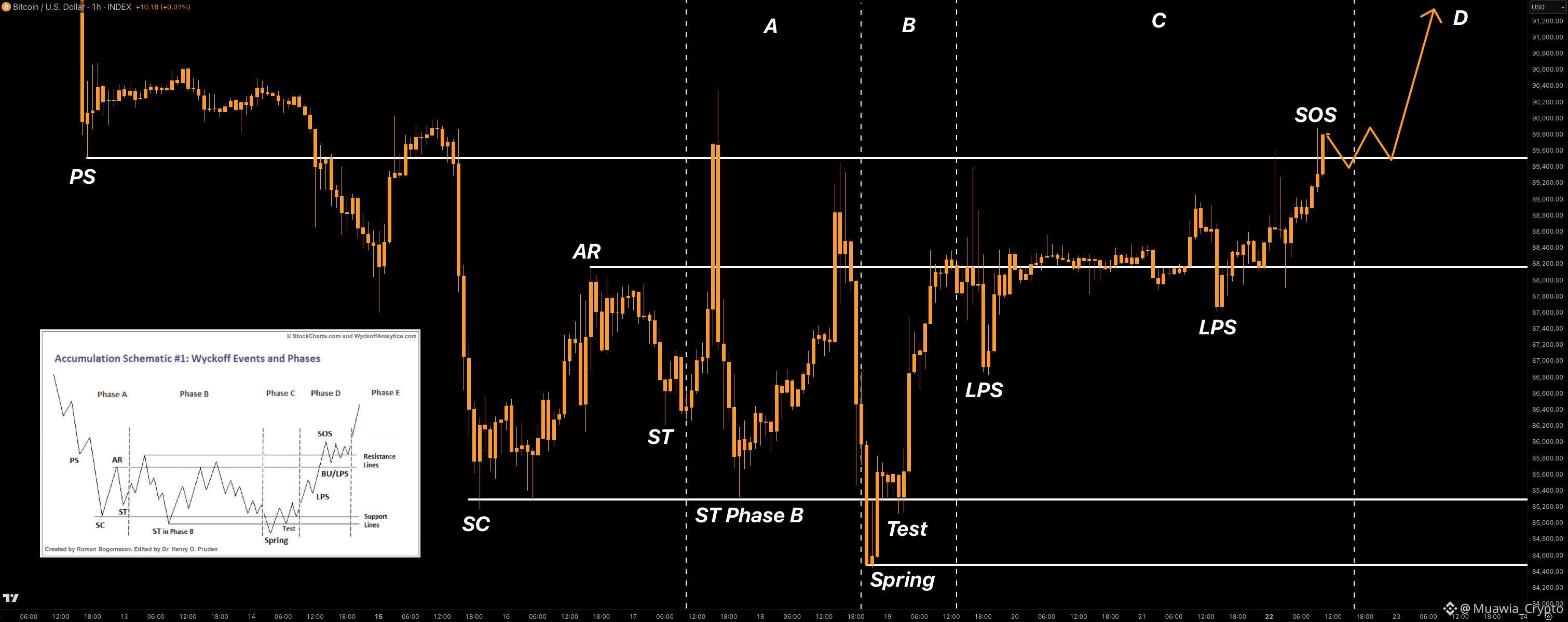
$BTC After weeks of granular price compression and muted volatility, Bitcoin is now exhibiting characteristics that align closely with a late-stage Wyckoff Accumulation structure—a phase historically associated with the quiet transfer of supply from weak hands to strong, informed participants.
This process is rarely obvious in real time. Accumulation is designed to be boring, frustrating, and deceptive, keeping participation low while larger players absorb available supply without materially moving price.
What the Market Is Signaling Right Now
1. Persistent Compression With Absorption
Price continues to coil within a well-defined range while downside follow-through remains limited. Each dip is met with aggressive absorption, suggesting sell-side liquidity is being systematically removed from the market.
2. Defined Range Highs Acting as the Structural Gate
The upper boundary near ~$90,000 is not arbitrary. It represents a repeated rejection zone where liquidity has pooled. In Wyckoff terms, this level functions as the final supply barrier—and the key trigger for a potential Mark-Up phase.
3. The Breakout Must Be Earned, Not Hoped For
A valid transition out of accumulation requires:
A decisive structural break above range highs
Volume expansion, confirming genuine demand rather than low-liquidity price drift
A successful resistance-to-support flip, proving control has shifted to buyers
Without these conditions, any upside move remains suspect.
Why This Phase Matters More Than Most Realize
Wyckoff Accumulation does not resolve slowly.
Once structure gives way, price does not meander—it expands violently as sidelined capital rushes in and late sellers scramble to re-enter.
This is the stage where:
Risk becomes asymmetrical
Trend followers are forced to chase
Volatility returns with intent
Bottom Line
Bitcoin is not stagnant.
It is loading.
If the $90K region is reclaimed and defended with volume, the accumulation phase can be considered complete—setting the stage for a directional expansion that historically leaves little room for hesitation.
The market always telegraphs its intentions first.
The question is whether you’re watching closely enough when it does.