
Bitcoin will reach a new high in the first half of 2026, expected to hit $150,000 in the first quarter! $200,000 in the second quarter!
Breaking the 4-year cycle, a super cycle will be reopened!

The 20 millionth Bitcoin will be mined in March 2026, and I've listed the top 10 crypto themes for 2026 in advance.
1. The risk of depreciation of the US dollar drives demand for currency alternatives
2. Clarity in regulatory policies helps promote the widespread application of digital assets
3. The GENIUS Act will expand the influence of stablecoins
4. Asset tokenization is at a turning point
5. Privacy solutions are imperative
6. Artificial Intelligence Solutions in Blockchain
7. DeFi is accelerating its development, with lending services leading the trend.
8. Mainstream applications will require next-generation infrastructure
9. Focus on sustainable income
10. Investors default to seeking collateral.
I once made 100 times my initial investment in three months, but I'm even more grateful that I didn't perish in the bear market.
A crypto analyst who has been in the crypto world for 10 years, experiencing three bull and bear market cycles, owns a house and a car, but every penny he earned was earned by walking on the edge of a knife - starting with an initial capital of 200,000, the lowest drawdown was less than 50,000, he suffered from insomnia and almost gave up, and finally used a "clumsy method" to grow it to eight figures.
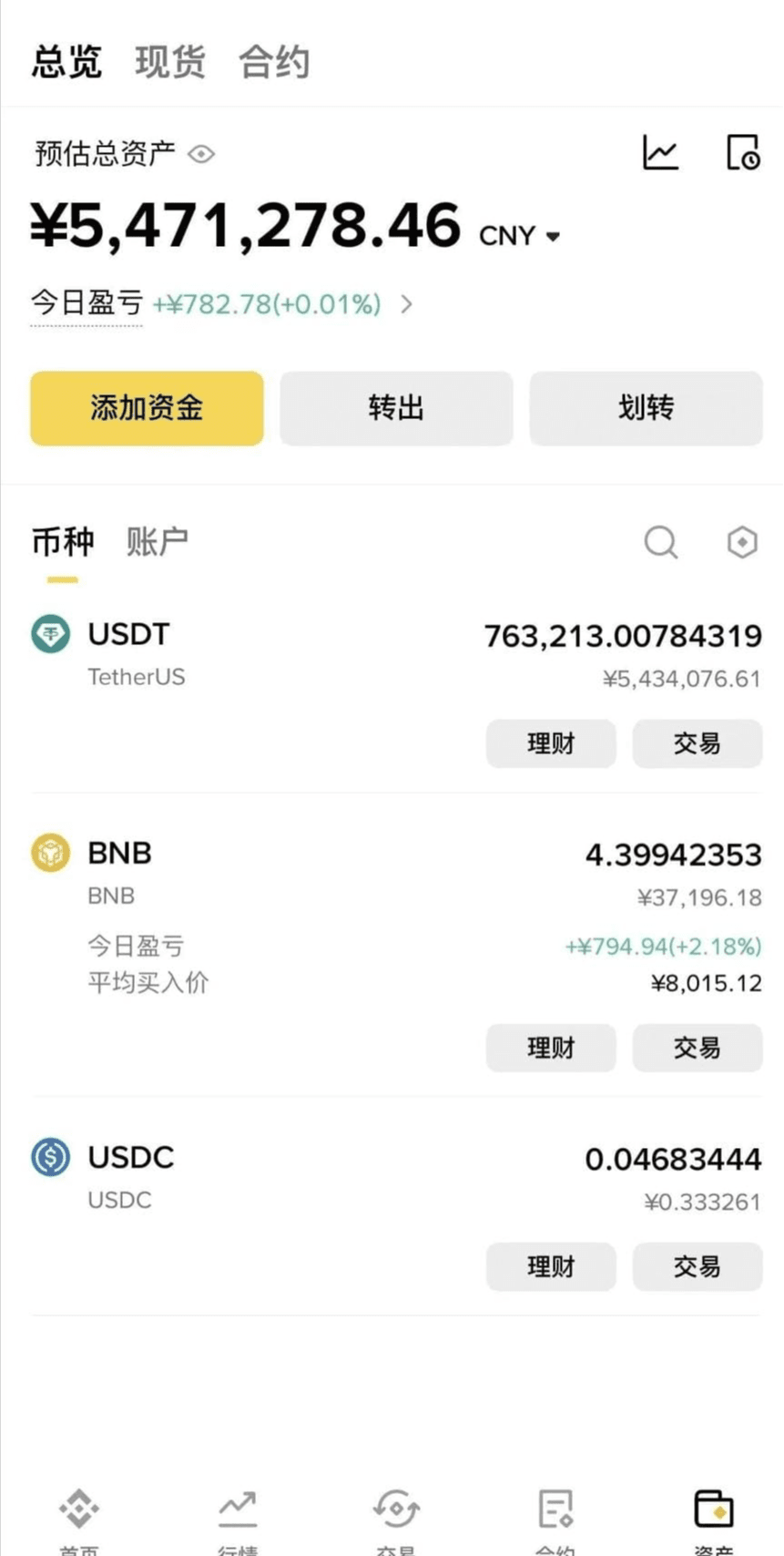
Today I'll speak the truth, no boasting or empty promises, just sharing survival rules forged in blood and tears.
1. A bull market is not an ATM, it's a filter for intelligence.
Many people think that a bull market is like picking up money everywhere, but they try to do too much at once and end up getting burned. My strategy is simple: focus on one sector and fully capitalize on its main upward trend.
For example, during the inscription craze of 2023, I stubbornly focused on the leading stock, ORDI, buying in at $1 and selling at $28, taking profits as soon as I could and never lingering. Meanwhile, those who chased AI, metaverse, and blockchain games simultaneously missed out on gains during sector rotations.
The truth is: In a bull market, 90% of the profits come from 10% of the time. Instead of frequently changing vehicles, it's better to cultivate a promising sector and wait for the right opportunity.
2. Don't get emotionally attached to old coins; the market only loves new stories.
EOS, Bytom... how many people have been scammed by these "old nostalgia" coins? The market is fickle: new coins have anticipated gaps and narrative space, while old coins have heavy trapped positions, making price manipulation as difficult as moving mountains.
I never touch coins with a market capitalization ranking outside the top 1,000 – 99% of them won't survive a year. During the animal coin frenzy in 2021, some people were holding onto "value coins" waiting to break even, but I had already positioned myself for later coins like ORDI and ETHI, reaping the benefits of the new narrative.
Ironclad rule: Cheap does not equal value; the market always pays for the future.
3. A contract is a knife; it can protect you, but it can also be your weapon.
I've had more margin calls than I've made money. The most painful one was when I opened a long position in SOL with 10x leverage, and a sudden price spike wiped me out completely. After that, I made a strict rule:
Never fully leveraged: No single currency pair should exceed 15% of the portfolio.
Leverage should not exceed 5 times: High leverage is a "suicide accelerator";
Stop loss as you breathe: cut your losses if they exceed 5%, and never hold onto a losing position.
Contracts are not gambling; they are a game of risk management. Only those who survive are qualified to talk about making a profit.
4. Cycles are the way of nature; those who defy them will perish.
The cryptocurrency market cycles every four years. Buying at the bottom during a bear market and selling at the top during a bull market—it sounds simple, but how many people have fallen victim to the urge to "not be willing to run"?
My signal lights are simple: when delivery drivers are all asking me what cryptocurrency I'm buying, it's definitely the top; when the community is dead and no one is discussing it, it's the bottom. During the Dogecoin frenzy of 2021, I sold all my shares at $0.7, avoiding a 90% drop afterward. Those who were greedy and thought they could "hold on a little longer" gave back all their profits.
Reminder: Bull markets are for cashing out, bear markets are for accumulating shares. Don't get it backwards!
5. The biggest enemy of retail investors is not the market makers, but themselves.
Get-rich-quick mentality: Want to turn your money 100 times in a year? This is the kind of "leeks" that big players love to exploit.
Chasing highs and selling lows: Frequent trading results in an annualized return of -47%.
Superstitious rumor: North Korean hackers posing as venture capitalists to scam investors; their schemes involving acquaintances are even more ruthless.
My approach was very simple:
Information firewall: Only trust on-chain data (such as changes in whale addresses) and GitHub code updates;
Position 532: 50% mainstream cryptocurrencies (BTC/ETH), 30% potential coins, and 20% cash for averaging down.
Counterintuitive strategy: Take profits in batches during a surge, and accumulate shares through dollar-cost averaging during a crash.
The crypto market isn't lacking in opportunities; what it lacks are people who survive the next bull market. If you can't withstand a 90% drop, you don't deserve a 10x gain. True winners are those who are fearful when others are greedy, and who build cognitive barriers when others are fearful.

How I Controlled My Impulsive Hands in the Crypto World: A Veteran Crypto Investor's Tearful Lessons
Discipline is the highest skill.
I'm your old friend, a seasoned veteran in the crypto world. Today, I won't talk about market trends or technical analysis; I'll just discuss a painful truth—most of us lose money not because we lack technical skills, but because we can't control ourselves.
I used to get my heart racing and my fingers itching whenever I saw market fluctuations. It was like a voice in my head was shouting, "Go for it, or it'll be too late!" But what happened? I regretted every trade I made, and my account balance was always on a rollercoaster ride.
Staying up all night watching the market, if you win you think you're a genius, if you lose you blame the market makers for eyeing your pockets. Later I realized that in the end, playing the crypto game isn't about technical skills, it's about discipline and mindset.
My regrettable moments of "impulsive" behavior
Have you ever had a similar experience?
The first thing I do when I wake up in the middle of the night is reach for my phone to check market trends. My heart skips a beat when I see a sharp drop, and I regret not going all in when I see a surge. After staring at candlestick charts for a while, I can even see all sorts of fantastical patterns, as if a certain coin is "sending me a signal."
I've learned a bunch of technical indicators, like MACD, KDJ, and Bollinger Bands, and I can talk about them fluently, but when it comes to actual trading, I forget them all and am completely led by my emotions.
The scariest thing is that after getting trapped, people become "crypto-world-obsessed," constantly making excuses for themselves even though it's clearly a worthless coin, and even adding to their positions to average down their costs, only to sink deeper and deeper.
My "Five Iron Rules" Saved My Account
After losing a significant amount of money, I learned my lesson and established five trading rules for myself. These rules seem simple, but sticking to them truly helped my account transition from volatile to stable growth.
1. Never fill your warehouses completely, even if the sky falls.
Even if I'm bullish on a particular coin, I'll only allocate a maximum of 1/5 of my portfolio to it. I keep some cash reserves, not for adding to my position, but so that I "still have something to play with."
The most terrifying time in the market is when you're fully invested and trapped, watching opportunities slip away right before your eyes. Leaving room for maneuver means leaving yourself a chance to turn things around.
2. Admit your mistakes; don't fall in love with market trends.
The crypto market is never short of new coins, so why fixate on just one? A drop in price is the market telling you "you were wrong," so don't stubbornly hold on, and definitely don't blindly add to your position.
Remember, averaging down doesn't lower your average cost; it amplifies your mistakes. Just like you won't necessarily win back your money just because you've been at the gambling table for a long time, you should leave when it's time to leave.
3. Let the price of a coin soar as it may.
Don't chase the price as soon as it goes up, or you'll get trapped. The good opportunities you miss will always outweigh the money you lose. Don't be a "crypto-world romance fanatic"—it doesn't love you, you're just a passerby.
I've done the math before, and the number of times I've been trapped after chasing high prices far exceeds the number of times I've missed out on gains. So now, I'd rather miss out than make a mistake.
4. If you spend more than one hour a day watching the market, you've already lost.
I used to set an alarm to turn off the software at the appointed time. Staring at candlestick charts for too long can create illusions; when emotions get the better of you, you forget all your strategies.
Use the time you would spend watching the market to study and enjoy life. You'll find that not only does your account not get worse, but your mood improves. Trading isn't everything in life; it's just a means to achieve a better life.
5. Before going to sleep, the account must be "calm and still".
Don't expect miracles in the middle of the night; usually, you'll only get a fright. Sleeping without heavy loads is the best sleeping pill I give myself.
Of course, this doesn't mean you have to liquidate your entire position, but rather that you shouldn't let your holdings become so heavy that they affect your sleep. A good night's sleep is essential for making rational decisions the next day.
The power of discipline is far greater than you can imagine.
After persisting with these "counterintuitive" practices, I found that I lost less money, my account fluctuated less, and my sleep quality improved.
The real "experts" aren't those who catch every price surge, but those who avoid all the pitfalls. In the crypto world, longevity is key.
I know you might be itching to buy now, but remember, resisting the urge every time is equivalent to making money. The crypto world isn't lacking in opportunities, it's lacking in patience and discipline.
Control your spending to control your finances. This is the only way to survive in the cryptocurrency world in the long run.
Having traded cryptocurrencies for 10 years, I've consistently used a high-win-rate trading technique: (RSI divergence), with a 98% win rate. This technique allowed me to grow my initial capital of 20,000 into over 60 million! The method is simple, practical, and easy to learn!
Here's some pure, hard-core information: The Ultimate Tutorial: The Complete Logic of Identification, Entry, Stop-Loss, and Exit.

Technical analysis uses historical price chart data to predict future market behavior. Oscillators like the RSI are among the most basic and commonly used technical analysis tools. One of the most powerful functions of oscillators is identifying price divergences. Today, we'll focus on how to identify and trade RSI divergence patterns.
What is the RSI indicator?
Before we begin, let's briefly explain what an oscillator is.
Oscillators are a type of technical indicator that fluctuates between high and low levels, making them ideal for determining whether the market is overbought or oversold.
RSI, short for Relative Strength Index, is a leading momentum indicator used to measure the strength and momentum changes of price fluctuations. It's considered a "leading indicator" because the signals generated by the RSI typically precede actual price reversals on the chart.
RSI is usually displayed in a sub-chart below the main chart, and its trend fluctuates synchronously with price changes.
Structure of the RSI indicator
The RSI indicator has only one line, which fluctuates between three zones, with a value range of 0 to 100.
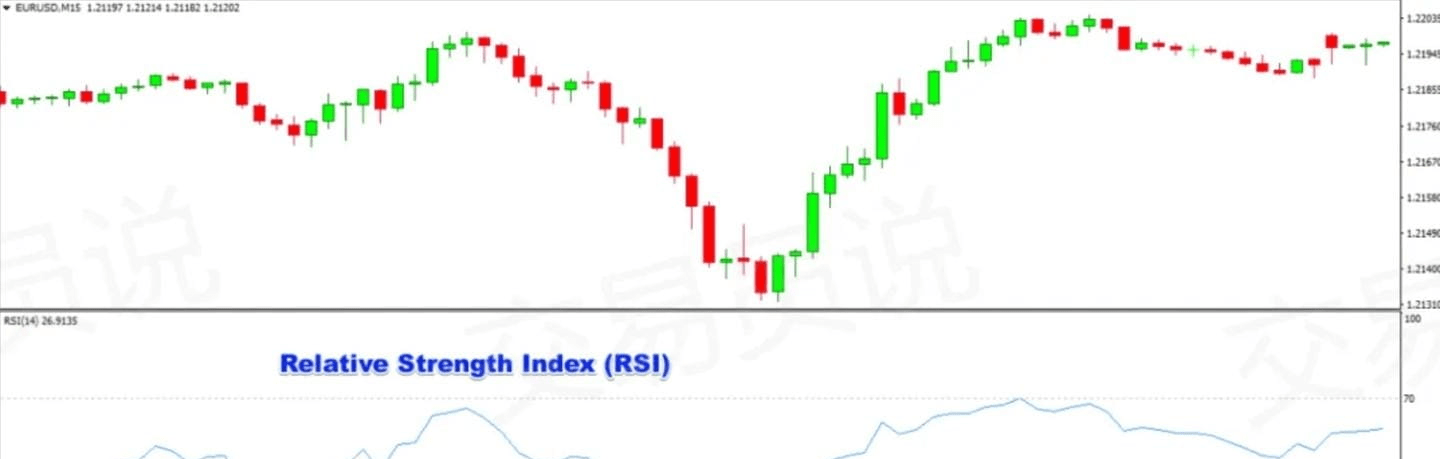
The oversold zone (0–30) indicates that the selling pressure in the market is too strong, and the bears have a clear advantage.
Within the neutral zone (30–70), there are no particularly clear signals, and the market is relatively balanced.
The overbought zone (70–100) indicates that the market is experiencing excessive buying, and the buying power may be nearing exhaustion.
It's important to note that these are the default RSI parameters. If you want more accurate signals, you can narrow the overbought and oversold ranges, leaving more space in the neutral zone. The advantage of doing this is a higher success rate, but the number of signals will be significantly reduced. In short, it's about "fewer but better."
How to calculate the RSI index
The default setting for RSI is 14 cycles. We will use this default parameter as an example to briefly explain the calculation logic.
First, the relative intensity (RS) needs to be calculated. The formula is as follows:
RS = (14-period EMA of the most recent 14 bullish candlesticks) ÷ (14-period EMA of the most recent 14 bearish candlesticks)
EMA stands for Exponential Moving Average.
If you change the RSI parameter to 10 periods, the formula will become:
RS = (10-period EMA of the most recent 10 bullish candlesticks) ÷ (10-period EMA of the most recent 10 bearish candlesticks)
Once you have obtained RS, you can calculate RSI using the following formula:
RSI = 100 −(100 ÷(1 + RS))
This gives you the RSI value for the current period.
RSI base signal
The most basic use of RSI is to observe the position of the RSI line. Its position relative to the three zones will give different market meanings.
RSI overbought signal
When the RSI line enters the overbought zone of 70-100, it indicates that the market's buying intention is extremely strong, to the point of being "overly aggressive" for a period of time. At this point, the bulls may have begun to tire.
Therefore, when the RSI is above 70, it often means that there is a possibility of a price pullback or reversal, which is usually regarded as a short-selling signal.
Of course, whether to enter the market immediately needs to be determined in conjunction with price structure and other conditions.
RSI oversold signal
Conversely, when the RSI line enters the oversold zone (0-30 range), it indicates that the selling pressure in the market is too concentrated, and the bears may have exhausted too much momentum and need to "take a breather".
When the RSI is in the 0–30 range, it is usually considered a buy signal, meaning that the price may reverse upwards.
RSI divergence signal
Among the various uses of RSI, divergence is arguably one of its strongest and most valuable functions. The reason is simple: the reliability of RSI divergence is generally higher than that of simple overbought or oversold signals.
Overbought and oversold signals appear frequently in the market, but true RSI divergence is relatively rare, and it is precisely because it is rare that it is more significant.
Generally speaking, RSI divergence refers to a situation where the direction of price movement is inconsistent with the direction of the RSI indicator. In other words, while the price is still moving, the RSI is already "warning" you that the trend may be about to change.
RSI divergence is mainly divided into two types: positive (bullish) divergence and negative (bearish) divergence.
Positive RSI divergence (bullish divergence)
When price trends continuously create lower lows and lower highs, while the RSI indicator creates higher highs and higher lows, a positive RSI divergence is formed.
Simply put: the price is still falling, but the RSI has already started to rise.
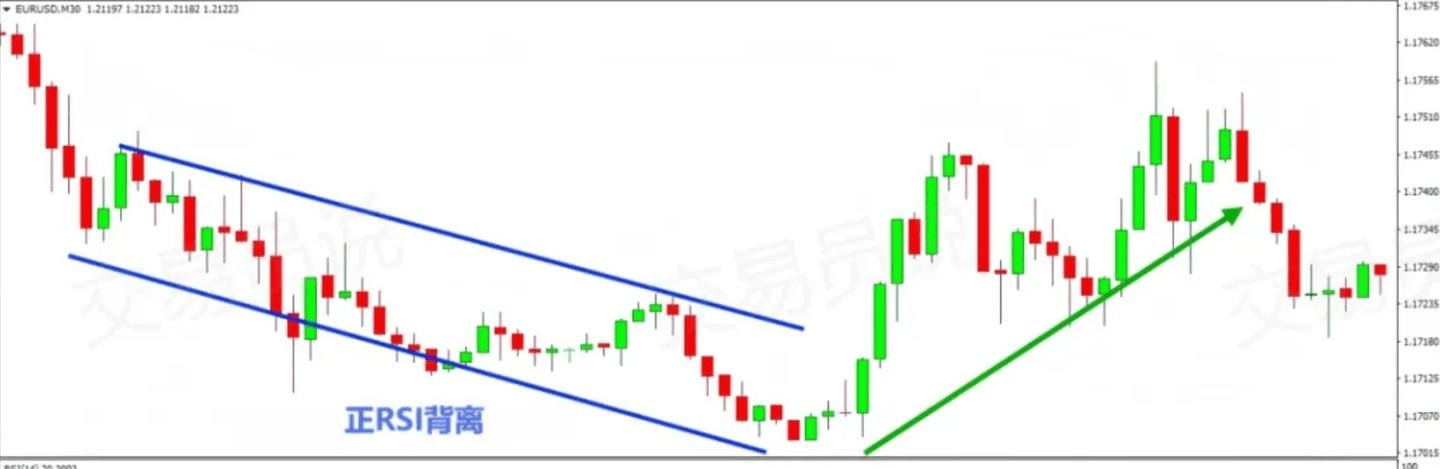
In the example chart above (MT4), the blue descending channel shows the price continuously declining, with both lows and highs getting lower; meanwhile, the RSI indicator below is rising, forming higher highs and lows. Shortly afterward, the price experienced a significant upward trend.
Another name for positive RSI divergence is bullish divergence. It usually means that the downtrend is nearing its end and the price is likely to turn upward soon. Therefore, positive RSI divergence is often a very good opportunity to go long.
Negative RSI divergence (bearish divergence)
Negative RSI divergence is the opposite of positive divergence and usually occurs in an uptrend.
When prices keep making higher highs and higher lows, but the RSI indicator makes lower highs and lower lows, a negative RSI divergence is formed.
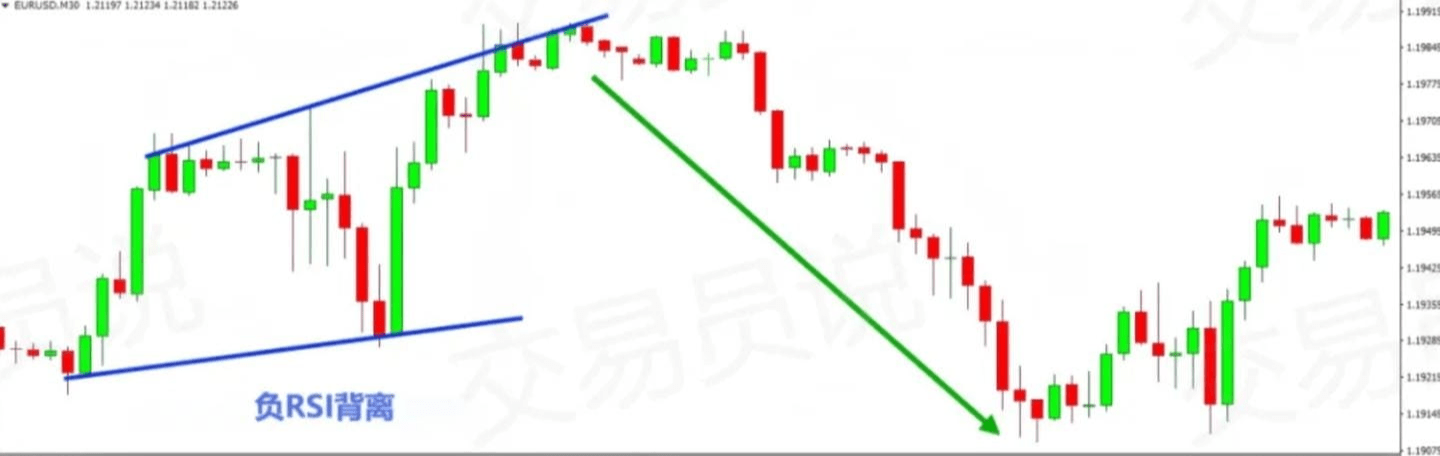
In other words, prices are rising, but the RSI is weakening. In this opposite scenario, the price structure remains a strong upward trend, but the RSI has already weakened, and ultimately, prices often experience a significant decline.
Negative RSI divergence is also known as bearish divergence because it suggests that a downtrend is about to begin, and it is usually a good time to consider shorting.
In short:
Positive divergence → Focus on long opportunities
Negative divergence → Watch out for short-selling signals
RSI divergence doesn't happen every day, but when it does, it's often worth paying close attention to.
RSI divergence trading
Next, let's talk about how to use RSI divergence for entry, stop loss, and exit in actual trading.
Entering the market using RSI divergence
When you want to enter a trade based on RSI divergence, two core conditions need to be met, and you can't rush it:
Step 1: Confirm that the RSI has diverged.
You need to clearly see: 1) the price highs/lows; 2) the price highs/lows moving in the opposite direction to the RSI line.
In other words, prices and RSI are contradicting each other.
Step 2: Confirm that the price has truly begun to reverse.
Not all RSI divergences are worth trading; false signals are inevitable.
Therefore, don't rush in as soon as you see a divergence. Instead, wait for the price to show real signs of reversal. This will greatly increase your success rate.
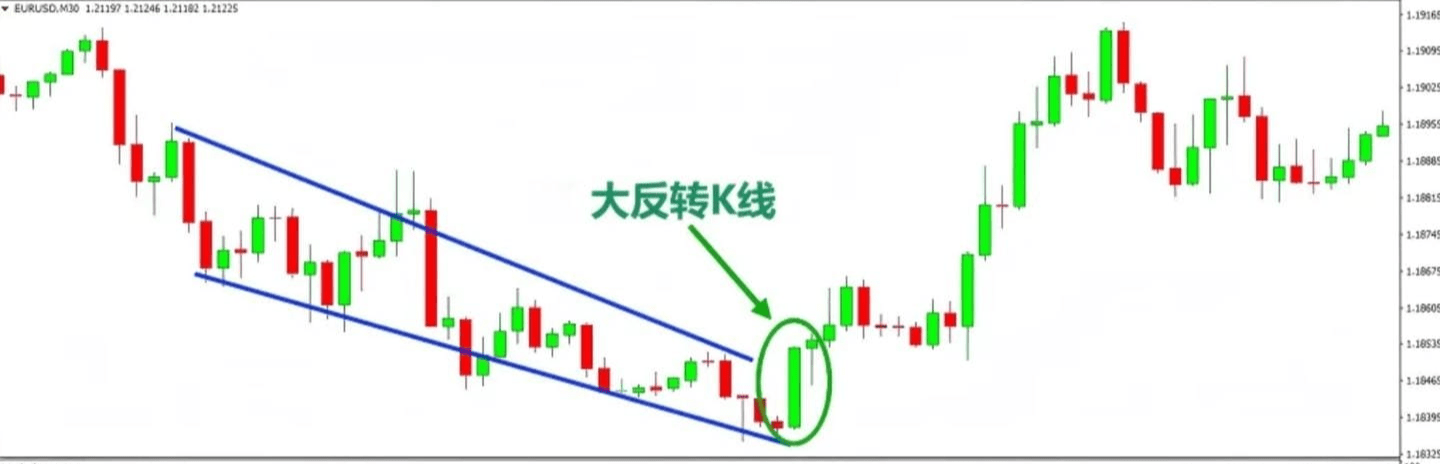
In the example above, the large bullish reversal candlestick can be seen as a signal that the trend may be reversing.
In different situations, these two conditions will appear differently on the chart. Sometimes, a reversal can be confirmed with just one candlestick; while in other cases, you need to see a clear upward move (momentum phase) followed by a pullback to confirm that a reversal has occurred.
Stop-loss settings in RSI divergence trading
When trading based on RSI divergence, always use a stop-loss order. Divergence is never 100% successful, and protecting your capital should always be your top priority.
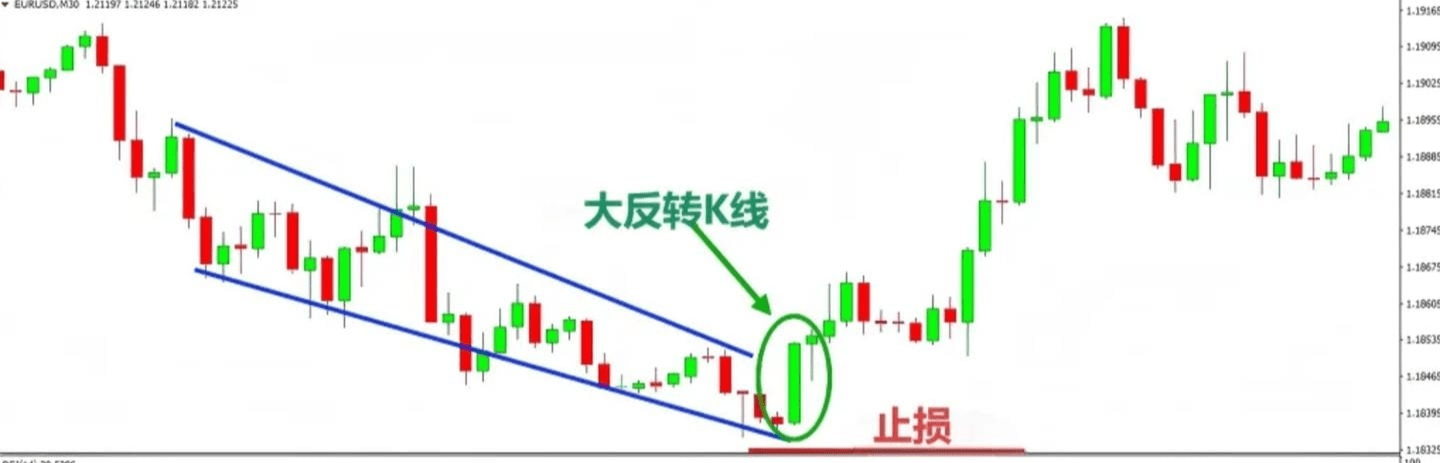
An ideal place to set a stop loss is at the critical boundary level formed when the price reverses.
If it's a bullish divergence, the stop-loss should be placed below the low point formed when the price reverses; if it's a bearish divergence, you need to pay attention to the high point formed when the price reverses and place the stop-loss outside that high point to protect your trades and capital.
Based on the case mentioned earlier, if we consider that obvious reversal bullish candlestick as a signal of the start of a bullish trend, then the stop loss should be set below the lowest point formed at the time of the reversal.
How to exit a trade based on RSI divergence?
Sometimes, prices will follow a significant trend after a reversal; but sometimes, it is just a brief correction of the previous trend.
There's no standard answer to where to exit; you'll need to judge for yourself based on the chart. As long as the price continues to move in your favor, you can continue holding the trade.
Using additional technical tools in conjunction with chart analysis can often help you more accurately determine the exit point for RSI divergence trades. Also, don't forget that the RSI's own overbought and oversold signals can be used as a reference, often helping you to better pinpoint your exit location.
Combining price action with RSI divergence trading
Price action analysis is always a very useful method when you need to look for more confirmation signals on charts. You can use any pattern you see on a chart to improve the accuracy of your trades, such as trend lines, channels, pattern structures, candlestick patterns, and so on.
The core idea of this strategy is to first confirm an RSI divergence, then use a price action signal as an entry point. Afterward, hold the position as long as the price action still supports your trading direction; or exit when you see a contrary RSI signal.
In any case, you must always set a stop-loss order to protect your account funds. This is something you can never skip.
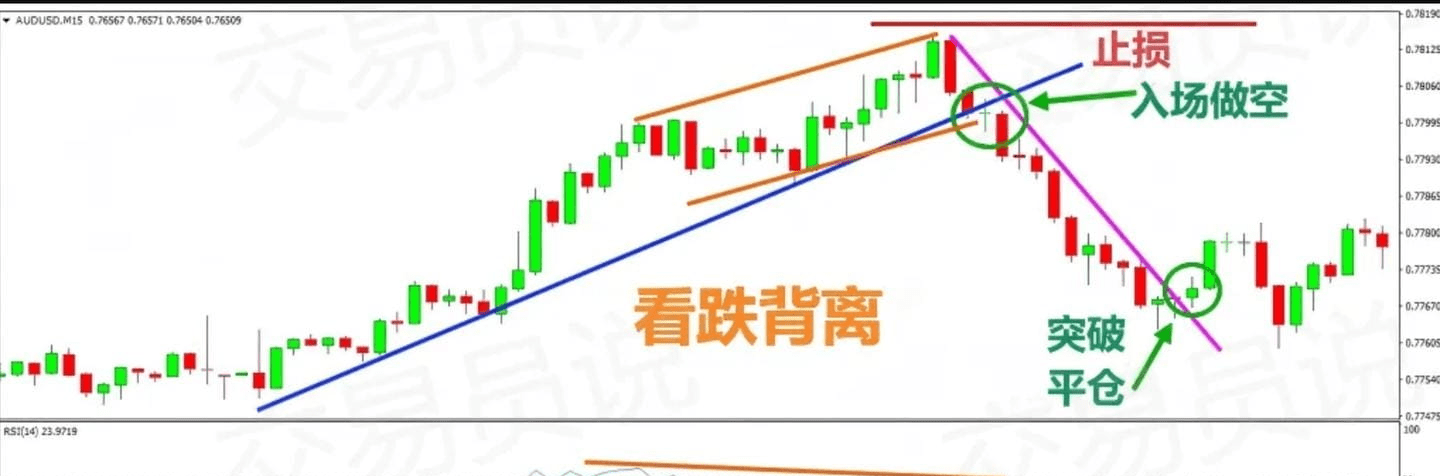
The chart is a 15-minute chart, and the RSI indicator below it uses the default parameter settings.
This case started in a clear uptrend, which we have marked on the chart with a blue trend line.
The orange lines in the chart mark the higher highs and higher lows in the price movement; while the orange lines in the RSI indicator show a bearish divergence in the RSI.
After confirming the RSI divergence, we can see the price begin to attempt a reversal and test the trend line downwards. Subsequently, the price suddenly breaks below this trend line, which is exactly the price action signal we need, so we can consider entering a short position.
The appropriate stop-loss level should be placed above the high point formed when the price reverses. The stop-loss level has been marked with a red horizontal line in the chart.
Next, we determined the exit point based on price action. The pink downtrend line represents the trend followed by the price decline. Subsequently, a candlestick broke through this trend line upwards, indicating that the downtrend may be nearing its end. This was a fairly good exit signal, so we closed our position here, ultimately securing a profit of 31 points.
Combining RSI divergence with other oscillators
In RSI divergence trading, another excellent approach is to combine the RSI signal with the signal of another leading indicator. One suitable oscillator for this combination is the Stochastic Oscillator.
The specific strategy is as follows: Enter a trade only when the RSI shows divergence and is further confirmed by the stochastic oscillator. After entering the trade, we will hold it until either of the following conditions is met:
The RSI gives the opposite signal. Or the stochastic oscillator shows a divergence in the opposite direction.
It's important to note that we don't use overbought/oversold levels on the Stochastic Oscillator as exit signals. This is because the Stochastic Oscillator is more sensitive and fluctuates more frequently than the RSI, easily generating numerous false signals. Therefore, exiting the market simply because the Stochastic Oscillator enters overbought or oversold territory often leads to premature exits unnecessarily.
In other words, overbought and oversold signals from the stochastic oscillator are not suitable for use as a basis for taking profits; otherwise, they may scare a trade that could have continued to be profitable out of the market prematurely.
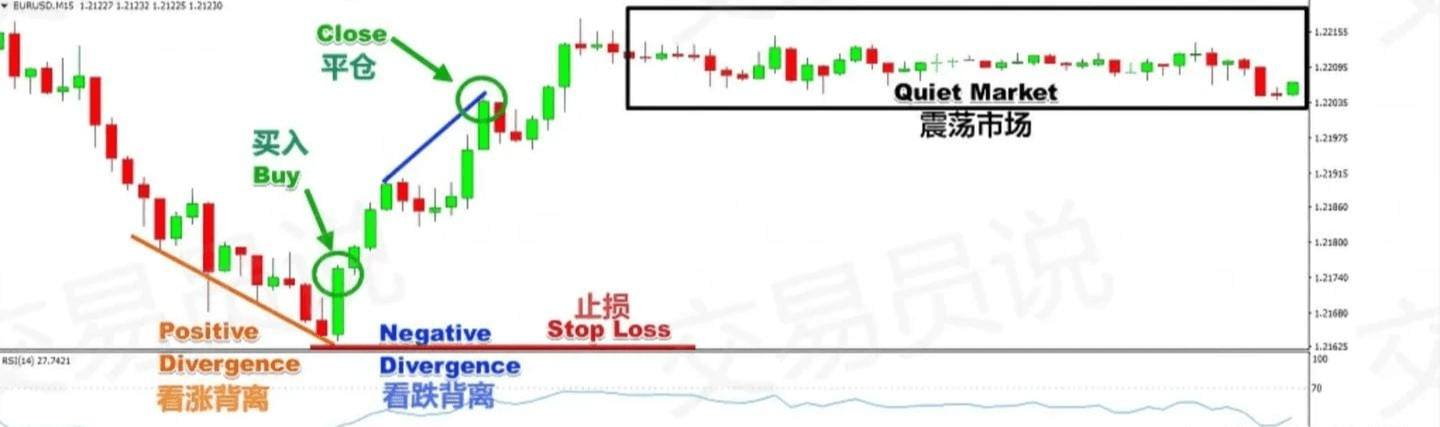
Below the chart, both the RSI and Stochastic indicators are displayed.
It's worth noting that in this case, the market initially entered a clear downtrend. Subsequently, both the RSI and Stochastic indicators confirmed a positive divergence. This is a very strong "double signal" that cannot be ignored; therefore, we entered a long position when the first clear bullish candlestick appeared on the chart.
Regarding stop-loss, we set it below the low point formed at the time of the reversal. Subsequently, we can see several significant price increases, with the RSI and Stochastic indicators also rising accordingly.
Next, the stochastic oscillator entered the overbought zone. However, this is a very common phenomenon, and we don't rush to close our positions just because it's in the overbought zone. The real key signal appears later: the next high of the stochastic oscillator is lower than the previous high, while at the same time, the price continues to make new highs.
This means that the stochastic oscillator gives a negative divergence signal on the chart, which is exactly the signal we use to exit the market.
Summarize
Oscillators are among the most basic and commonly used technical analysis tools in cryptocurrency trading. One of the most popular oscillators is the Relative Strength Index (RSI).
The RSI is a leading indicator, meaning its signals usually precede actual price reversals. The RSI consists of a single line that oscillates between overbought, oversold, and neutral zones.
The default parameters for RSI are as follows:
Oversold zone: 0–30
Neutral zone: 30–70
Overbought zone: 70–100
Default calculation cycle: 14 cycles
Before calculating RSI, you first need to calculate Relative Strength (RS): RS = (14-period EMA of the most recent 14 bullish candlesticks) ÷ (14-period EMA of the most recent 14 bearish candlesticks)
Then substitute RS into the RSI formula: RSI = 100 − (100 ÷ (1 + RS))
This will give you the RSI value for the current period.
The two most basic RSI signals are:
Market overbought
Market overselling
However, compared to simple overbought and oversold conditions, a more advanced and reliable signal is RSI divergence. RSI divergence is mainly divided into two types:
Positive RSI divergence (bullish divergence)
Negative RSI divergence (bearish divergence)
If you want to enter a trade based on RSI divergence, you need to do the following:
Confirm the actual RSI divergence on the chart.
The price has begun to show signs of reversal.
When a reversal occurs, place the stop loss on the other side of the key inflection point.
It's important to note that there are no fixed profit-taking rules for divergence trading. As long as the price movement remains in your favor, or your trading system allows it, you can continue to hold.
Combining RSI divergence strategies with price action yields excellent results.
When RSI shows divergence and price action signals appear, it's time to enter the market.
The stop loss should be placed on the other side of the reversal point.
Continue to hold your position as long as price action continues to support your direction.
Another very practical RSI divergence strategy is to use it in conjunction with the stochastic oscillator:
When the RSI shows divergence and the stochastic oscillator provides a confirmation signal, it's time to enter the market.
Set a stop-loss order on the other side of the reversal point.
Then hold the trade until you see the RSI give the opposite signal, or the stochastic oscillator show a divergence in the opposite direction.
In short: RSI divergence is already a high-quality signal. If it is confirmed by price action or other oscillation indicators, the stability and success rate of trading will be significantly improved.
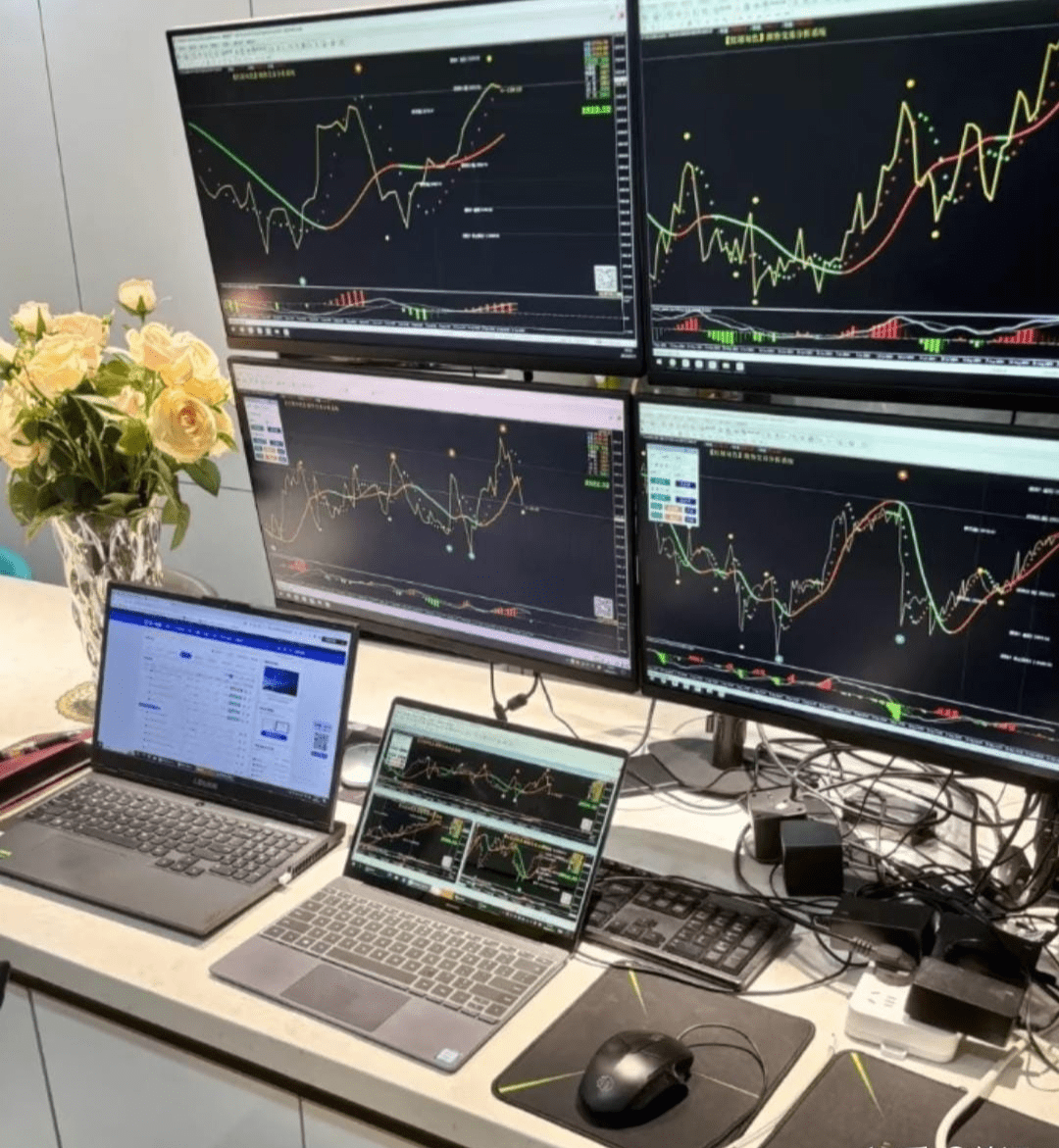
Having traded cryptocurrencies for 10 years and experienced three bull and bear market cycles, let me tell you: Understand these three signals and say goodbye to being a sucker who tries to buy the dip!
The market doesn't believe in tears; only data can reveal the truth.
A few days ago, a fan messaged me privately: "Teacher, I poured six months' salary into buying at the bottom, and now I'm down 20%. Should I buy more?" Looking at the time he sent the purchase message, it was exactly the day that the whole internet was buzzing about "the key point being an iron bottom"—a typical "bottom-guessing hero" backfiring.
Having worked in crypto market analysis for ten years, the most surreal scene I've witnessed is this: when the market drops, everywhere you look there are gurus who claim to have "accurately predicted the bottom"; but once retail investors rush in, the so-called "safety line" is instantly breached. From "the round number level is stable" to "the next support level must be defended," every time, impatient investors rush in to become "bagholders," only to find that the support level is as flimsy as paper, leaving a mountain of trapped investors.
Today I want to share a core point: market bottoms are never guessed, but rather determined by the market's vote of confidence. Those who claim to be able to accurately predict market bottoms are either lucky enough to get it right once, or they're just trying to fleece you.
I. Both volume and price are rising; capital is the most honest signal.
A sustained price increase with rising volume is the true market bottom. What is a surge in volume? It's when a large bullish candlestick suddenly appears during a downtrend, with trading volume exceeding the average volume of the previous three days by more than 30%, and the price doesn't fall below the low of this bullish candlestick for the next three days.
After last year's major market downturn, I observed this signal and decided to enter the market. My assets subsequently rose by 35% in the following two weeks. The behavior of funds is the most reliable indicator: when prices fall and no one dares to buy, a sudden appearance of large funds to support the market is a reliable entry signal.
When prices show increased volume at key levels, such as a breakout with high volume or a surge in volume followed by stagnation at the top, it indicates strong market divergence in that price range, and the possibility of a reversal is increasing.
II. Formation confirmed: a double bottom structure is the solid foundation.
High volume alone is not enough; the chart pattern is also crucial. When the price falls to a certain level and rebounds, but then retraces without breaking the previous low, forming a "W" shape, this is a double bottom pattern. More importantly, after the double bottom, there needs to be at least two weeks of consolidation, with the price fluctuations ideally not exceeding 10%.
Why is consolidation so important? Because it's the stage where major players accumulate shares. Before last year's 70% surge, the market consolidated for a whole month. Many people left the market due to a lack of patience, only to regret it when the price rose again.
True bottom formations are often accompanied by classic candlestick reversal signals, such as a hammer, bullish engulfing pattern, or morning star appearing at low levels. If these patterns are confirmed by subsequent candlestick patterns, the likelihood of a price increase increases significantly.
III. Sentiment Reversal: Market Silence is Golden
Open your social media feed and see if it's still full of calls to "buy the dip" and "go all in," then it's definitely not the bottom. When everyone falls silent, or even says "I'll never touch it again," an opportunity may be brewing.
I have a useful tip: pay attention to the "long/short ratio" on major trading platforms. When the short ratio exceeds 70% and remains around this level for three consecutive days, it usually means that the market sentiment has bottomed out.
The Fear & Greed Index is an effective tool for measuring market sentiment. When the index is below 20 (extreme fear), it often corresponds to a temporary bottom. Conversely, when the index enters the extreme greed zone, it's time to be wary of risks.
Improve win rate by combining indicators
In addition to the three key signals mentioned above, some reliable technical indicators can also be used to assist in the judgment:
Ahr999 Coin Accumulation Indicator: When the index is below 0.45, it may be a buying opportunity; between 0.45 and 1.2, it is suitable for dollar-cost averaging; above 1.2, it indicates that the coin price is too high and it is not advisable to chase the price.
RSI (Relative Strength Index): When the RSI is below 30, it indicates that the market may be oversold. Historically, areas with an RSI below 20 have often been good opportunities to buy at the bottom.
MVRV ratio: When Bitcoin's MVRV ratio is less than 1.0, it means that the price is lower than the market average cost of holding the coin, which usually means that it is deeply undervalued.
Conclusion: Patience is the highest level of trading strategy.
Many people always want to profit from the "head" of the fish, believing that entering the market early will yield more profits, but they forget that the head of the fish has many bones. I have seen too many investors who, in their pursuit of a 10% return, end up trapped with a 50% loss, eventually unable to hold on and forced to sell at the bottom.
In reality, once the bottom is confirmed, there are never a shortage of opportunities to get on board. Even waiting for a 10% rebound before entering the market is far better than blindly buying at the bottom and getting trapped. In spot trading, patience is not weakness, but a life-saving skill.
Next time someone tells you "this is the bottom," don't rush to believe them. First, verify it with the three signals I mentioned today: Has the volume increased and stabilized? Has a double bottom pattern formed and undergone sufficient consolidation? Has market sentiment reached rock bottom? Only when these three signals resonate is it the real entry point.
The market is like the ocean, with its ebb and flow. True investing isn't about chasing every wave, but about identifying the direction of the tide and following it. In moments of greatest fear and uncertainty, return to the data, remain patient, and remember that the market always rewards those who follow the rules.
If you are still struggling in this cycle of margin calls, please force yourself to do these three things first:
1. Reduce transaction frequency:
2: Strictly implement stop-loss orders.
3: Don't let any small loss get out of control
If you're still feeling lost in the market and unsure of your next move, I'm here to share more specific strategies and mindset management methods. Opportunities are right in front of you; if you take the initiative, we can have a story together.
I'm Little Egg Tart. Follow me for daily updates on the latest news and trading analysis! #ETH走势分析 $ETH


