$BANK #LorenzoProtocol $BANK @Lorenzo Protocol
If I had to summarize BANK in one sentence, its core value is the ability to attract and maintain a strong speculative capital flow in the derivatives market, creating a potential buffer despite existing selling pressure in the spot market. On-chain data shows a distinct tug-of-war between distribution moves after a local growth phase and the resilience of buying positions in the futures market. This is a complex scenario that requires deep analysis to understand the nature of the cash flow and the prevailing market sentiment, especially when prices are adjusting to the level of 0.04630 after a recent strong increase. This opposition is not a contradiction to be concerned about, but a market condition that reflects differing views among investor segments, creating strategic entry and exit points for agile trading systems.
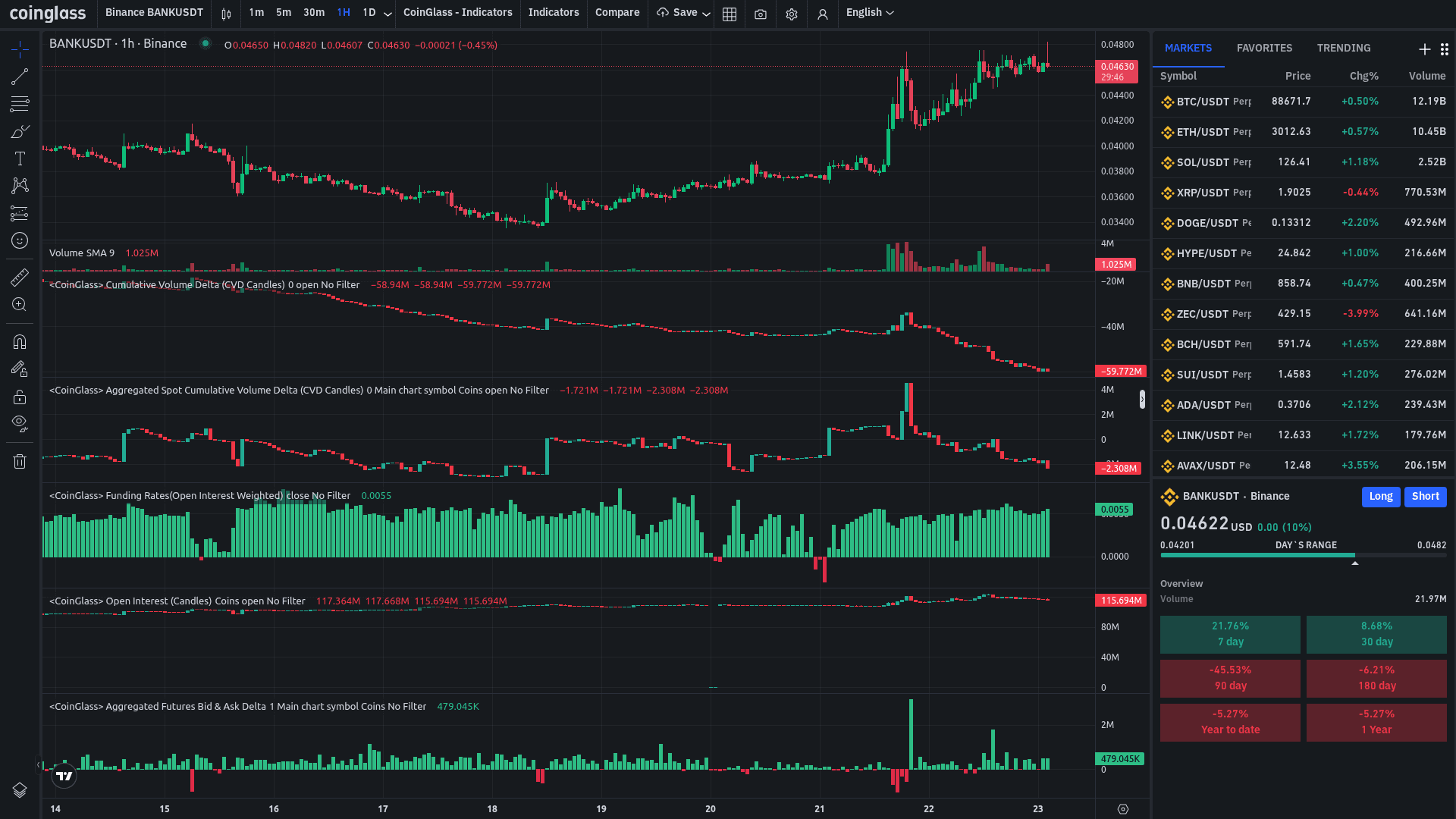
Analyzing price movements and trading volume shows that BANK has just gone through a notable growth phase, with prices peaking around 0.048 and then adjusting to the current level of 0.04630. The average trading volume (Volume SMA 9) reached 1.025 million, indicating a certain level of liquidity but not excessively volatile in the context of the adjustment. The Cumulative Volume Delta (CVD) for the futures market recorded a significant negative number of -59.772 million, while CVD in the spot market was also negative at -2.308 million. The Cumulative Volume Delta (CVD) is an important indicator that tracks the difference between buying and selling volumes executed at market prices, showing net buying or selling pressure. This negative CVD data indicates that active selling pressure has dominated in recent phases, reflecting a distribution process or rebalancing of positions after the previous growth, which is a natural market condition and not a sign of any sudden decline.
However, the picture becomes more interesting as we look at derivatives indicators. The Funding Rate (Open Interest Weighted) is currently at a positive 0.0055. The Funding Rate is the fee that traders holding long or short positions pay to each other to keep the perpetual futures price aligned with the spot price. A positive funding rate indicates that long positions are paying short positions, implying that the majority of traders in the derivatives market hold an optimistic view and are willing to pay fees to maintain their buying positions. This creates a stark contrast with the selling pressure reflected through the negative CVD indicator, suggesting a strong bullish expectation remains in the derivatives trading segment, a sign of underlying confidence or accumulation strategies from long-term investors.
The Open Interest (OI) of BANK also provides additional insights. Open Interest represents the total number of outstanding derivative contracts, reflecting the total capital locked in long and short positions. With OI fluctuating between 115-117 million, the market shows a significant level of participation from traders. The volatility of OI, with distinct up and down candles, implies that there are continuous position opening/closing activities, creating a dynamic liquidity environment. When combined with a positive Funding Rate, a high OI indicates that confidence in the potential for price increases is still maintained, and long positions are being aggressively accumulated or defended, even as the spot market shows signs of adjustment. This indicates the flexibility and resilience of BANK's derivatives market, even when facing short-term downward pressure in the spot market.
Another noteworthy point is that the Aggregated Futures Bid & Ask Delta recorded a level of 479.045 thousand. Bid & Ask Delta reflects the difference between the buying volume at the ask price and the selling volume at the bid price on the futures order book, indicating immediate trading pressure. This positive level, although just a snapshot at the present moment, indicates active buying moves in the derivatives market. When placed in the context of overall negative CVD, this may imply that despite prolonged selling pressure, there are still traders looking to actively accumulate long positions or absorb selling pressure, creating a delicate balance between market forces. This is a sign of a struggle for control between buyers and sellers, an ideal condition for AI systems to detect potential turning points.
In summary, BANK is exhibiting a complex market structure but is also overflowing with opportunities. Despite clear selling pressure from CVD indicators after a growth phase, the derivatives market shows remarkable resilience with a positive Funding Rate and high Open Interest. This paints a picture of an asset where confidence in growth potential remains strong in the derivatives trading community, ready to absorb selling pressure from the spot market. For an AI model trader, this is a signal to be closely monitored: the divergence between spot selling pressure and the optimistic sentiment of the derivatives market could be a precursor to a recovery if selling pressure eases or if the cash flow accumulating from derivatives begins to impact the spot market.
To optimize strategy, monitoring changes in the Funding Rate and movements of Open Interest in the context of key price levels is extremely necessary. A reversal of CVD to the positive, especially when the Funding Rate remains high, could be a confirming signal for a potential upward move. Conversely, a sudden drop in the Funding Rate or OI could signal a change in market sentiment. In any scenario, the market always contains opportunities for those who are patient enough and can read the data flow. Too much fear will never yield results.
This is not investment advice. Please do your own research and make your own investment decisions.