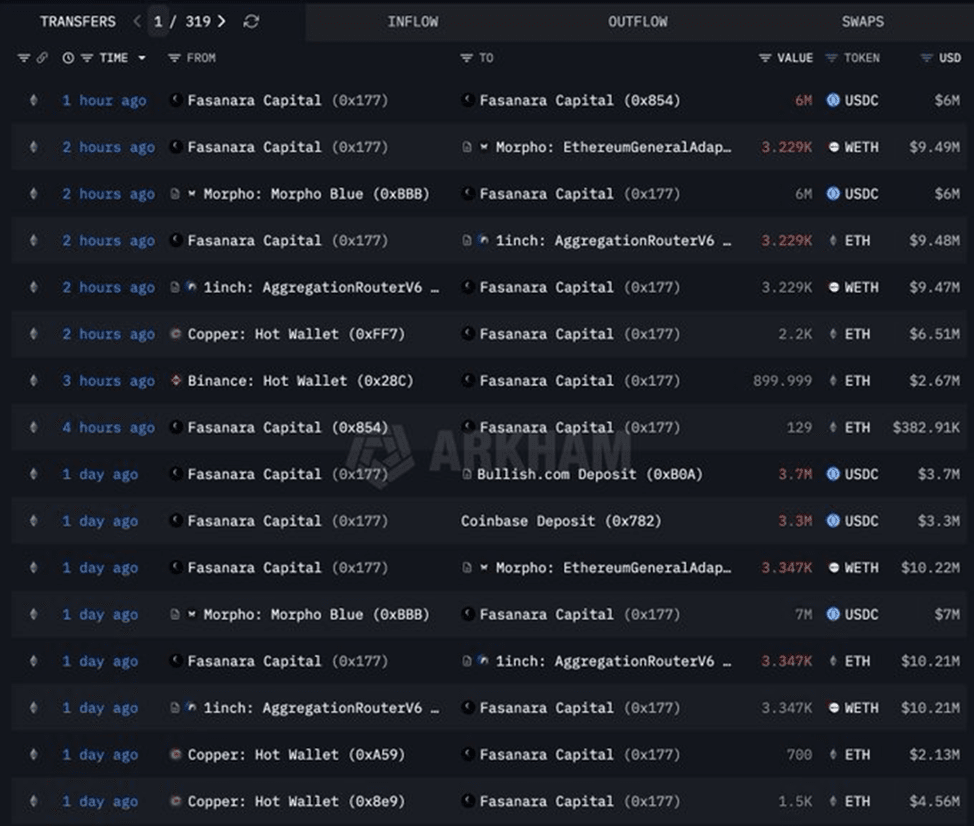
1) News: Fasanara Capital is leveraging ETH through Morpho
1. Summary (1-2 lines)
Fasanara Capital bought 6,569 ETH (~$19.72 million), deposited it in Morpho, and borrowed 13 million USDC to buy more ETH (leverage through ETH collateral).
2. What does this mean for the market (honestly)
BTC: does not directly affect. Indirectly — this is a story about risk appetite, but not about the BTC structure.
ETH: bullish signal by sentiment: a large player is not “waiting it out,” but is increasing their position with borrowed funds.
Alts / liquidity: supports the thesis “capital seeks yield/bet,” but the effect is pinpoint.
Risk appetite: increases specifically in the ETH segment (willingness to take on leverage).
Market structure: this is not a reversal of the market “as a whole,” this is a local impulse of trust in ETH against a weak/nervous backdrop in BTC.
3. Real effect
Strength: moderate.
Short-term: may provide support for ETH on expectations and trigger local purchases “in tandem.”
Medium-term: weaker if there is no confirmation through flows/demand across the wider market.
What has changed in the structure: globally — nothing; locally — an argument has been added “institutions are ready to take risks in ETH.”
4. News risks
Leverage = vulnerability: in case of a sharp sell-off of ETH, forced liquidations/margin effects are possible (pressure on price).
Liquidity: the market often “tests” such stories through sharp wicks, removing stops and collecting liquidity at levels.
Behavior of the big players: other funds may not replicate (one case ≠ trend).
5. Conclusion on the news (1 sentence)
The news creates local support for ETH through the risk appetite signal, but does not itself change the overall market structure.
2) News: BTC reserves on Bitget have increased, Proof of Reserves 175%
1. Summary (1-2 lines)
BTC reserves on Bitget have increased to 34,055 BTC (~$3 billion), +114% year-on-year; Proof of Reserves audit (December 2025) shows a ratio of 175%.
2. What does this mean for the market (honestly)
BTC: ambiguous. Growth of exchange reserves often means growth of deposits/inflow of coins to the exchange, which potentially increases readiness to sell and liquidity for trading.
ETH: there is no direct impact.
Alts / liquidity: more exchange liquidity = easier to “rotate” the market both ways, sharp movements often occur on news/levels.
Risk appetite: PoR increases trust in the platform, but it is not a bullish trigger for the market by itself.
Market structure: this is an infrastructure signal (trading conditions), not a trend signal.
3. Real effect
Strength: weak–moderate.
Short-term: more liquidity on the exchange → easier to make impulses and remove stops.
Medium-term: neutral, if the growth of reserves is just the growth of the client base, not preparation for sales.
What has changed in the structure: the trend does not change; it changes the “environment” — liquidity/potential volatility.
4. News risks
Interpretation risk: “growth of reserves = bullish” — mistake. This can also be accumulation on the exchange before sales.
Volatility: higher chance of sharp candles around key levels when exchange reserves and leverage in the market grow.
5. Conclusion on the news (1 sentence)
News about Bitget improves trust in the infrastructure, but regarding the BTC market, this is rather a signal about the growth of exchange liquidity, not about a trend.
3) News: outflows from BTC/ETH ETFs and inflows into SOL ETFs (rotation)
1. Summary (1-2 lines)
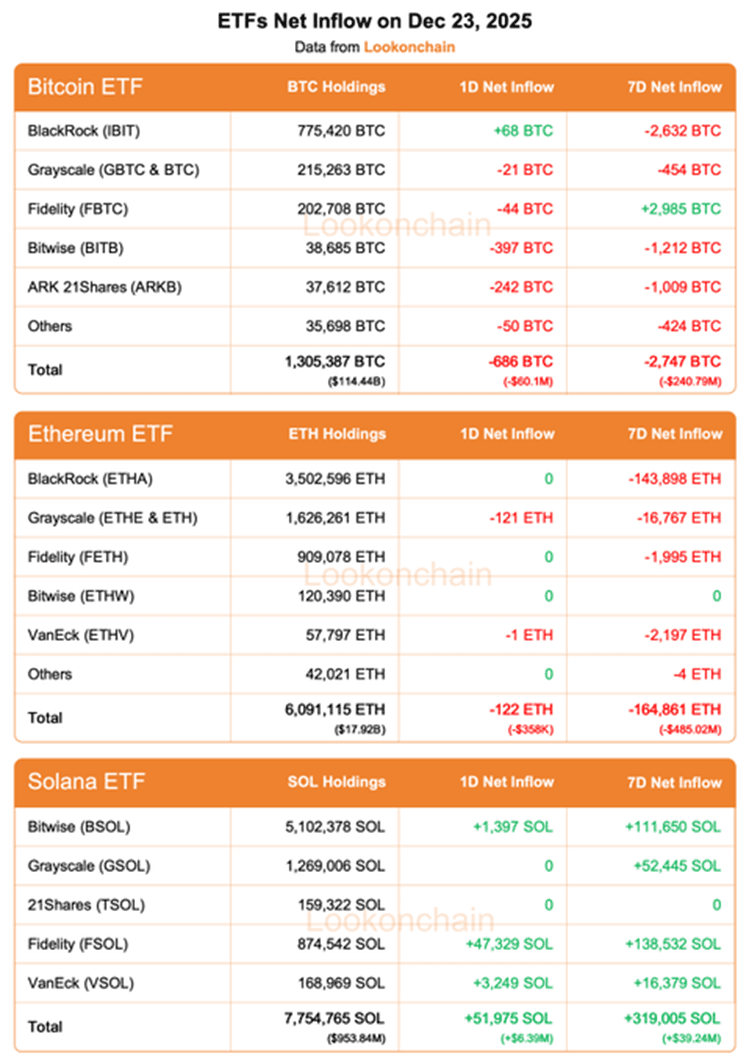
For the day/week: outflows from BTC ETF ($60.1 million / $240.8 million), from ETH ETF ($0.358 million / $485 million); meanwhile, SOL ETF is in the positive ($6.39 million / $39.24 million), December inflows into SOL ETF > $95 million.
2. What does this mean for the market (honestly)
BTC: pressure from sentiment and demand through the ETF channel; this is not a “crash,” but it indicates a lack of a steady buyer.
ETH: weekly outflows look heavier — this is negative for institutional demand specifically in the ETF segment, even if someone is buying on-chain.
Alts / liquidity: SOL receives the status of “liquidity magnet” — capital does not leave crypto, it flows.
Risk appetite: paradoxical, but logical: overall risk is moderately reduced (exit from BTC/ETH ETFs), but locally the risk increases where returns are expected (SOL).
Market structure: this is classical rotation, not a unified “market up/down.”
3. Real effect
Strength: strong (ETF flows — one of the most “clean” signals of demand/caution).
Short-term: BTC/ETH find it harder to grow sustainably without a return of inflows; SOL/the sector related to SOL may receive impulses.
Medium-term: if rotation continues — the market will be “ragged”: BTC/ETH without momentum, individual altcoins/sectors with pumps.
What has changed in the structure: the model of “not market growth, but selective growth of assets” has strengthened.
4. News risks
Crowd trap: traders start chasing SOL/alt impulses → the market often punishes through sharp pullbacks and gathering liquidity under local longs.
Where volatility:
BTC/ETH: wicks at resistance levels due to lack of pure demand.
SOL: increased risk of “liquidations” in both directions (overheating on inflows).
Behavior of the big players: when BTC is weak, the big players often use alt growth as a source of liquidity for redistribution.
5. Conclusion on the news (1 sentence)
ETF flows confirm caution regarding BTC/ETH and simultaneously show capital rotation into SOL, strengthening the selective market instead of a general trend.
6) Conclusion of all news of the day (overall picture)
Today's vector — rotation and selectivity, not “the market has turned around.”
The main thing that matters: ETF flows (weak demand in BTC/ETH and inflow into SOL).
Secondary, but important for understanding risk: institutional leverage in ETH (provides support but increases fragility in a downturn).
Infrastructure: growth of exchange reserves = more liquidity and potential for sharp movements, but not a signal of direction.
What traders should watch today:
confirmation/denial of demand through flows (ETF/capital),
price reaction to key levels without “support from money,”
where the crowd is already in longs (this is where liquidity is most often collected).
#strategy #CryptoTrading #Altcoins #BTC #ETH