

If you spend enough time in this market, you develop a pretty sensitive lie detector. Nowadays, any network that wants to go up 20% adds the tag "AI" to its X biography. But if you stop to analyze how a real AI agent works, you realize that most of these networks are house of cards.
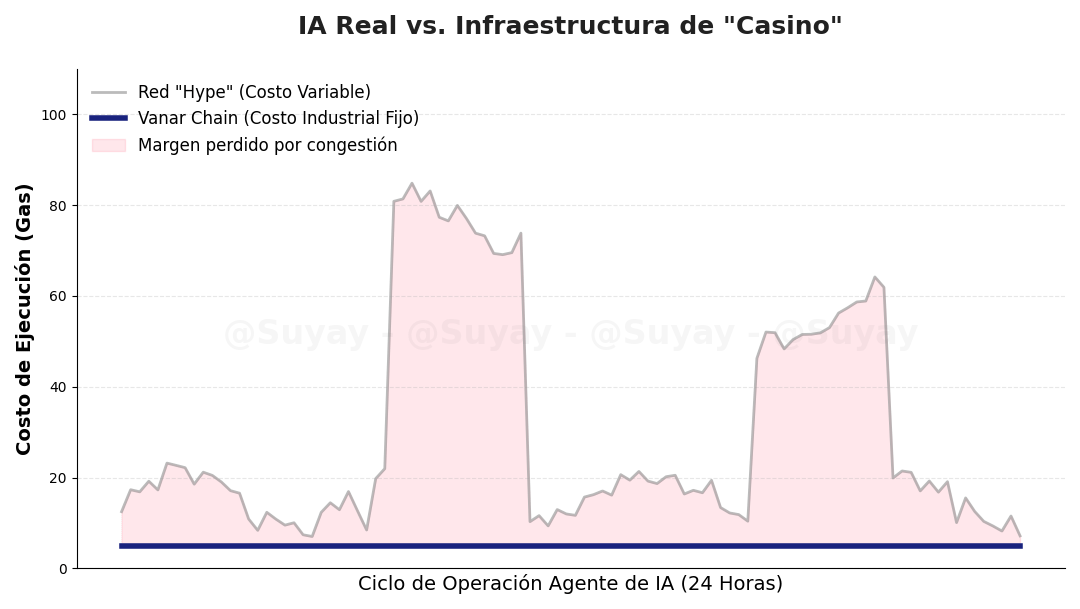
I have seen incredible AI projects fail not because of their code, but because the infrastructure supporting them was a chaos. What's the use of having an ultra-advanced AI agent if every time it has to make a decision, the gas cost has risen by 300% because someone is minting a collection of puppy photos? That's not technology, it's a casino.
The error of "Variable Calculation"
What made me look at Vanar was not its "gaming" marketing, but understanding the problem of predictability. In the real world, a company has a budget. If an AI agent has to execute 10,000 transactions a day, the CFO needs to know exactly how much it will cost. "Probabilistic finality" and "dynamic fees" are the suicide of any serious business model.
In Vanar, I understood that the $0.0005 fixed fees are not an "offer", they are an industrial requirement. It's the difference between a toy and a tool.
Memory vs. Narrative
Another point that made me change sides: memory. Most L1s are "amnesic". An AI agent on a normal network has to consult external databases (outside the chain) to remember what it did 5 minutes ago. That breaks decentralization and adds latency.
When I discovered myNeutron in Vanar, I realized they were solving an engineering problem, not a hype: giving native memory to the protocol.
Conclusion: I prefer the "boring" that works.
Dusk taught me that instant finality is key for real money. Vanar is teaching me that cost stability and native memory are key for real intelligence.
I'm not here for the next pump of a trendy narrative. I'm here because, when the noise of AI calms down, only the networks that were built with operational efficiency in mind will stand, not the Twitter algorithm.
What are you looking for? The adrenaline of a network that gets congested or the peace of an infrastructure that simply keeps its promise every time?
