

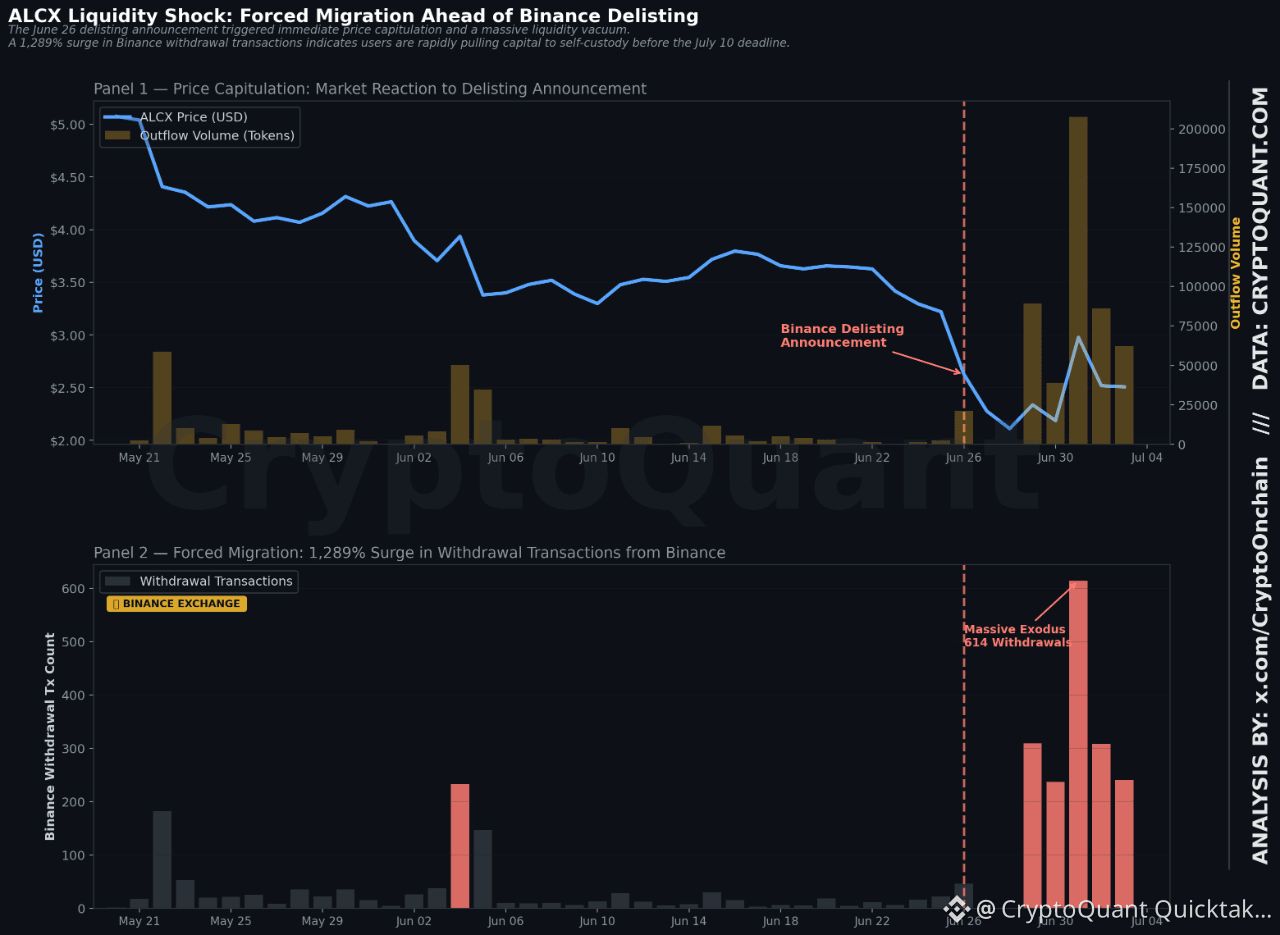
Following Binance’s June 26 announcement to delist ALCX (effective July 10), the token’s on-chain dynamics experienced a violent structural shift. The initial news triggered an immediate ~30% price contraction. Concurrently, network data reveals a massive 1,289% week-over-week surge in Binance withdrawal transactions, peaking at an anomaly of 614 individual withdrawal counts on July 1 (compared to a baseline of under 20).
A major exchange delisting inherently creates a localized liquidity vacuum. The explosive 3,856% surge in Binance inflows combined with a 1,484% spike in outflows illustrates a classic “forced migration” phase. Retail users are likely panic-selling their positions (driving inflows), while savvy investors, market makers, and arbitrageurs are rapidly withdrawing tokens to self-custody or alternative exchanges (driving the massive outflows) before the trading pairs are suspended.
Interestingly, while the price action reflects severe capitulation, broader network activity metrics—such as active addresses (+107%) and total token transfers (+510%)—have skyrocketed. However, unlike organic utility-driven growth, this spike in activity is purely defensive. The persistent negative netflow (-285%) confirms that, ultimately, capital is fleeing the Binance ecosystem, fundamentally altering the token’s distribution landscape.
This abrupt structural reorganization creates conditions of extreme short-term fragility. As the July 10 deadline approaches, the continued draining of Binance’s liquidity pool may lead to erratic volatility. Historically, tokens facing similar delisting events experience severe downward pressure followed by a potential stabilization phase, once the forced-selling exhaustion is reached and the new fragmented liquidity landscape takes shape.
Written by CryptoOnchain