

OpenGradient is a decentralized infrastructure network that hosts, executes, and verifies AI models at scale. The network operates as a specialized AI coprocessor, letting applications, agents, and on-chain protocols outsource AI workloads to a dedicated set of GPU and TEE nodes, with every inference verified by the network's validator set.
The project addresses two long-standing gaps in AI infrastructure: (i) verifiability -- AI outputs are widely trusted despite being produced by opaque centralized providers, and (ii) privacy -- users hand over sensitive prompts to those same providers with no way to prove the data is not logged or trained on.
OPG is the network's exclusive medium for gas, staking collateral, and governance. It is used in the following functions:
Network Settlement: OPG is the exclusive medium for paying transaction gas fees and settling private and verifiable AI inference compute on the OpenGradient network.
Consensus Security (Delegated Proof-of-Stake): Validators and delegators stake OPG to secure consensus and attest to AI inference results.
Access and Payments: OPG is used for real-time AI inference settlement via the x402 (HTTP 402) protocol, Model Hub model licensing, and utility-based access to ecosystem applications (OpenGradient Chat, BitQuant, MemSync, Twin.fun, and more).
The OpenGradient network is built on the Cosmos SDK with EVM compatibility and CometBFT (BFT) consensus, providing deterministic instant finality. Specialised node roles separate concerns: Validators secure consensus and are subject to slashing; Inference Nodes provide GPU and TEE compute; Storage Nodes integrate Walrus; and Data Nodes serve deterministic data feeds.
Inference verification supports three methods, selected per request: TEE hardware attestation (AWS Nitro and NVIDIA Confidential Computing, with attestation anchored on-chain in the TEE Registry) and signature-only attestations. The Hybrid AI Compute Architecture (HACA) decouples execution from verification so responses are returned synchronously while proofs finalise asynchronously.
Live products in the ecosystem:
OpenGradient Chat (chat.opengradient.ai): privacy-first generative AI assistant routing to frontier text, image, and video models.
Model Hub (hub.opengradient.ai): decentralised repository hosting 4,500+ AI models from 100+ developers, persisted on Walrus.
BitQuant (bitquant.io): AI-powered quantitative trading platform with 1.8M+ registered users and 69M+ AI agent queries.
MemSync (memsync.ai): personalized AI memory and chat platform with 39K+ active users.
OpenGradient has raised $9.5M from 37 accredited institutional and angel investors across a seed round, led by a16z crypto.
Notable investors include a16z crypto, Coinbase Ventures, Foresight Ventures, Symbolic Capital, Canonical Crypto, Balaji Srinivasan, Sandeep Nailwal, Illia Polosukhin, NEAR Foundation, Celestia, and SV Angel.
OPG has a fixed total supply of 1,000,000,000 tokens with no inflation mechanism outside the programmatic Staking Rewards allocation. Initial circulating supply was 190,000,000 OPG (19.0% of total supply) per the published Token Release Schedule. Current circulating supply is 197,590,000 OPG (19.76% of total supply, as of 1 July 2026 per CoinMarketCap).
Key metrics (as at July 1, 2026)
1. What is OpenGradient (OPG)?
Project overview
OpenGradient is a decentralized infrastructure network that hosts, executes, and verifies AI models at scale. The network operates as a specialized AI coprocessor: applications, blockchains, and agents outsource AI workloads to a dedicated set of GPU and Trusted Execution Environment (TEE) nodes, with results verified by the network's validator set. On top of that infrastructure, OpenGradient offers private LLM inference (Oblivious HTTP + attested TEE enclaves) so client identity is unlinkable from prompt content, and a consumer assistant, OpenGradient Chat, that routes to frontier models through the same anonymizing layer.
Project mission
OpenGradient's mission is to make verifiable and privacy-preserving AI compute available as public infrastructure, so applications and on-chain protocols can call AI models without trusting an opaque centralized provider. The project aims to make this category of compute as accessible as today's cloud APIs.
Project value proposition
OpenGradient combines a Hybrid AI Compute Architecture (HACA), a verification spectrum (TEE or signature-only attestation), and a Private LLM Inference layer that uses Oblivious HTTP plus attested AWS Nitro enclaves to offer both secure and verifiable AI inference for users.
The architecture decouples execution from verification, so inference latency stays comparable to centralized providers while proofs are finalized asynchronously.
The privacy layer adds identity / content unlinkability on top of verifiable inference.
Project Key Highlights
Hybrid AI Compute Architecture (HACA): Decouples fast inference execution from asynchronous proof verification, enabling web2-like latency alongside on-chain verifiability.
Verification + Privacy Spectrum: Three verification methods (TEE hardware attestation or vanilla signature-only) plus an optional Private LLM Inference layer (OHTTP + attested TEE enclave, RFC 9458 / RFC 9180) so developers pick the trust and privacy level per workload.
On-Chain ML Execution (PIPE): The Parallelized Inference Pre-Execution Engine lets smart contracts call ML models natively, with atomic execution guarantees inside a single transaction.
OpenGradient Chat (Privacy-First Consumer AI): A generative AI assistant that routes to frontier text, image, and video models (ChatGPT, Claude, Gemini, Grok, ByteDance Seed at launch) through an anonymizing layer (HPKE-sealed Oblivious HTTP plus attested TEE enclaves), so prompts are never linkable to user identity. Live at chat.opengradient.ai with 1,000 free credits at signup.
Existing Products
OpenGradient Chat (https://chat.opengradient.ai): Privacy-first generative AI assistant. Routes prompts to ChatGPT, Claude, Gemini, Grok, and ByteDance Seed at launch through an anonymizing layer (HPKE client-side encryption, Oblivious HTTP relay, attested AWS Nitro TEE gateway). Supports mid-conversation model switching, side-by-side comparison, live web search, image generation, and file uploads. New users receive 1,000 free credits on signup.
Private LLM Inference SDK (Python and TypeScript): Developer-facing version of the Chat stack. Requests are HPKE-sealed client-side and decrypted only inside an attested Nitro enclave; responses are signed inside the enclave and verifiable against an on-chain TEE registry. Same model coverage as the verifiable inference layer (OpenAI, Anthropic, Google, xAI), with streaming supported via Chunked OHTTP.
OpenGradient Network: 1.9M+ transactions, 263,500+ unique wallets, approximately 13,000 daily transactions, ~10.22-second block time.
Model Hub (https://hub.opengradient.ai): Decentralized model repository with 4,500+ models.
BitQuant (https://bitquant.io): AI-powered quantitative trading platform. 1.8M+ registered users, 69M+ AI agent queries, 14:40 average session length.
Aggregate ecosystem metrics across applications: 2M+ unique users, 71M+ AI messages processed, 170M+ platform events, 9.5M+ sessions across 40+ countries.
2. Technical Infrastructure
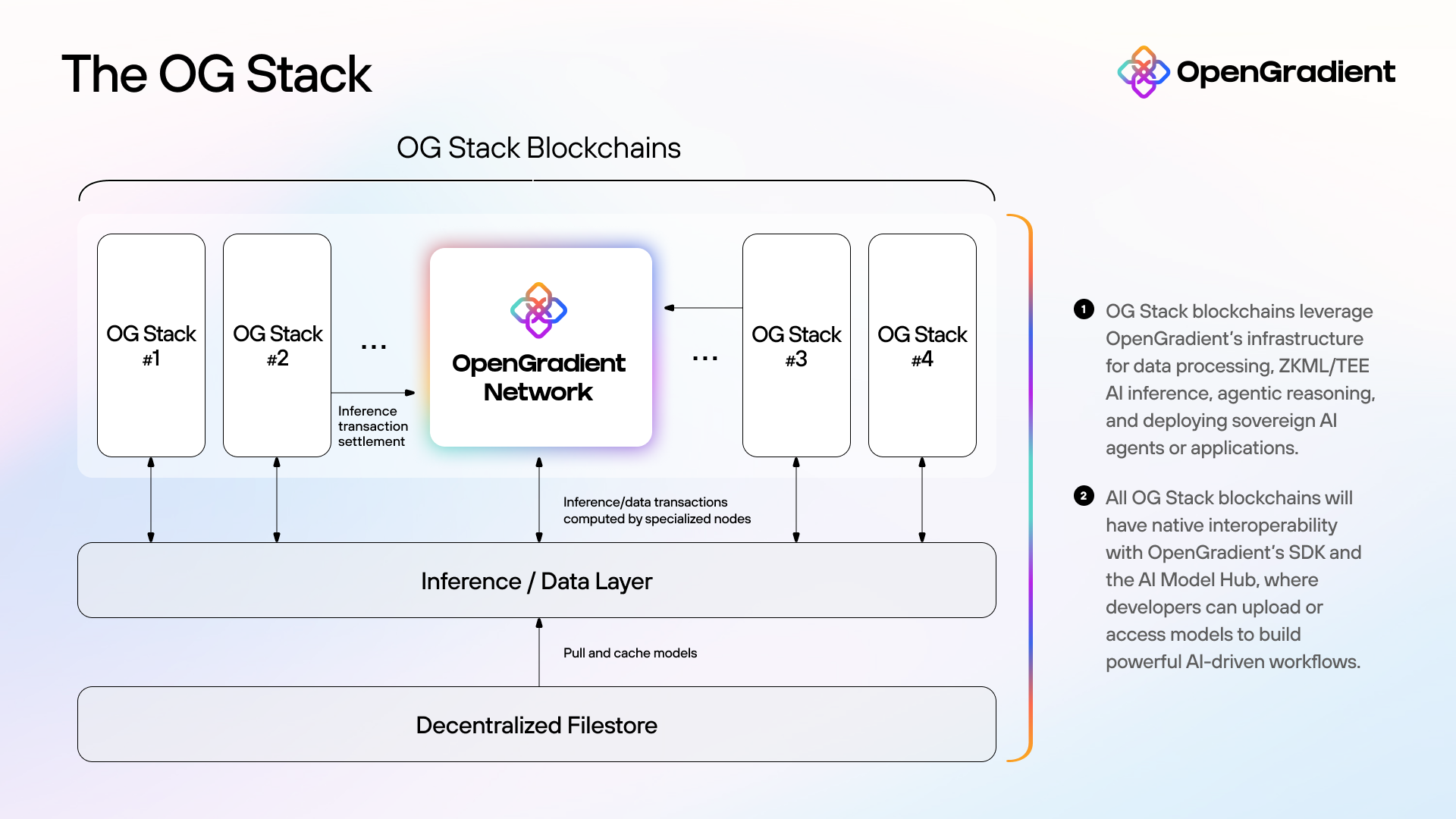
Network architecture: Cosmos SDK with EVM compatibility and CometBFT (BFT) consensus, providing deterministic instant finality.
Node roles: Validators (consensus, slashing), Inference Nodes (GPU and TEE compute), Storage Nodes (Walrus integration), and Data Nodes (deterministic data feeds).
Verification methods: per-request selection across (i) TEE hardware attestation using AWS Nitro and NVIDIA Confidential Computing, with PCR measurements anchored on-chain in the TEE Registry; (ii) signature-only attestations.
Hybrid AI Compute Architecture (HACA): Decouples execution from verification. Inference responses are returned synchronously while proofs are finalized asynchronously, keeping client latency comparable to centralized providers.
Private LLM Inference: Oblivious HTTP (RFC 9458) with HPKE (RFC 9180) over a two-hop relay-and-gateway architecture. The OHTTP relay sees client IP but only ciphertext; the AWS Nitro TEE gateway decrypts and sees plaintext but never the client IP. Streaming uses Chunked OHTTP (draft-ietf-ohai-chunked-ohttp).
Attested key distribution: The HPKE public key, the response signing key, and the enclave's PCR measurements all commit to a single Nitro attestation transcript. Clients verify the transcript against the on-chain TEE Registry before encrypting their first request
Privacy guarantee: Non-collusion between the relay and the gateway. Provided those two operators do not share data, no party can link a given client to a given prompt.
3. Token Sales and Economics
Token Distribution
Token Release Schedule
4. Risk Analysis
4.1 Initial Circulating Retail : Institution Ratio
4.2 Airdrop Details
4.3 Initial TGE Main Bucket On-chain Wallets Addresses
5. Roadmap & Updates
Completed Milestones
Link to whitepaper: https://docs.opengradient.ai/learn/whitepaper
Link to current whitepaper: https://docs.opengradient.ai/learn/whitepaper
Current Roadmap
Q3 2026 (active):
Mainnet launch (planned for Q3 2026) on a CometBFT + EVM-compatible Cosmos SDK chain.
Transition from identity-based validator set to permissioned PoS with economic security (staking + slashing live).
Canonical Base / OpenGradient bridge live; in-protocol AI inference gas market live.
Staking Rewards emission begins (linear release of 100M OPG over 96 months from mainnet launch).
Q4 2026:
Permissionless validator admission; validator set expansion beyond initial bootstrap.
Expanded ZKML verification coverage (additional model architectures supported).
Cross-chain inference: bridge integrations with major L2s for inference-as-a-service.
Model Hub v2 with on-chain model royalties and revenue-share splits to model contributors.
Q1 2027:
On-chain governance launch (token-weighted voting on protocol parameters and treasury spend).
IBC interoperability with Cosmos ecosystem; verifiable AI inference accessible via IBC packets.
ZK Coprocessor integration: verifiable inference proofs consumable in Ethereum L1 smart contracts.
AI agent marketplace with on-chain agent reputation and dispute resolution.
Q2 2027:
Full decentralization milestone: Foundation transfers protocol authority to on-chain governance.
Cross-chain AI verification standard (joint specification with partner L2s).
Decentralized data oracles for training and inference inputs.
First confidential / private AI inference workloads live in production.
Commercial and Business Development Progress (Selected)
Walrus (Mysten Labs) (https://www.walrus.xyz): Decentralized storage protocol; OpenGradient is the official AI inference partner and uses Walrus as the canonical storage layer for the Model Hub.
LangChain (https://www.langchain.com): Industry-standard LLM application framework; OpenGradient is integrated as the first verifiable AI provider via PR #30190 to the core LangChain repo.
Bittensor (https://bittensor.com): Decentralized machine intelligence network; OpenGradient runs a production subnet (SN15) providing verifiable inference services to the Bittensor ecosystem.
Uniswap Foundation (https://uniswap.org/governance): Joint research partnership on ML models for AMM fee prediction and dynamic pool parameter optimization.
Coinbase (https://www.coinbase.com): Ecosystem participation across AgentKit and x402, with Coinbase Ventures participating in the OpenGradient seed round.
6. Community
X (Twitter): https://x.com/opengradient
Binance Square: https://www.binance.com/en/square/profile/opengradient
Blog / Medium: https://www.opengradient.ai/blog
Telegram (Korean): https://t.me/OpenGradient_KR
GitHub: https://github.com/OpenGradient