
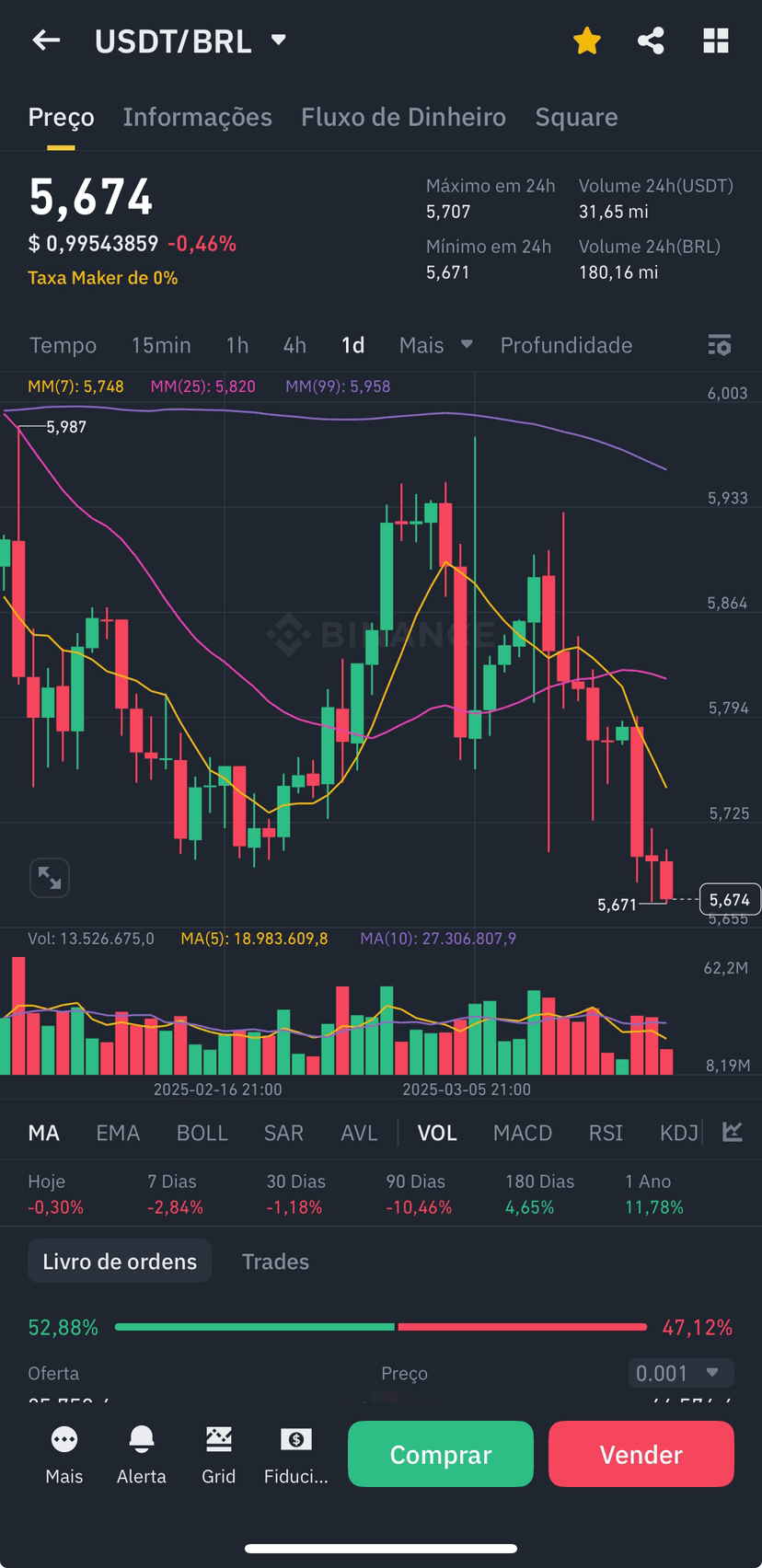
The image shows the USDT/BRL pair on Binance, where USDT is quoted at R$5.674. This price varies according to the demand and supply of the Brazilian market. To profit from this, here are some effective strategies:
 1. Arbitrage between Exchanges
If USDT is cheaper at one exchange and more expensive at another, you can buy at the cheaper one and sell at the more expensive one.
• Step 1: Identify exchanges where USDT is below R$5.674.
• Step 2: Buy USDT at the cheapest exchange.
• Step 3: Send to the exchange where it's more expensive and sell.
• Step 4: Convert the profit to BRL and repeat the process.
This works well when there are price differences between Binance, Mercado Bitcoin, NovaDAX, etc.
2. Trade on Volatility (Swing Trade/Day Trade)
If USDT drops to R$5.60 and then rises to R$5.80, you can buy low and sell high.
• Short strategy (Day Trade): Buy USDT when it is at support (lowest price of the day) and sell at resistance (highest price of the day).
• Long strategy (Swing Trade): If USDT drops to a strong support level, hold and sell when the market is bullish.
Tip: Follow moving averages and indicators like RSI and MACD to predict movements.
3. Profit from Dollar Increase
If the real depreciates and the dollar rises, USDT will also rise. Example:
• Today USDT is R$5.67.
• If the dollar rises and USDT goes to R$6.00, you earn 5.8% profit.
This works well if there are economic crises, high inflation, or political instability in Brazil.
4. Interest and Yield with USDT
• Staking: Some platforms pay interest for locking USDT for a period.
• P2P Lending: You can lend USDT and charge interest.
• DeFi Liquidity Pools: By providing USDT to protocols like Aave and Curve, you earn transaction fees.
Conclusion:
The best strategy depends on your profile:
• Low risk: Hold USDT for protection against the depreciation of the real.
• Medium risk: Arbitrage between exchanges.
• High risk: Day trade on volatility.