
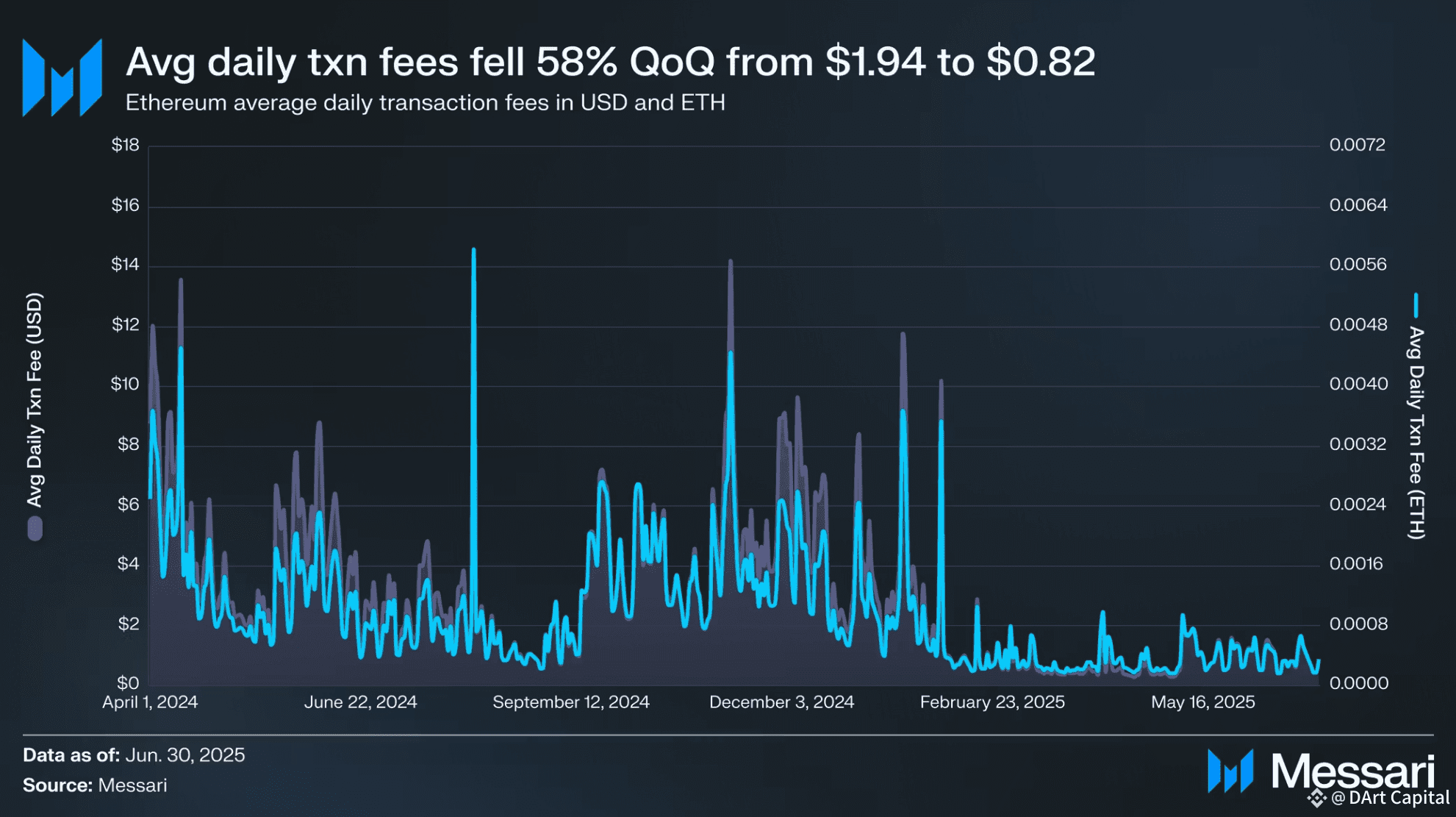
The latest news from the Ethereum network has caught a lot of attention. According to data from Messari, the average daily transaction fee on the Ethereum network has experienced a drastic decline, plummeting by 58% quarter-over-quarter (QoQ), from $1.94 to just $0.82.
Although this sounds like good news for us, in the crypto world, this is a phenomenon that has two sides to the coin, like a double-edged sword! ⚔️
Positive Side: Ethereum Becomes More User-Friendly! 😄
The drop in transaction fees makes the Ethereum network much more affordable and 'friendly' for everyday users.
•Cheaper: With average fees below $1, now the general public and retail investors can transact, buy NFTs, or use applications on Ethereum without having to dig deep into their pockets. This is good news for mass adoption!
•Support for Adoption: Lower fees will encourage more people to use the Ethereum network and try various applications built on it. This is a positive signal for Ethereum's long-term growth.
Negative Side: Are Validator Revenues Threatened to Decline? 📉
On the other hand, this decrease in fees could be a problem for those securing the Ethereum network, namely validators and stakers.
•Reduced Income: Validators earn income from transaction fees. When transaction fees drop drastically, their income will also decline.
•Potential Impact on Supply: Low transaction fees could also impact the total supply of ETH. Some of the transaction fees for ETH are burned to reduce supply. With low fees, the amount of ETH burned also decreases, which means the supply of ETH could potentially increase. This raises concerns about potential inflation on the Ethereum network.
What Does This Decline Really Mean? 🧐
The decrease in transaction fees often reflects a decline in network activity or a lack of demand from users. Data shows that this could be a sign of slowing on-chain activity. However, there is also another view that says this decline is caused by increasing efficiency and the use of Layer-2 solutions such as Arbitrum, Optimism, and Polygon.
Conclusion for Us:
The decline in Ethereum transaction fees is like a 'fog' shrouding the market. On one hand, this is good news as Ethereum becomes more accessible. However, on the other hand, it is a warning signal that demand on the main network (Layer-1) may be weakening.
As an investor and user, it is important to keep monitoring this data and see if transaction fees will rise again along with the onset of a bull run, or if these low fees will continue due to the increasing mass adoption of Layer-2. 👀
