
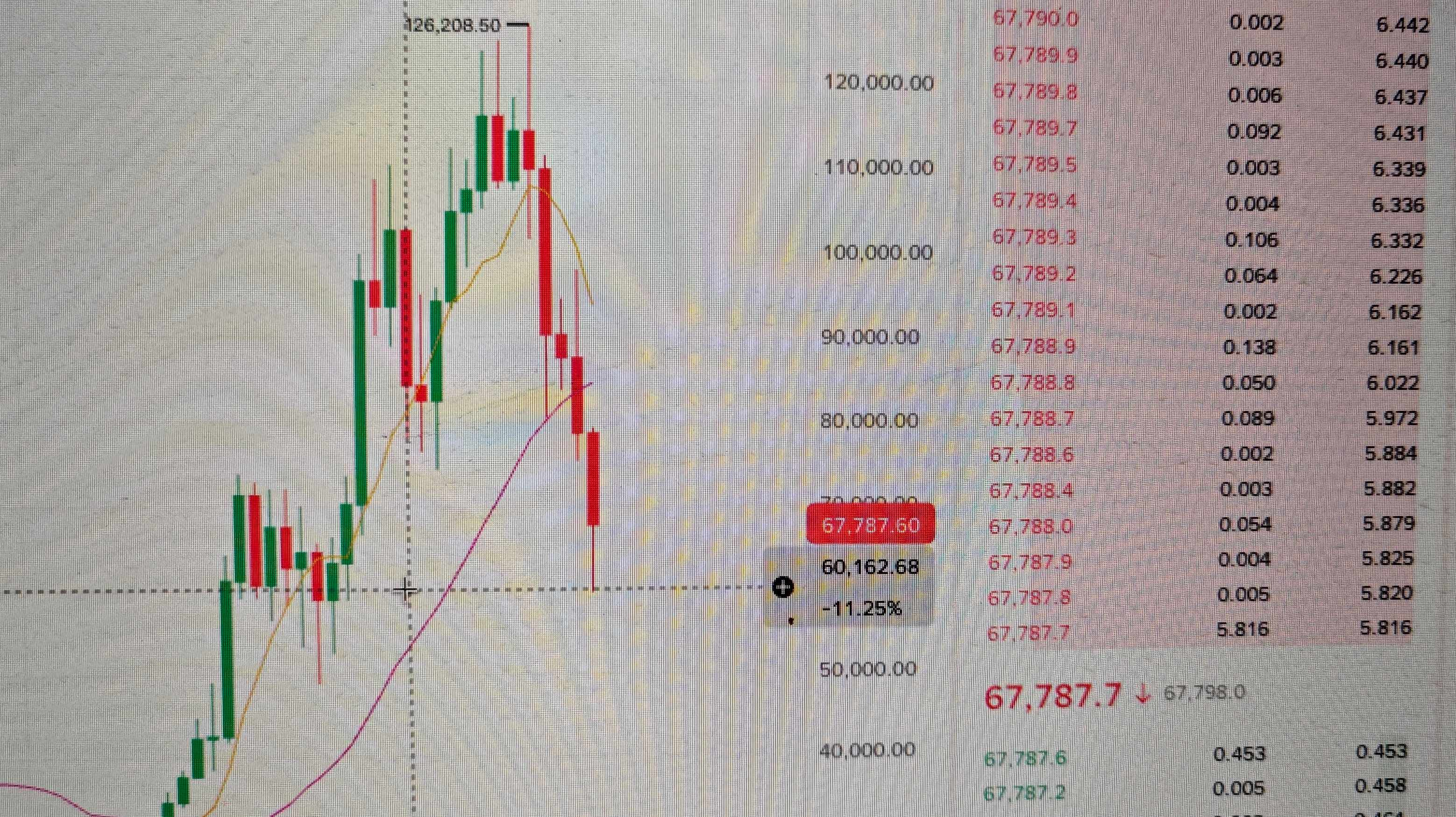
The significant drop of Bitcoin this time (early February 2026) fell from last October's high of about $125,000 - $126,000 to a recent low that nearly approached the $60,000 range. Currently (around February 7), it has rebounded back to around $70,000, overall it has halved or even more. The market commonly refers to this as a new round of 'crypto winter'. There is no single 'real reason', but rather a combination of multiple factors leading to liquidity squeeze + forced liquidation of leverage + a chain reaction of narrative collapse. Below are the core drivers currently indicated by mainstream views and data, sorted by importance: institutional demand reversal + continuous net outflow of spot ETFs (the most direct and largest source of selling pressure).
In 2025, the US spot Bitcoin ETF saw crazy net buying (at one point absorbing over 46,000 BTC in a single year), but after entering 2026, it directly turned into net selling. In the past week, the outflow amount has exceeded $1-1.2 billion, and in the last few days, there have been single-day withdrawals of hundreds of millions.
Institutions (especially hedge funds and non-crypto funds in places like Hong Kong) are the first to cut allocations to high-volatility assets when global risk appetite declines.
This directly leads to a vacuum in spot buying, with a lack of price support.
The Fed's policy expectations have turned hawkish + liquidity tightening (macro reason). Trump nominates Kevin Warsh as the new Fed chairman (hawkish, advocating for higher real interest rates + balance sheet reduction).
Combined with Powell's statement at the end of January to maintain interest rates → the market interprets this as a 'delay in interest rate cuts/reductions'.
Result: The US dollar strengthens, risk assets come under pressure (US tech stocks, precious metals, and cryptocurrencies all plummet simultaneously).
Bitcoin is treated as 'the most liquid risk asset' → during global de-risking, it is the first to be sold off for cash (similar to the 'everything must go' logic of March 2020).
Excessive leverage + large-scale forced liquidations (accelerator)
In the past week, the total amount of liquidations exceeded $2 billion (mainly long positions), with a single-day peak even higher.
Once the price rapidly breaks below key levels (70,000 → 69,000 → 65,000 psychological barriers), it triggers a chain reaction of forced liquidations → trading volume suddenly increases, but it is actually 'forced selling' rather than 'active buying', liquidity thins instantly, and prices fall like free fall.
Liquidity was already poor during the weekend + Asian trading hours, amplifying volatility.
The narrative of Bitcoin as 'digital gold/safe-haven asset' has completely collapsed (a blow to confidence). In times of geopolitical tension (such as the escalating US-Iran conflict), gold and silver may also fluctuate but ultimately rise, while Bitcoin leads the decline.
The market finds that it resembles 'high beta tech stocks' more during risk-averse sentiment, rather than a safe haven → faith collapses.
The Trump dividend (which surged after his election) has been completely consumed, even falling below pre-election levels → 'policy benefits' expectations have fallen flat.
Other minor/amplifying factors: whales/early holders taking profits (at very low costs).
Some miners/leverage players sell off to supplement margins.
Technical aspect: Breaking below long-term moving averages + price gaps (low volume price ranges), once entered, it accelerates.
Minor noise: such as the South Korean exchange mistakenly sending out BTC, causing temporary panic (mostly recovered, not the main cause).
Current market consensus summary (latest on February 7): A technical rebound may occur in the short term (having pulled back from a low of 60,000 to above 70,000), but liquidity remains thin, making it easy to test the bottom again.
Multiple institutions (10X Research, Galaxy Digital, etc.) believe there is still a risk of new lows before summer this year, with the most pessimistic outlook being $50,000 or even in the $40,000-$50,000 range.
Unless a new strong buying narrative emerges (or the Fed suddenly turns dovish), this round of adjustment is likely not over.
In a nutshell: This time it is not because Bitcoin itself is bad, but because it resembles a risk asset too much. During the liquidity tightening and deleveraging cycle, it was hit the hardest and the first. The cycle is still ongoing, but the dual cleansing of faith and leverage is in progress.