
Welcome, my friend, the new trader seeking wealth, luxury, and luxury cars.
Yes, these were the dreams of many when deciding to download the platform's application for trading cryptocurrencies, where the infinite and rapid profits can exceed the exhaustion of months and years in traditional work. But let me be honest with you, all these dreams are just false advertising if you do not manage your money carefully and make a plan that suits its management and bear the risks that may occur.
In the beginning, let me say frankly that capital management is the most important tool in any financial market.
Maintaining capital is a priority before seeking profit.
And to understand the nature of the cryptocurrency market, you must understand the nature of financial markets in general, as the currency market is one of the markets within the larger market.
What are financial markets?
Simply,
It is the 'market' where financial assets are traded between sellers and buyers.
These markets aim to direct funds from people with surplus
(investors) to those who need financing (like companies or governments).
The main types of financial markets:
Stock market: where you buy shares in companies (like Apple or Amazon).
Commodity market: trading metals (gold, silver) and energy (oil). (Forbidden)
Currency market (Forex): exchanging paper currencies like the dollar and euro. (Forbidden)

Cryptocurrency market.
It is a relatively modern market that relies on blockchain technology. Unlike traditional markets, this market does not sleep (operates 24/7) and is not controlled by central banks (decentralized).
Bitcoin: considered the 'digital gold' and the first store of value. It is the first digital currency that appeared and is the spiritual father of the entire market and its main driver.
Altcoins: like Ethereum, providing technical solutions and smart contracts.
Financial markets are famous for profits but do not forget they are markets full of risks and losses.
For quick profit, high and big risks are required.
And the rule is that the more profit increases, the more risk increases, and losses increase.
high risk = high reward.
And to start your journey, my friend, in the world of markets, you must invest in yourself before you invest your money. This means you should learn technical analysis; proficiency and expertise are not required, as I told you before, managing your capital with a little technical analysis is enough to bring you to safety in the markets.

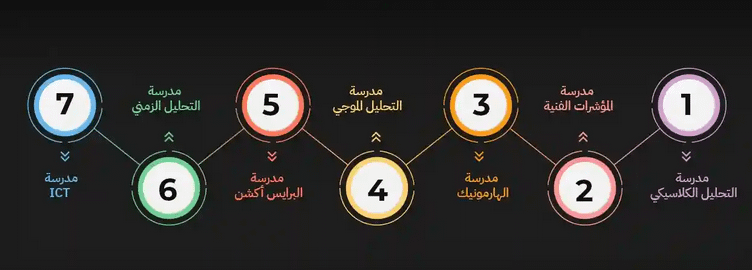
And when you search for the best analysis schools or which school is the best. The answer is there is no school better than another as all schools are just a means and you have to choose for yourself which school you prefer to use and which is closer to your mind and comfort while trading.
To establish all schools, you need to study.
The classical school is first as it is like the cornerstone on which all schools are built; it is the oldest. Some of its most famous terms are support and resistance, trend lines, and candlestick patterns.
The wave analysis school (Elliott Waves) relies on the idea that market movements occur in cycles and recurring wave patterns.
The 'Smart Money' (SMC) school is one of the modern schools derived from the ICT school.
SMC relies on the idea that the market does not move randomly, but is driven by 'smart money'
(banks, major financial institutions, whales). Your goal as a trader is to discover where
these players place their orders and enter with them, instead of being the 'liquidity' that
they swallow.
HARMONIC school.
The Harmonic Trading school is 'chart engineering', which relies entirely on Fibonacci ratios to discover recurring geometric patterns in financial markets, and predicts reversal zones with extreme precision. This school believes that market movements are not random, but follow specific ratios and proportions. If a certain geometric pattern (like the letter M or W) forms, the price will often head to a specific point called the PRZ (Potential Reversal Zone).
Do not hesitate to try to learn and acquire skills from analysis. Proficiency and expertise are not required at the beginning, but practice sharpens skill and experience. Invest your free time in watching some analysis videos on the famous video sites. There are thousands of Arabic and foreign videos and thousands of free courses to learn. Do not despair from not understanding at the beginning, as everyone started without knowledge, and upon loss and trying to search for the reasons for loss, some decided to learn and understand, while others left the market without return.
Learn technical analysis at the start and practice trading on a demo account for a while and do not start with real money at the beginning until you understand the market and avoid losses.
In conclusion, I apologize to you, my friend, for the length, but I must give you some advice that I hope will benefit you at the beginning of your path. (I wish I had someone to tell me this.)
Entering the trading world without awareness is like gambling. Securing your capital is a priority before profits. Plan and do not trade out of revenge against the market. Revenge trading brings more losses.
Do not invest with money you need soon or later. Invest your surplus funds. Do not borrow or take loans to invest. Financial markets are not guaranteed in time and periods.
Education before execution. Learn, learn, learn.
Try to manage your money carefully. Do not put all your money into one deal. Divide your capital when entering and exiting the market. Split your entry into batches.
Avoid emotion: the fear of missing out (FOMO) is the trader's number one enemy; wait for the right opportunity and do not chase the rising price.
I wish you a good experience in the market that is enjoyable and profitable, God willing.