
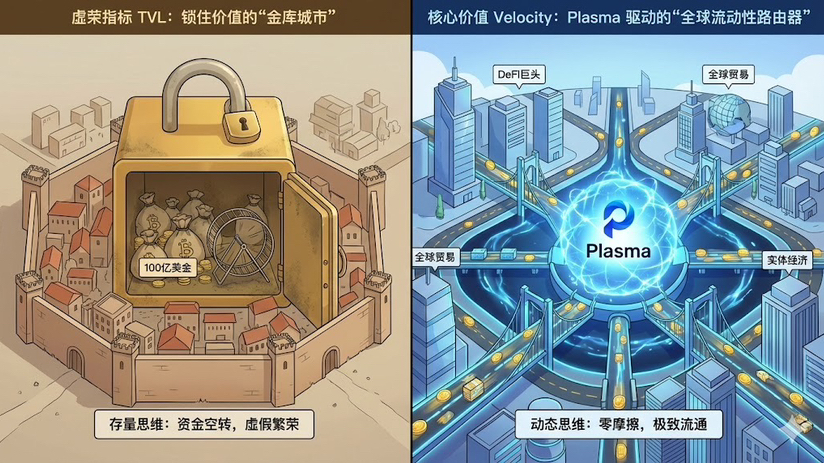
In the crypto world, we are accustomed to using TVL (Total Value Locked) to measure the success of a public chain or DeFi project. The higher the TVL, the stronger the consensus seems to be, and the more impressive the project appears. However, I increasingly feel that this may be a huge misconception. If a chain has locked up $10 billion, but this money is just sitting there engaged in endless 'mining, withdrawing, and selling' and Ponzi schemes, does it contribute anything to the real world? No, it does not.
This is like evaluating a city; we only look at how much money is stored in its banks, but we don't consider how prosperous its business is or how bustling the streets are with people coming and going. Is a lifeless 'bank city' really more valuable than a vibrant 'trade center'? The emergence of Plasma has prompted me to deeply reconsider this evaluation standard.
🔴 The trap of the vanity metric TVL
TVL is essentially a 'stock' metric. It can easily be manipulated by high token subsidies. Project parties can attract a large influx of funds in the short term through extremely high annual percentage yields (APY), creating a booming TVL surge. However, this prosperity driven by 'stimulants' is often unsustainable. Once subsidies decrease or stop, funds will quickly withdraw, leaving a mess behind. Overemphasizing TVL can lead us to favor those 'casinos' skilled in capital games while neglecting those 'factories' that truly create value.

🟡 The return of core value Velocity
The essence of currency is for circulation. A 100 yuan bill, if used for transactions 10 times in a day, creates 1000 yuan of economic activity for society. If it is just locked in a safe, its created value is zero. Velocity measures the efficiency of this 'value circulation.' The entire design philosophy of Plasma seems to be aimed at achieving extreme circulation speed.
- Zero Gas fees: Eliminating the biggest friction of circulation.
- Payment priority: Focus on the highest frequency circulation scenarios.
- Global settlement: Serving real fund flows such as cross-border trade and salary payments.
Plasma even made me start to doubt whether the term 'Layer 1' can still accurately define it. Perhaps it is more like a 'Global Liquidity Router,' whose core mission is not to 'lock' value, but to let value 'flow' to where it is needed most, at the lowest cost and fastest speed.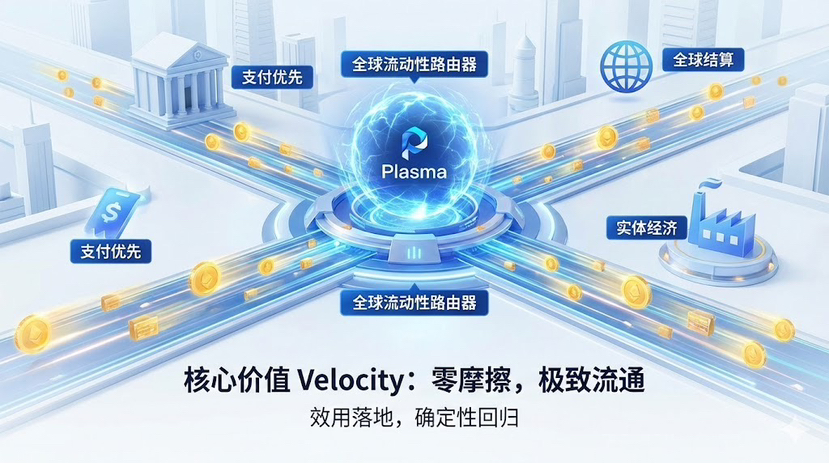
🟢 Certainty in the bear market: the realization of utility
Why do I have so many thoughts about Plasma? Perhaps because I'm tired of nihilism. In the past few years, we chased too many projects that not only did not solve problems but also created more problems. Watching the Plasma ecosystem slowly grow during the bear market, and seeing DeFi giants like Aave and Ethena choose to settle in, I feel something called 'certainty' returning. This certainty is not about price fluctuations, but about the realization of utility. When real users and applications begin to gather on a network, its Velocity will naturally increase, which is the most solid foundation of value, unshakable by any market sentiment.
Insights for ordinary people:
The next time you analyze a project, try to move TVL away from your core metrics. Look for metrics that reflect 'Velocity,' such as daily transaction count, daily active address count, number of applications integrated with the real economy, and daily turnover of stablecoins. A project's TVL may be halved in a day, but a network driven by real demand and high-frequency usage is hard to destroy in the short term. Look for projects that are committed to increasing 'circulation speed' rather than 'locked value,' and you may discover a completely different investment world.