
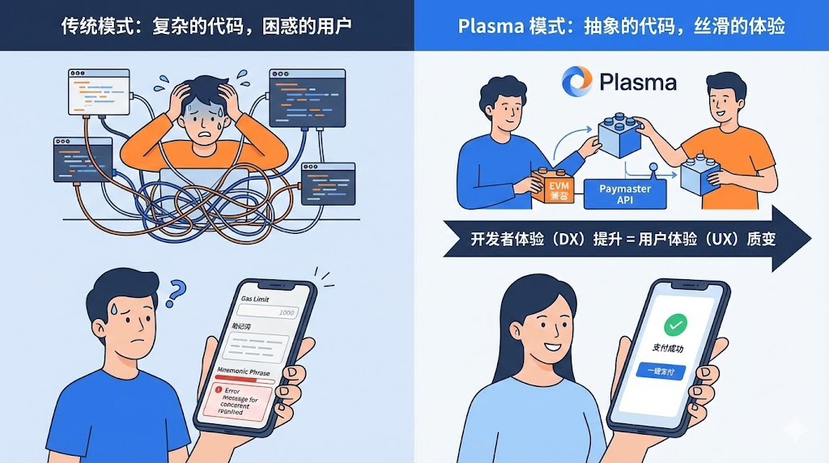
We often say that 'Mass Adoption' is the holy grail of the industry. But mass adoption won't be achieved by getting a billion people to learn how to manage mnemonic phrases, nor by making them understand what Gas Limit is. It can only be achieved through 'abstraction'—leaving the complexity to the code and the simplicity to the users.
To achieve 'abstraction' for users, we must first achieve 'abstraction' for developers. If developers are overwhelmed themselves, how can they possibly create a smooth user experience? Recently, I was testing the developer tools for Plasma, and as someone who occasionally writes code, I must admit that it excels in this regard.
1️⃣ Extreme optimization of developer experience (DX)
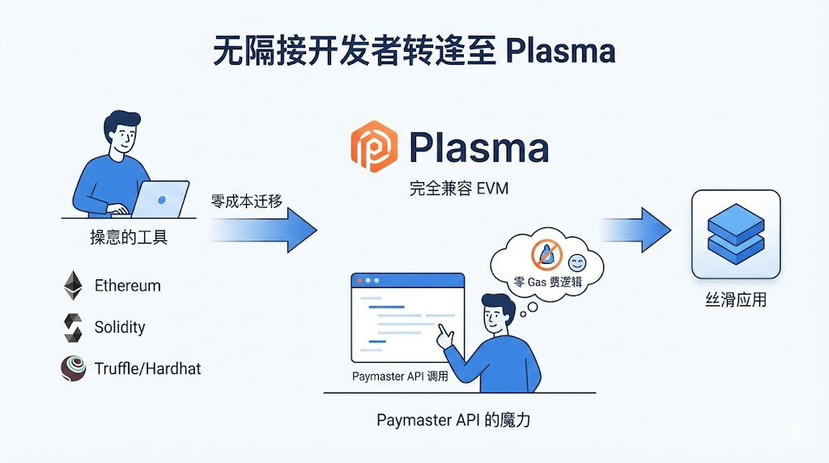
- Fully compatible with EVM: this is an extremely wise choice. This means the world's largest and most mature army of Ethereum developers can migrate at zero cost. They do not need to learn new programming languages (like Rust or Move) and can deploy directly using the most familiar Solidity language and tools like Truffle and Hardhat. This greatly lowers the threshold for ecological startup.
- The magic of Paymaster API: this is the real finishing touch. I tried writing a simple transfer demo, and the simplicity of the code made me feel delighted. Developers no longer need to write complex logic to handle users' Gas fee issues (such as checking if users have Gas tokens, guiding users to purchase, or exchanging through DEX), but just need to call a simple API interface, and the network layer will automatically handle all costs. This improvement in 'developer experience' (DX) will ultimately be transformed into a qualitative change in 'user experience' (UX).
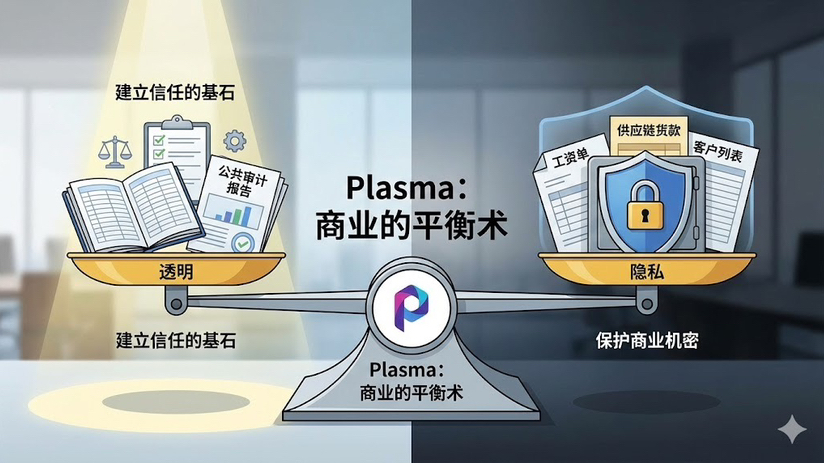
2️⃣ The balance of business: privacy and transparency
The transparency of blockchain is a double-edged sword. For individual users and community governance, it is the cornerstone of building trust. However, for enterprise-level users, complete transparency is unacceptable. No company wants to display its payroll, supply chain payments, or customer lists openly on a public blockchain explorer for everyone to see.
Plasma's layout in confidential payments demonstrates its profound understanding of the essence of business. Its privacy design is not meant to serve black market transactions, but to return business to its essence—maintaining transparency where public transparency is needed (such as audits and regulations) to build trust, while providing protection where necessary (such as business secrets and user privacy). This wisdom in finding a balance between 'transparency' and 'privacy' tests a team's maturity more than pure technical stacking.
3️⃣ From infrastructure to killer applications: The vision of Plasma One
If the underlying zero Gas fees and friendly developer tools are meant to 'pave the road,' then the Plasma One concept for C-end Neobank (digital banking) is designed to enable 'killer applications' to run on that road. I've been wondering why we still need traditional bank accounts? If we could have a non-custodial wallet that is as easy to operate as a banking app, yet enjoy high yields on-chain and seamless global payments, what would be the meaning of traditional banks? Plasma One is exploring this direction, attempting to package powerful underlying infrastructure into a product that ordinary people can easily use.
The long-term potential of a project depends not only on how advanced its technology is but also on whether it can attract enough excellent developers to contribute and whether it truly understands and meets the needs of the business world. When evaluating a project, you can check whether its developer documentation is clear and user-friendly, and whether there are active developers in its community discussing and building. At the same time, consider whether its design takes into account the complexities of the real world, such as privacy requirements. A platform that is friendly to developers and businesses is more likely to grow truly valuable applications.