
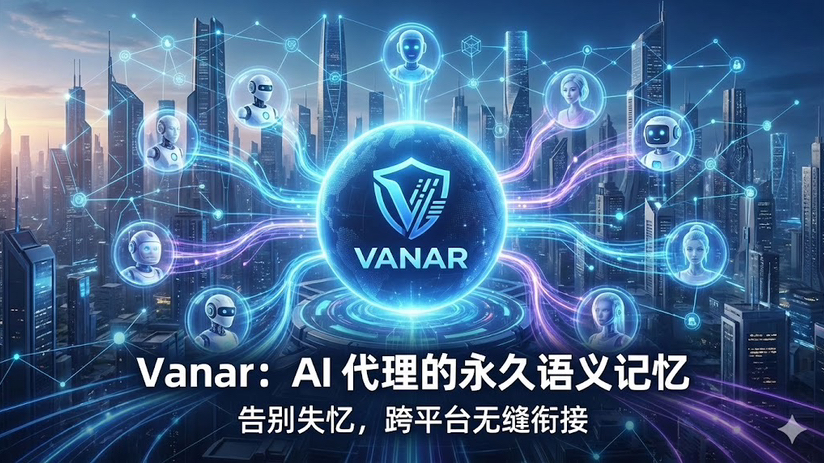
Most people are still discussing 'which chain is faster and which has cheaper gas', but there is a project that is already addressing a more fundamental issue: why do AI agents always forget?
🎬 TOKEN2049 Dubai: A 30-second technical declaration
On April 30, 2025, at the 360-degree screen of the Dubai Digital Art Theater (TODA), Vanar did something crazy:
On site, a 25MB 4K video was compressed into a 47-character 'seed', embedded in a mainnet transaction, and then completely reconstructed and played back within 30 seconds.
There were more than 120 investors, payment giants executives, and media members in the audience. Che Cabreros from Worldpay stated on the spot: 'When refunds and proof of chargebacks themselves are immutable seeds, the gray area between merchants and banks disappears.'
This is not a PPT presentation, but a real on-chain operation—not relying on IPFS, not relying on S3, not relying on any centralized storage. CEO Jawad Ashraf stated plainly: 'This is the world's first technology that simultaneously supports physical compression and semantic compression.'
🤖 The dilemma of OpenClaw: why do agents always start from scratch?
If you have used OpenClaw (that recently popular open-source AI agent), you must have encountered this problem:
Does the agent remember last week's tasks? Can it find previous conversations when switching devices? Does it still recognize you after a restart?
The answer is: no.
The memory of traditional AI agents exists in local Markdown files, lost when switching platforms, forgotten upon restart, and 'amnesiac' when context is compressed. That’s why you always have to re-explain 'who I am, what I'm doing, and what my preferences are.'
In February 2026, Vanar launched the Neutron memory API for OpenClaw. It turns agents' memories into 'permanent assets':
✅ Exists on-chain, will not disappear due to platform shutdown.
✅ Cross-device synchronization, seamlessly connecting when switching computers or phones.
✅ Queryable, verifiable, with cryptographic proof to ensure integrity.
A developer on Reddit said: 'My clients always ask for adjustments, and after using myNeutron, the feedback process became organized, without needing to explain the requirements from scratch each time.'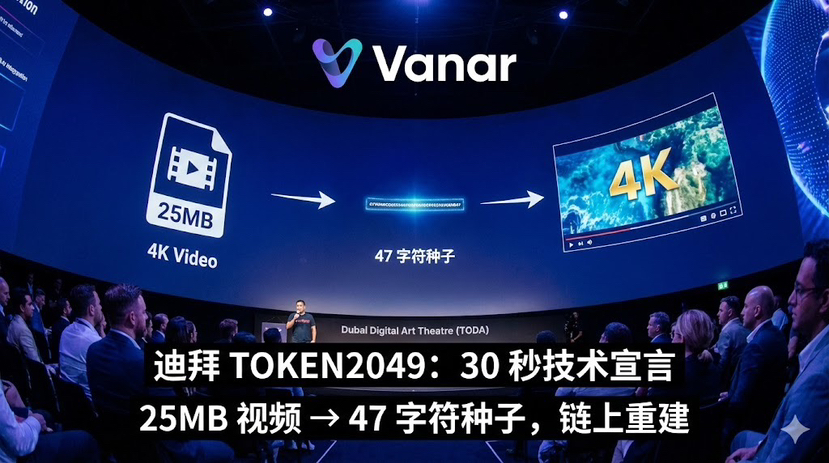
🧠 Not just storage, but 'memories that AI can understand.'
The core of Vanar is not 'storing more,' but 'storing smarter.'
Neutron compresses data into 'semantic seeds'—not just simple file compression, but transforming information into a form that AI can directly understand, query, and reason.
For example:
- Traditional solutions: storing a PDF, AI has to read and parse it again each time.
- Neutron solution: transforming PDFs into 'semantic seeds', so AI directly knows 'what this is about, where the key information is.'
This is why Vanar achieves a compression ratio of 500:1 while ensuring AI does not lose its understanding capabilities.
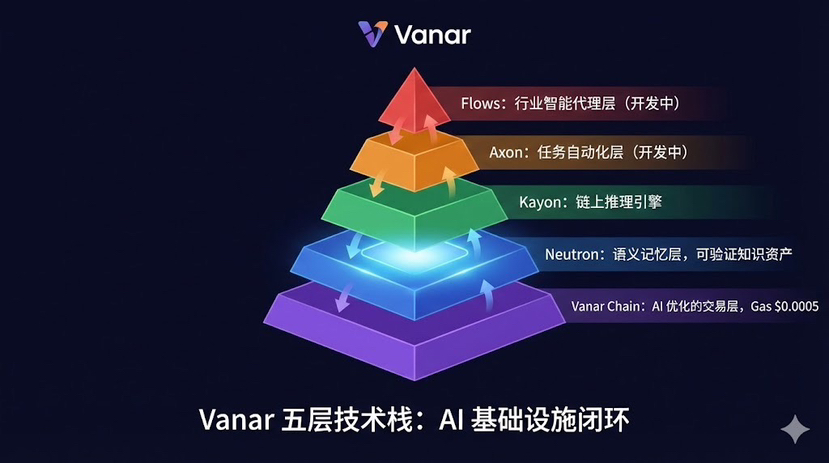
🏗️ Five-layer tech stack: a complete closed loop from storage to reasoning.
Vanar is not a point solution, but a complete AI infrastructure:
1️⃣ Vanar Chain: AI-optimized transaction layer, fixed gas fee $0.0005.
2️⃣ Neutron: Semantic memory layer that stores verifiable knowledge assets.
3️⃣ Kayon: On-chain reasoning engine that supports natural language queries and automated decision-making.
4️⃣ Axon: Task automation layer (in development).
5️⃣ Flows: Industry intelligent agent layer (in development).
Integrated with Nvidia CUDA and the full Omniverse suite, Google Cloud serves as a verification node. This is not just 'riding the wave,' but genuinely building the infrastructure for the AI era.
💡 Why is this important?
We are entering the era of the 'AI agent economy':
- Agents need to remember your preferences, project history, and decision logic.
- Agents need to seamlessly switch between different platforms (ChatGPT → Claude → Gemini).
- Agents need to 'prove' that their memory is real and untampered.
What Vanar solves is this problem. It turns AI's memory into 'portable, verifiable, permanent' digital assets.
Just like databases in the 1990s—no one thought it was important at the time, but later it became the infrastructure of the internet.