
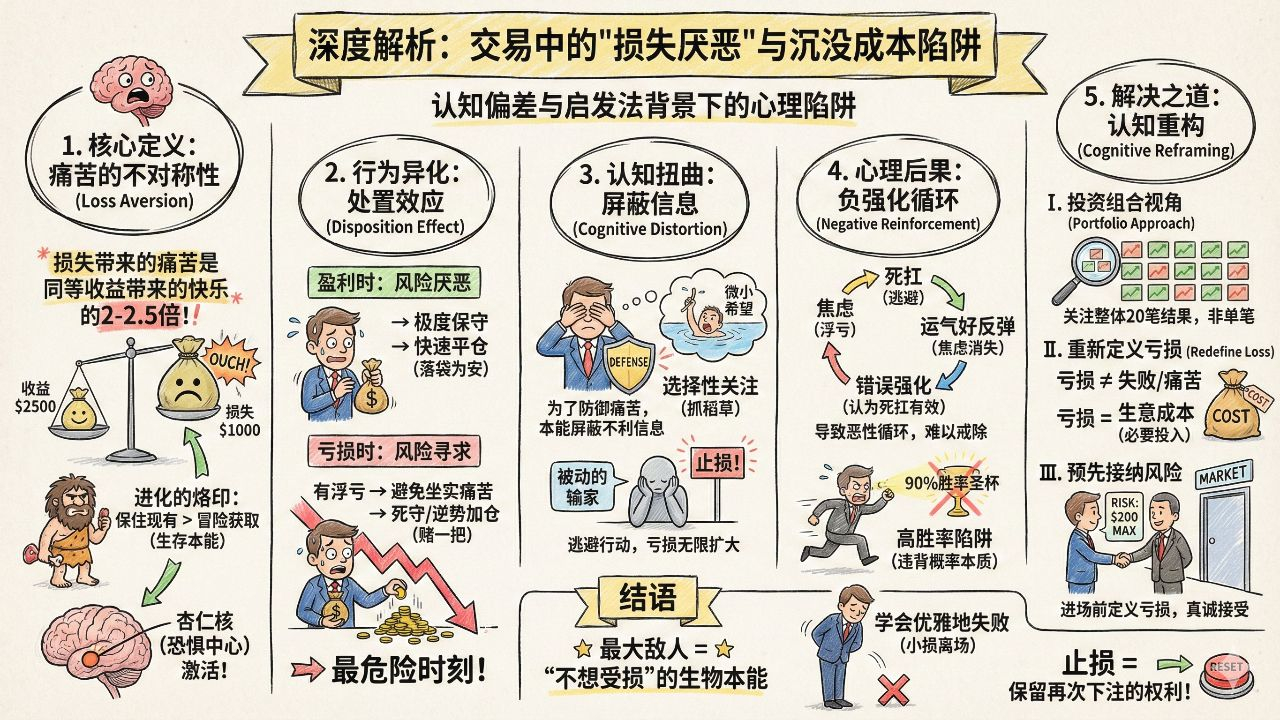
Loss Aversion is consistently regarded by Gary Dayton and Mark Douglas as the most stubborn and destructive psychological trap faced by traders.
It is not only an emotional response but also a deeply rooted biological defense mechanism. It directly distorts traders' assessment of risk and probability, being the culprit behind the fatal error of 'cutting profits short and letting losses run (holding onto positions).'
──────────────────
1. Core Definition: The Asymmetry of Pain
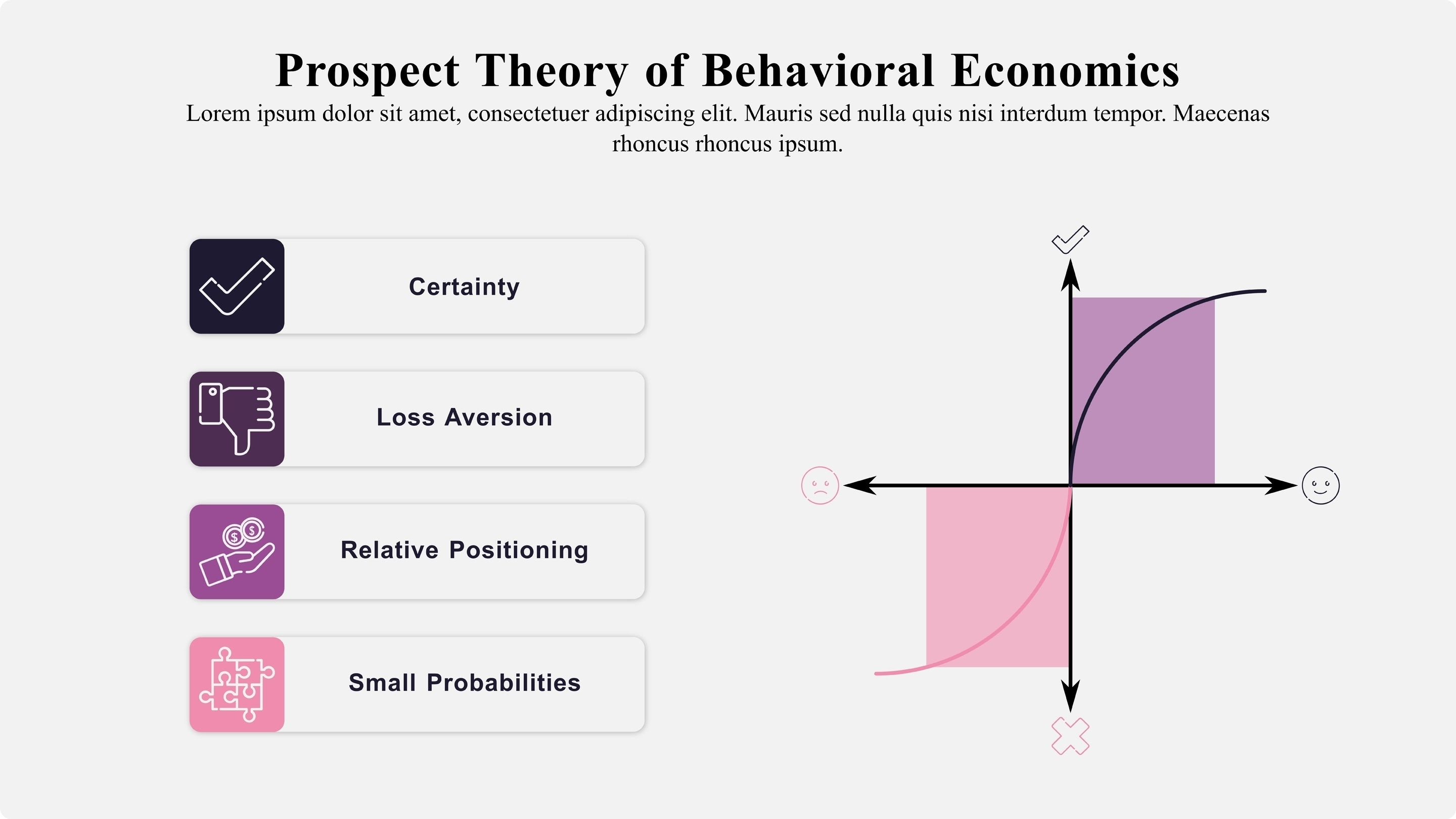
Within the realm of cognitive psychology, loss aversion reveals a cruel truth: human psychological responses to 'loss' are far stronger than to equivalent 'gains.'
The multiplier effect of psychological shock:
Gary Dayton references Daniel Kahneman's research, pointing out that the negative effect (pain) caused by loss is 2 to 2.5 times。This means: the mental torment caused by a loss of $1,000 requires a profit of $2,500 to psychologically offset it.
Evolutionary imprint:
This asymmetry is not a character flaw but a survival instinct determined by genes. In the evolutionary process, 'preserving existing food' (avoiding loss) is more critical for life and death than 'risking to find more food' (pursuing gains). Dayton points out that when facing the threat of loss, the brain's **amygdala (fear center)is automatically activated, and eventhe anterior cingulate cortex (the area processing physical pain)** lights up—For the brain, losing money really does 'hurt'。
2. Behavioral alienation: Disposition effect (The Disposition Effect)
Loss aversion directly leads to the famous 'disposition effect,' where traders tend to 'sell winning positions too early but hold onto losing positions.' This triggers an interesting risk paradox:
Risk aversion when facing profits:
When there are unrealized gains, to 'preserve' this vested interest (avoiding the 'psychological loss' of profit giving back), traders become extremely conservative, tending to close positions quickly and 'take the profit off the table.'Risk-seeking when facing losses:
This is the most dangerous moment. When there are unrealized losses, to avoid turning floating losses into 'real losses' (i.e., solidifying the pain), traders become willing to take on huge risks.Behavioral representation: Holding onto losing positions, even increasing positions against the trend (averaging down), hoping for a market rebound. This kind of 'gamble' behavior is fundamentally driven by risk-seeking due to 'loss aversion.'
──────────────────
3. Cognitive distortions: Blocking information to defend against pain
Mark Douglas explores in (The Disciplined Trader) how loss aversion fundamentally undermines traders' information processing abilities.
Shielding threat information:
To avoid admitting mistakes and suffering psychological pain, fear triggers defense mechanisms, causing traders to instinctively block out key information indicating that 'the market will continue to be unfavorable to you.'Selective attention:
Traders become like drowning people, desperately grabbing onto any straw. They only focus on trivial information that supports the idea that 'the market will reverse.' This kind of self-deceptioncognitive bias is meant to protect self-esteem from harm, but at the cost of account destruction.The 'passive loser':
Douglas emphasizes that the market has no end. If you do not actively cut losses, they will infinitely expand. However, loss aversion instinctively leads people to choose 'avoidance' (not looking at the account, not admitting losses), resulting in traders becoming 'passive losers' when they most need to take positive action (stop losses).
──────────────────
4. Psychological consequences: negative reinforcement and vicious cycles
Gary Dayton proposed an insightful psychological mechanism: negative reinforcement, explaining why the bad habit of 'holding on' is so difficult to break.
The paradox of closing positions:
When holding a substantial losing position, traders are filled with anxiety.Scenario A: If you close the position (stop loss) at this time, the anxiety instantly transforms into acute pain.
Scenario B: If you choose to hold on, and luck has it that the market bounces back, the anxiety disappears without suffering pain.
Consequence: The brain mistakenly believes that 'holding on' is an effective solution to anxiety. This experience of 'successfully avoiding pain' deeply reinforces the neural pathways of 'holding on' until the next time the market no longer rebounds, leading to a direct liquidation.
The high win rate trap:
Due to loss aversion, traders often become obsessed with finding the '90% win rate' holy grail system, attempting to completely avoid the pain of loss by 'not making mistakes.' But this contradicts the essence of trading as a probabilistic game.
──────────────────
5. Solution: Reconstructing the definition of 'loss'
To overcome the loss aversion rooted in DNA, mere willpower is not enough; cognitive reframing is essential.
Ⅰ. Adopting a 'portfolio' perspective (Portfolio Approach)
Dayton suggests forcing oneself to adopt a 'summation perspective.'
Do not focus on the win or loss of a single trade, but rather on the overall results of 'the next 20 trades.' Research shows that when traders view a single loss as a small statistical data point in a grand plan, the activation level of the anterior cingulate cortex (pain center) significantly decreases.
Ⅱ. Redefining 'loss' (Redefining Loss)
Douglas emphasizes that it is essential to psychologically detach the emotional value of loss.
Old definition: Loss = Failure = Pain = I am stupid.
New definition: Loss = Cost of doing business = Necessary investment to capture probabilistic advantages.
Ⅲ. Pre-accepting risk (Pre-acceptance)
Before entering the market, it is crucial to 'define loss in advance.'
When you clearly know 'this trade I will lose at most $200' and genuinely accept that outcome, the market can no longer harm you. Once the risk is accepted, the 'information shielding' caused by fear will disappear, allowing you to objectively see exit signals.
──────────────────
Conclusion
Our biggest enemy in trading is not market fluctuations, but our biological instinct of 'not wanting to lose.'
A mandatory lesson for professional traders is to learn to fail gracefully—accepting it without pain when losses are still small.
Remember: stop loss is not admitting failure, but preserving the right to bet again.