
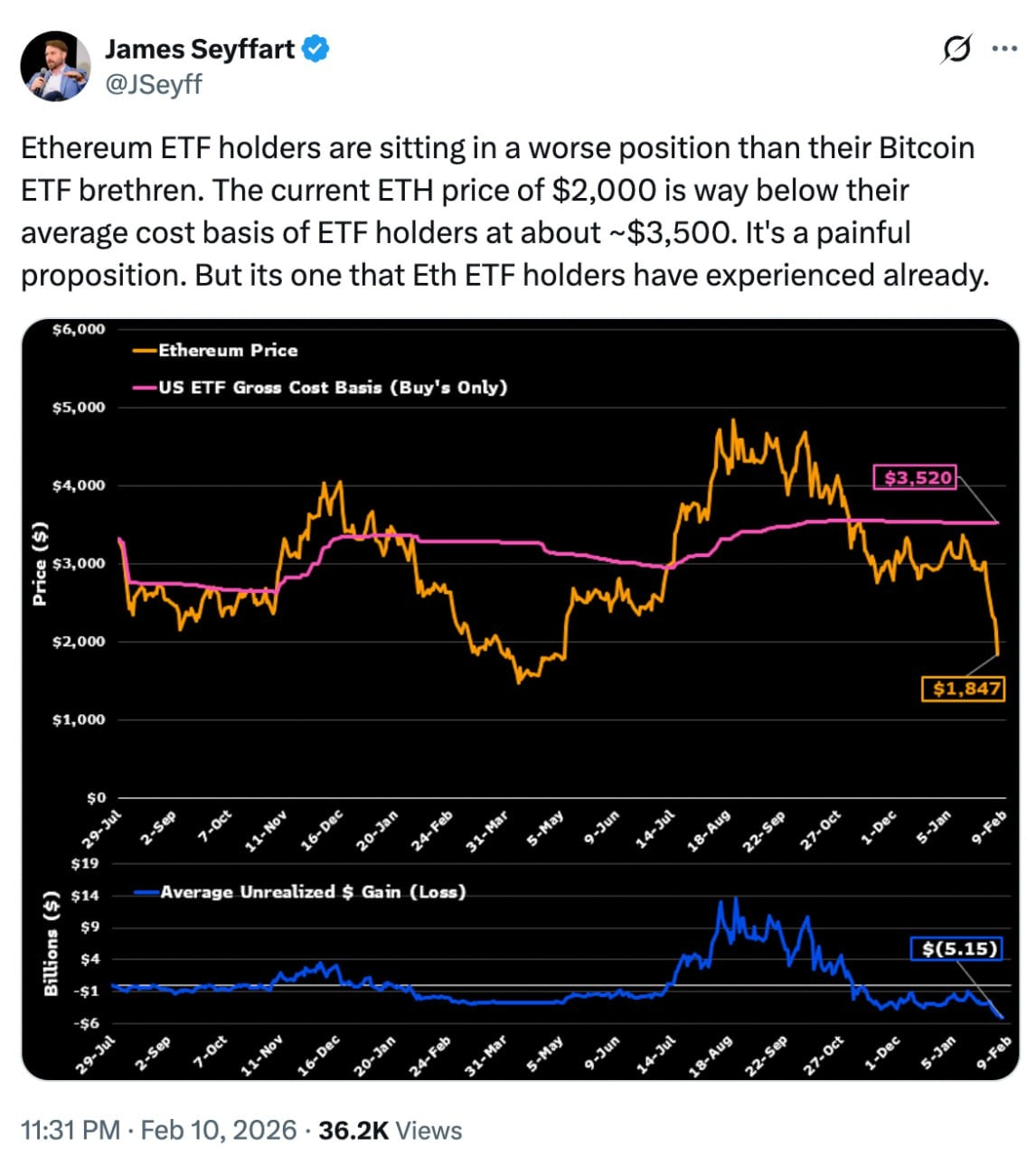
Ethereum dropped below $2,000, pushing the majority of addresses into unrealized losses, but large wallets switched to 'full-scale' accumulation mode and continued to absorb supply from the market
➡️ Price pressure and losses on the network
🟡 ETH dropped 38% in a month and is trading around $1,950 — this is down 60.5% from its all-time high of $4,950
🟡 Only ~41.5% of addresses are still in profit, more than 58% of holders are in unrealized losses
🟡 Current prices are below the average entry point for accumulator addresses (~$2,580) and the estimated cost basis of the spot ETF (~$3,500), which increases pressure on long-term and institutional investors.
🟡 BitMine, the largest ETH treasury, holds millions of ETH and shows paper losses of over $8 billion at current prices.
➡️ Who is buying the ETH dip?
🟡 Accumulator addresses received 1.3 million ETH in 5 days — about $2.6 billion at current exchange rates.
🟡 The combined balance of these wallets reached a record 27 million ETH, +20.36% since the beginning of 2026, even though prices fell 34.5% during the same period.
🟡 An accumulator address is a wallet that only receives ETH and does not conduct outgoing transactions: this can be a long-term holder, fund, treasury, or entity that strategically accumulates ether rather than trading it.
🟡 Historically, spikes in inflows to such addresses often precede rises: after a record inflow of 380,000 ETH on June 22, 2025, prices rose nearly 85% within a month; the spike in November was accompanied by a rally of about 25%.
➡️ Key levels below $2,000.
🟡 Losing $2,000 opens the way to the $1,800–$1,850 range — this is the crucial nearest support that the 'bulls' must maintain.
🟡 Below that, according to Glassnode URPD data, demand clusters around $1,880, $1,580, and $1,230 can be seen — zones where significant buying volume was previously formed.
🟡 Several analysts see deeper: $1,750 and $1,530 as the next targets, with a more aggressive scenario discussing a retest of the $1,000–$750 range on the monthly chart.
🟡 As long as ETH has not reclaimed and maintained the $2,000 level, the market remains vulnerable to continued declines.
➡️ How do the big players read this?
🟡 Combination: the majority of addresses are in loss + aggressive accumulation by large wallets = a classic 'pain market' profile often used by long-term players to build positions.
🟡 For retail, the current level looks like capitulation; for treasuries and funds — like a long-term entry point with a horizon of several years.
🟡 The historical pattern of ETH shows: zones like this do not guarantee instant reversals but often serve as starting points for the next cycle when macro pressure and forced selling have been absorbed.
The current ETH market is living in a harsh risk reassessment mode: prices have broken key support, but accumulator addresses are absorbing record volumes from the market. Next, it will depend on whether ether can hold the $1,800–$1,850 zone and whether buying the dip continues by those looking at a horizon of several years, not just a few days.