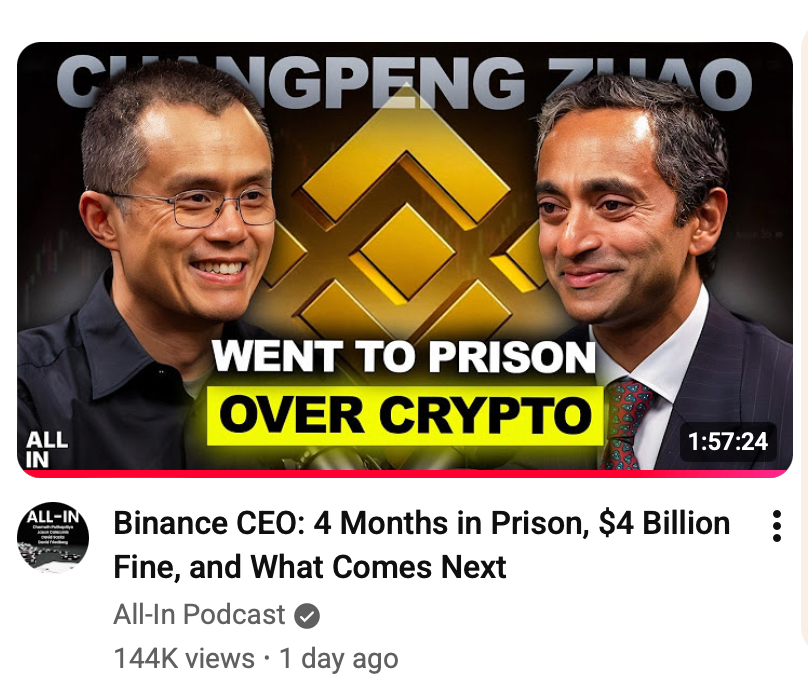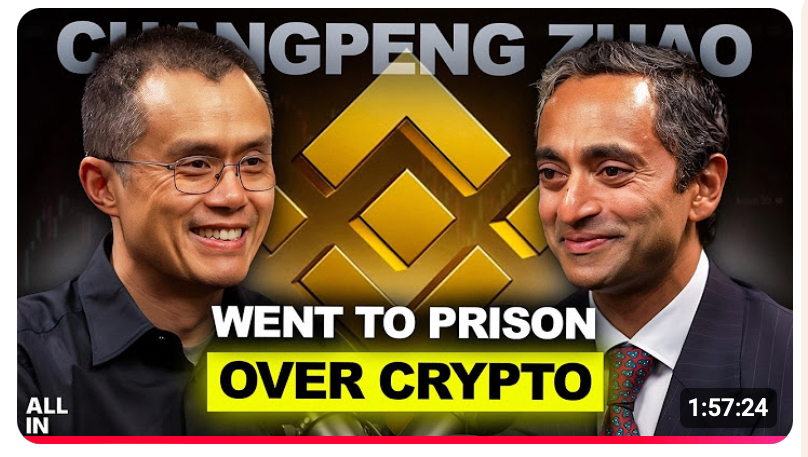
Hello, friends. Yesterday I watched CZ's two-hour interview. To be honest, every time I see the life experiences of such successful people, I can't help but think of one question:
What exactly sets them apart from us ordinary people? Is it luck? Is it intelligence? Or is it something we never even consider, or something we think of but dare not do?
This is my own learning diary, but I also want to share it with my friends.
Part One - What Makes Successful People Different?
First of all, we always feel that successful people are 'chosen ones', but CZ's early experiences are as ordinary as it gets. Immigrating, working at McDonald's, going to college, becoming a programmer... doesn't this path sound very familiar?
But the first turning point came in 2013. When a friend mentioned 'Bitcoin' at the poker table, how might ordinary people react? Perhaps they would say, 'Oh, I see,' then go home to search and exclaim, 'I don’t understand,' and that would be the end of it.
But CZ spent a full six months going through all the materials and forum posts he could find online at that time. He not only researched on his own but also talked to everyone willing to discuss Bitcoin, traveling from Shanghai to Taiwan, and finally flying to Las Vegas to attend the Bitcoin conference.
You see, this is the first difference: ordinary people approach new things with a 'superficial taste,' while he digs deep.
After thorough research, he made that seemingly crazy decision—selling his house in Shanghai and going all-in on Bitcoin.
Part Two - How can each experience become a weapon for the future?
I used to think that changing jobs or failing in startups was a waste of time. But upon reviewing CZ's experiences, I discovered an astonishing fact: his life is like playing a game, where each level accumulates experience and equipment for the next level.
The first piece of equipment: In Tokyo and Bloomberg, he worked for over a decade on the 'order matching system'. This sounds overwhelming for ordinary people, but it is the 'nuclear weapon' that allowed Binance to provide a top-notch trading experience from the very beginning. This is the foundation of his technology.
The second piece of equipment: In Shanghai, during his first startup, the company almost went bankrupt, forcing a transformation into various outsourcing tasks. What did this experience teach him? It taught him how to cope with policy risks and how to find a way out in adversity. This is the foundation of his business survival.
The third piece of equipment: Later, he briefly joined Blockchain.info and OKCoin, where he learned what users in this industry want and what kind of company culture is likely to fail. This is the foundation of his understanding of the industry.
So you see, by the time he founded Binance in 2017,
He already holds an abundance of 'legendary gear': top-notch technology, rich business experience, and profound industry understanding. He did not succeed out of thin air; every previous step was essential.
The biggest insight I've gained is: never underestimate any of your current experiences; as long as you are sincere, they will eventually turn into your weapons at some point in the future.
Part Three - How can we adopt an 'All-in' mindset?
When it comes to All-in, many people might think it's a gambler's mentality. But is CZ's All-in really just gambling? I don't think so. His All-in is a 'necessary choice' based on deep understanding.
Think about it: when you've spent six months researching something more thoroughly than 99% of people, what you see is not risk, but certainty. The bet you place, in your eyes, is not gambling but investing.
So why do ordinary people always experience FOMO (fear of missing out)? Because we often only pay attention after prices have risen; we chase prices instead of value. CZ entered the market after Bitcoin had risen 15 times, and he felt he was 'too late,' but he did not buy at the $1000 price point; he bought the value behind Bitcoin. Therefore, the best way to combat FOMO is to conduct in-depth research.
So what if you make the wrong judgment? CZ's thoughts are even more extreme; he said, "If Bitcoin goes to zero, I'll start over."
What is the confidence behind this statement? Is it money? No. It is his belief in his ability to create value from 0 to 1. His sense of security comes from his skills, not from his savings. This is what we should reflect on the most.
Part Four - Where are our opportunities in 2026?
Finally, let's talk about something practical. Standing in 2026, do ordinary people still have opportunities?
CZ mentioned three major waves in his life during the interview: the Internet, Bitcoin (blockchain), and AI.
He predicts that the largest future cryptocurrency users may not be humans, but AI agents. AIs need to cooperate and trade with each other, requiring a native, permissionless payment method. This practically points us in the right direction! AI + Web3, this is one of the biggest opportunities in the next decade.
What can we do now?
First, learn. Don't just study AI or just study Web3; learn their intersection. Understand what kind of on-chain identity AI needs. How can AI's decisions be executed through smart contracts?
Second, practice. Create a DApp that serves AI, no matter how small. For example, a platform that allows AI models to pay each other for access? A tool for certifying AI-generated artwork on the blockchain?
Third, think. Return to value creation. What CZ is currently doing with Giggle Academy, a free education platform, is deliberately not issuing tokens, just to return to the essence of 'education'.
This tells us that the noisier an industry becomes, the more we need to calm down and think about whom we are creating long-term value for.
Alright, that's all for today. CZ's story has shown me that an ordinary person, through continuous learning, rational decision-making, and exceptional execution, can ultimately reach heights we admire. His era may not be replicable, but the logic of growth is always worth studying.
I hope today's sharing can also inspire you. Let's encourage each other.