
The decentralized finance (DeFi) and blockchain ecosystem thrives on a single core principle: trustless data. Smart contracts, decentralized apps, and even tokenized real-world assets (RWAs) all depend on accurate, real-time information. If the data that powers these protocols is flawed or unverifiable, the entire DeFi narrative collapses.
This is where oracles come in — bridges that connect blockchain applications with off-chain information, like market prices, stock data, or interest rates. Today, the oracle sector is dominated by big names like Chainlink, but a new contender is quietly building momentum: DIA (Decentralized Information Asset).
With verifiable data infrastructure, a custom-built rollup for computation (Lumina), and RWA price feeds already live, DIA is redefining what a trustless oracle should look like. Trading at around $0.69 per token with a market cap near $83 million, DIA’s combination of transparency, technology, and growth potential makes it one of crypto’s most compelling underdog stories.
In this article, we’ll dive deep into DIA’s:
Price action and technical outlook
Key fundamental milestones and upcoming catalysts
Unique product features and competitive positioning
Long-term price potential and scenarios
Why DIA could be the next big player in crypto infrastructure
Price Action & Technical Analysis: The Calm Before the Storm
DIA’s chart tells a story of accumulation and preparation. After a significant correction earlier in the year, DIA has entered a tight consolidation range. This type of price action often signals that smart money is positioning ahead of the next big move.
Here’s a breakdown of the key metrics:
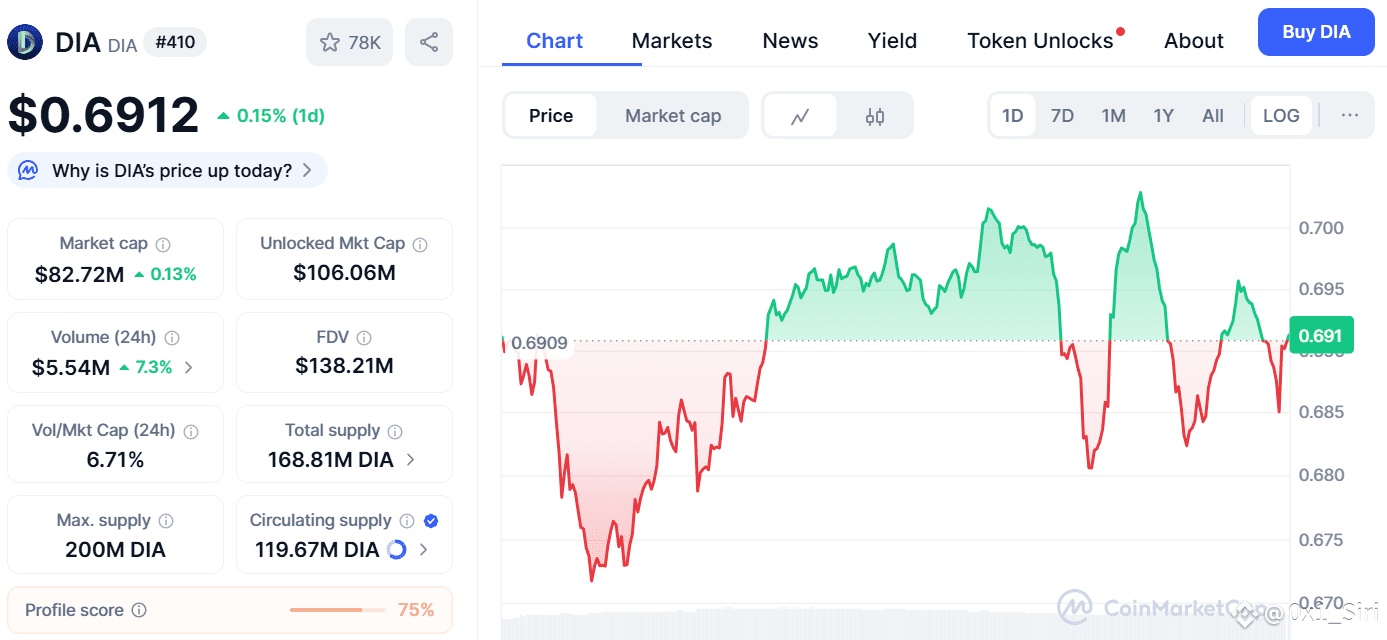
Current Price: ~$0.69
Market Cap: ~$83M
Fully Diluted Valuation (FDV): ~$138M
Daily Trading Volume: ~$5.5M
Circulating Supply: ~119.7M DIA
Max Supply: 200M DIA
Support and Resistance Zones
🟢 Strong Support: $0.65–$0.68 (historical accumulation zone and Fibonacci retracement level).
🚧 Key Resistance: $0.80–$1.00. A breakout above $1.00 would represent a psychological milestone and unlock new upward momentum.
🎯 Target: Short-term technical target sits at $1.20, a ~70% upside from current levels.
Technical Indicators
Pattern: DIA’s price has been forming a falling wedge pattern, characterized by lower highs converging with stable lows. This pattern typically precedes a bullish breakout.
Volume: Despite price consolidation, volume has held steady with occasional spikes. This suggests quiet accumulation by informed traders.
On-Chain Trends: Exchange balances of DIA are decreasing as wallets identified as “whale” accounts accumulate tokens — a strong bullish indicator.
Momentum Oscillators: Indicators like RSI are stabilizing near neutral zones, signaling room for upside momentum without overbought conditions.
In summary, DIA’s technical picture looks primed for a breakout, and traders are closely watching the $0.80–$1.00 zone for confirmation.
DIA’s Fundamentals: The Tech Behind the Token
While many tokens pump on speculation, DIA has been steadily shipping products and integrations that justify its narrative. Here’s why fundamentals are driving confidence in DIA’s long-term vision:
1. Lumina Rollup: A Trustless Oracle Backbone
DIA’s Lumina is a custom-built rollup specifically designed for verifiable computation. Here’s why this matters:
All price calculations, outlier detection, and aggregation logic happen on-chain, not in a black box.
Lumina leverages Zero-Knowledge (ZK) proofs and other cryptographic techniques to ensure data integrity.
Developers and users can audit every data point from source to smart contract.
This level of transparency sets DIA apart from competitors, most of which provide data feeds without exposing the full methodology or proof of accuracy.
2. xReal: Bringing Real-World Assets On-Chain
Tokenized RWAs are projected to become a $10 trillion market by 2030. As traditional financial assets like stocks, bonds, commodities, and real estate come to blockchain, demand for reliable and auditable price feeds will explode.
DIA is already ahead of the curve:
Coverage of 1,000+ assets, including S&P 500 stocks, forex pairs, bonds, and commodities like gold and oil.
Fully auditable data pipelines for institutional trust.
Partnerships with tokenization projects like Plume, Alephium, and Hydration show DIA’s feeds are already powering real DeFi apps.
3. Staking and Incentive Alignment
DIA has rolled out a staking program that allows token holders to secure the network, earn rewards, and influence governance decisions.
Key staking benefits:
Locking DIA tokens reduces circulating supply, applying upward pressure on price.
Stakers earn rewards from network activity, creating a circular incentive loop.
Community members directly contribute to network security, decentralization, and data reliability.
4. Multi-Chain Presence and Ecosystem Growth
Unlike some oracles that focus on a handful of chains, DIA has established itself as truly chain-agnostic:
Deployed on 55+ networks including Ethereum, Arbitrum, Polygon, BNB Chain, Avalanche, Polkadot, and Alephium.
Over 200 decentralized apps (dApps) rely on DIA data feeds today.
The Oracle Grants Program offers cost-free oracles to projects, helping DIA rapidly expand integrations and TVS (Total Value Secured).
DIA’s approach to partnerships emphasizes accessibility and transparency, giving smaller projects a reliable oracle solution without enterprise-level costs.
DIA’s Unique Edge vs Competitors
DIA vs Chainlink
Chainlink is the dominant player, but its infrastructure is partially opaque (data aggregation is done off-chain by trusted nodes).
DIA, on the other hand, offers full auditability from source data to smart contract output.
Chainlink’s market cap is $15B+, making DIA’s $83M valuation seem undervalued given its unique features.
DIA vs Pyth
Pyth specializes in high-frequency data from trusted publishers like exchanges and market makers, but it requires trusting these publishers.
DIA removes this trust assumption through open-source methodologies and cryptographic verification.
DIA vs Band Protocol
Band pioneered oracle solutions on Cosmos, but its adoption has been slower.
DIA’s flexible modular architecture and wider asset coverage give it an edge in adoption potential.
DIA’s unique selling points — transparency, modularity, and verifiability — give it a distinctive market position in a competitive oracle landscape.
📈 Price Prediction Scenarios
Let’s explore where DIA could realistically go based on adoption trends, market cycles, and comparable valuations.
Conservative Case (~$2.00)
If DIA matches peers like Band Protocol (market cap ~$125M), a modest rally to around $2.00 per token is achievable.
Base Case (~$7–$8)
If DIA achieves adoption levels comparable to Pyth (market cap ~$900M), we could see a 10x rally to around $7–$8 per token.
Bull Case ($10+)
In a full-blown RWA + DeFi adoption cycle, even 10% of Chainlink’s current market cap (~$1.5B) would push DIA into double digits.
Given its focus on transparency and early RWA integrations, this scenario is ambitious but realistic.
Why DIA Deserves Attention
Real Product-Market Fit: DIA isn’t a speculative token — it powers data for 200+ dApps.
RWA Leadership: As tokenization accelerates, DIA is one of the first oracles truly designed for institutional-grade data feeds.
Strong Tokenomics: Fixed supply, staking lockups, and ecosystem growth create a bullish long-term supply-demand equation.
Undervalued vs Peers: With a market cap under $100M, DIA has asymmetric upside compared to other oracles.
Transparency Advantage: In an era where institutional adoption depends on trust, DIA’s “proof-first” design is a massive differentiator.
🔮 The Investment Thesis
Blockchain infrastructure projects that succeed often follow a simple pattern:
Build real products.
Secure integrations across ecosystems.
Solve a mission-critical problem better than anyone else.
DIA checks all three boxes:
It’s solving trust in oracles, a problem critical for DeFi, tokenized RWAs, stablecoins, and beyond.
Its integrations and ecosystem traction prove teams are choosing DIA over competitors.
The technology stack — Lumina rollup, ZK proofs, and customizable feeds — shows DIA is designed for the future of Web3.
At this valuation, DIA represents a high-upside, high-conviction bet on the next era of decentralized data infrastructure.
If the next big wave in crypto is about transparency, institutional trust, and real-world utility, $DIA is perfectly positioned to lead that charge.