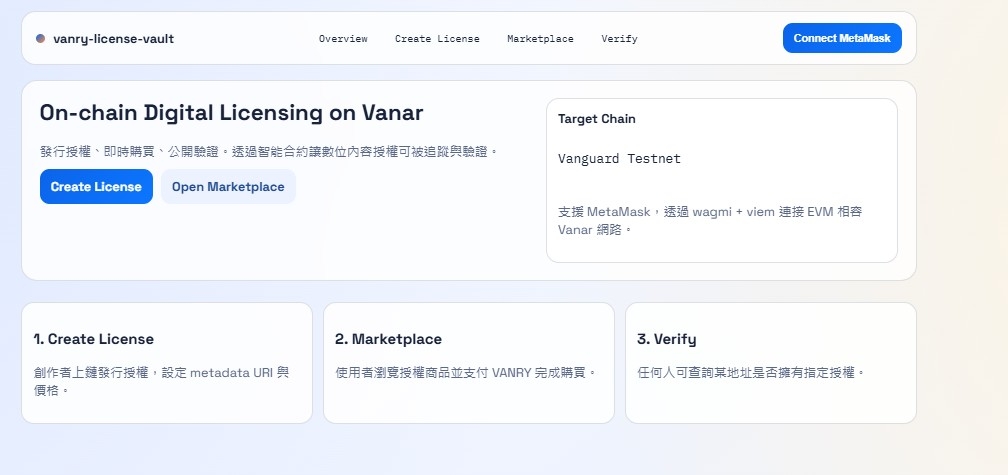
In recent development experiments, I chose to use Vanar Chain @Vanarchain #Vanar as the infrastructure to implement an on-chain digital authorization system (License Vault). Rather than simply issuing NFTs, I am more focused on the 'verifiable authorization logic' itself—how to enable real-time verification of whether a certain address has the usage rights to specific content through on-chain status.
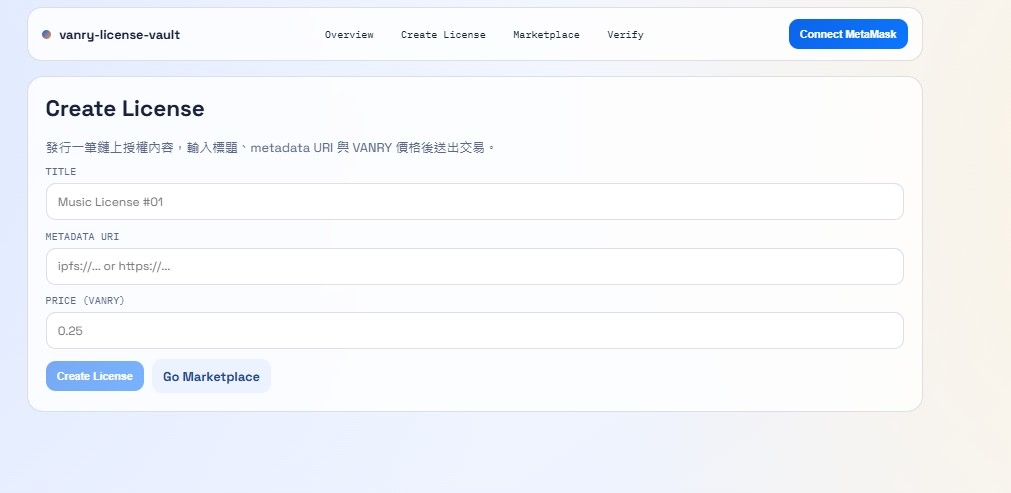
The core of this project uses Solidity to write smart contracts, deployed on Vanar's EVM-compatible testnet. The contract design includes three key functions: createLicense (creator issues authorization), purchaseLicense (user pays $VANRY to obtain authorization), hasLicense (check if a certain address has a specified authorization). All purchase actions are directly written to the on-chain state through a payable function, ensuring that the data is immutable. This design avoids trust issues associated with centralized databases and allows for authorization verification to be directly integrated into other application services.
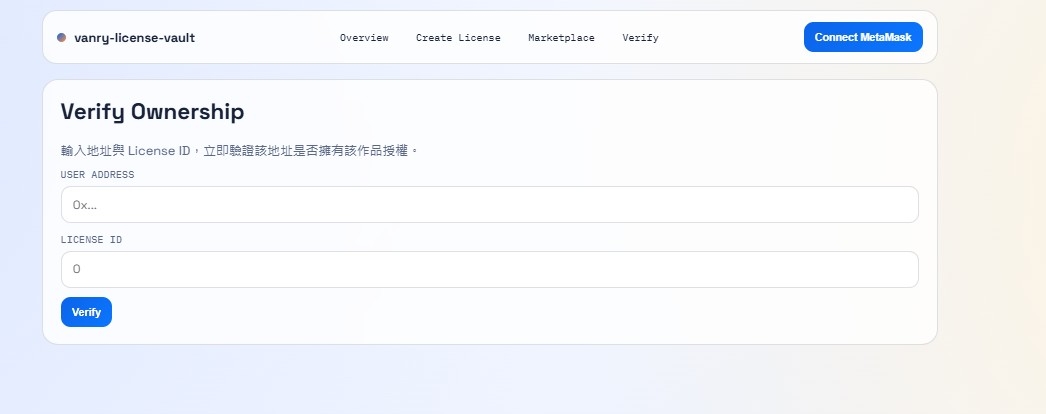
The frontend part uses Next.js along with wagmi and viem to connect to MetaMask, directly interacting with the Vanar network. Users can browse all licensed content on the Marketplace page and complete payments using $VANRY; at the same time, by entering the address and License ID on the Verify page, they can obtain real-time on-chain verification results. The overall process from contract call, transaction confirmation to status update completely relies on Vanar Chain's on-chain data, rather than any backend authorization server.
Technically, I am particularly focused on two points: first, the balance between gas costs and user experience; second, the scalability of the on-chain data structure. Since Vanar Chain supports EVM-compatible environments, the development process and toolchain are relatively mature, making the process from Hardhat deployment to frontend integration quite smooth. This compatibility means that existing Web3 development experience can be directly migrated to the @vanar ecosystem, lowering the development threshold.
From an application perspective, this on-chain authorization model can be extended to music licensing, game asset licensing, AI-generated content usage rights verification, and even subscription-based digital products. When the authorization status becomes a publicly queryable on-chain data, any third-party platform can verify it through contract interfaces without relying on creators to provide proof themselves. This is exactly what Web3 emphasizes in terms of verifiability and transparency.
I believe Vanar Chain has potential in the creator economy and digital entertainment fields, and $VANRY is not just a transaction medium but also the foundation for value circulation and authorization logic operations. In the future, if combined with NFTs or subscription mechanisms, it could even build a complete on-chain content business model.