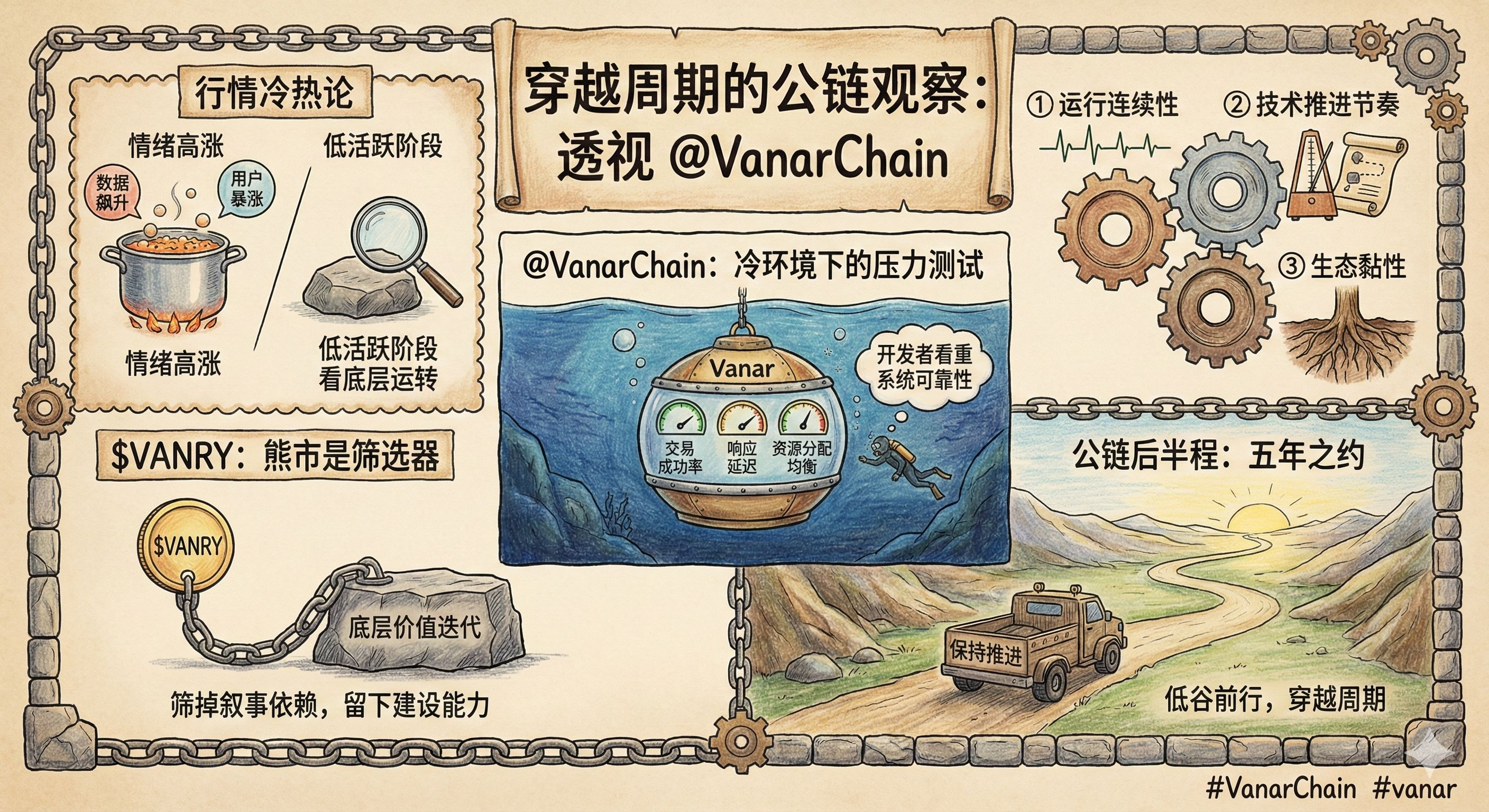
When the market is hot, it's easy to let emotions guide the judgment of a chain. Data surges, user numbers skyrocket, and social media discussions intensify; everything appears to be accelerating. However, when the market enters a low-activity phase, I prefer to slow down and look at some indicators that are usually not very noticeable.
I am currently evaluating public chains, focusing on three dimensions: operational continuity, the pace of technological advancement, and ecological stickiness. Price is just a result variable; what truly determines the direction is whether the underlying system continues to operate.
When re-evaluating @Vanarchain , I pay more attention to its performance in a low liquidity environment. Are there any significant node losses? Is the version update progressing as planned? Is the development repository remaining active? These signals are more authentic than any traffic peak. Many projects appear strong during expansion periods, but in cold cycles, only networks with clear structures can maintain stability.
I am particularly concerned about the network's performance under pressure. The transaction success rate, response latency, and whether on-chain resource allocation is balanced—these details determine whether developers are willing to deploy in the long term. Those who truly build applications do not only look at promotional data; they care more about whether the system is reliable.
From an asset perspective, $VANRY will fluctuate with the overall market, which is an objective law. However, if the protocol layer continues to iterate, the node distribution does not have centralization risks, and there are no obvious breaks in ecological participation, then the underlying value has not been weakened. A bear market is more like a stress test, filtering out parts that rely on narratives and leaving behind teams that truly have the ability to build.
As public chain competition reaches the latter stage, what is being compared is not the short-term growth curve, but the operational state five years later. Those who can maintain progress during the trough stage have a better chance of crossing the cycle.