
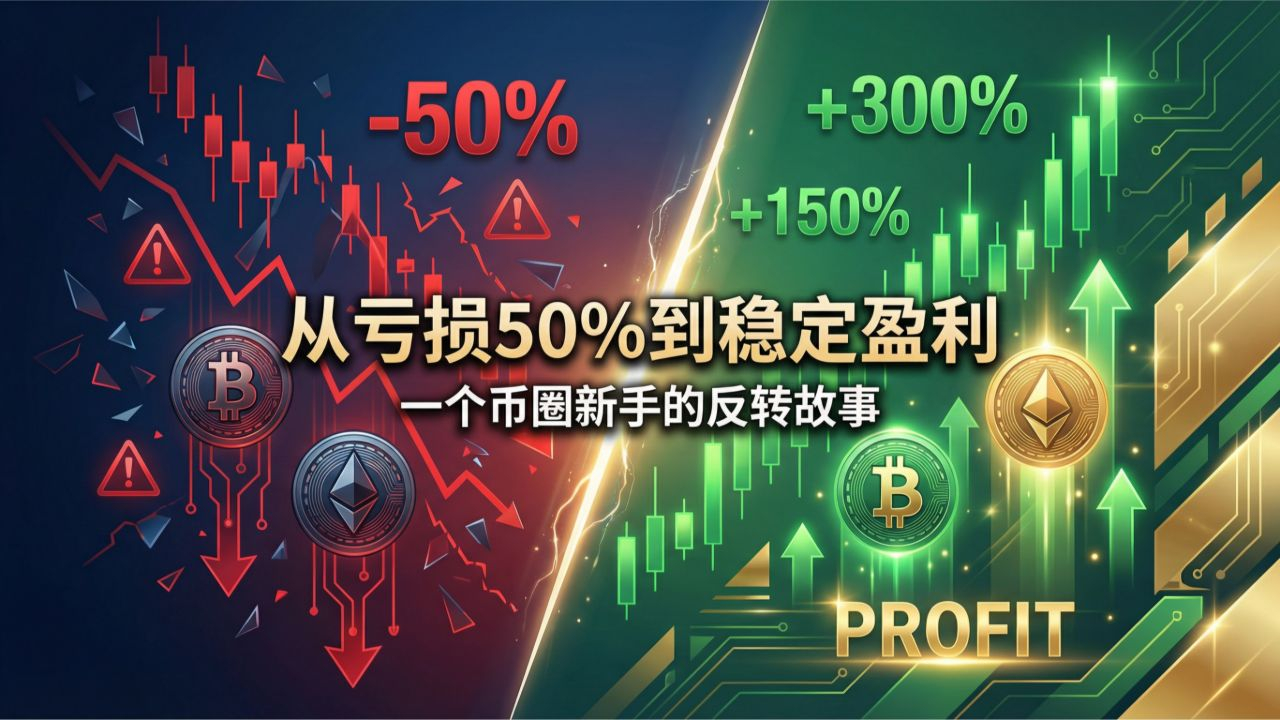
Story 1: The 'FOMO' trap of chasing highs and lows, and my first intimate encounter with 'value investing'
In early 2024, like many people, I was drawn into the cryptocurrency world by a sudden wave of 'animal coins.' I remember very clearly that a meme coin featuring a cartoon dog as its avatar surged tenfold in just one week. Social media was flooded with various screenshots of profits, and every number seemed to mock my hesitation.
"If I don't enter now, it will be too late!" — this voice looped endlessly in my mind, which is what we commonly refer to as 'FOMO' (Fear of Missing Out).
So, on a night when the price had already soared, I invested half of my savings at the time. I didn't even spend a minute understanding what this project was, who the team was, or what problem it solved. I only knew that it was rising and rising crazily.
The result is predictable. After the celebration, a mess was left behind. In just a few days, the price was halved again. I became one of those 'leeks' shaking on top of the mountain, with paper losses exceeding 50%. That feeling was not just a reduction in numbers but an extreme denial and regret of myself.
After deep reflection, the first principle I learned was: invest, not speculate.
I began to force myself to turn off those dazzling candlestick charts and read the project's white paper, understanding what DYOR (Do Your Own Research) means. I no longer asked, 'Which will be the next hundredfold coin?' but rather asked:
•What real-world problem does this project solve? (For example, $ETH created a decentralized application platform.)
•What is the team's background? (Do they have the ability to continue building and delivering?)
•What is its token economic model? (Is it inflationary or deflationary? How to capture value?)
I began to turn my attention to 'blue-chip' crypto assets that had survived the test of bull and bear markets, such as Bitcoin ($BTC) and Ethereum ($ETH). I no longer went all in at once but adopted a Dollar-Cost Averaging (DCA) strategy—investing a small amount weekly. This approach not only spread out costs but, more importantly, cured my 'FOMO' anxiety. Market fluctuations no longer concerned me; I only cared about whether I was continuously accumulating quality assets.
Story Two: The pain of 'cutting losses' from panic selling and the deep understanding of 'long-termism.'
Having experienced the painful lesson for the first time, I thought I had grown. Most of my assets were converted into $BTC and $ETH, and I had some small profits. However, the cruelty of the market far exceeded my imagination.
A 'black swan' event in 2025 caused the entire market to plummet by 30% within 48 hours. Looking at the red numbers in my account, the fear of losing 50% hit me again. This time, I was surrounded by various doomsday remarks: 'The crypto circle is going to zero,' 'Run quickly, even recovering a little is better than nothing.'
I couldn't withstand the pressure. One deep night, I sold all my chips and realized a real loss. I told myself, 'I just stopped the losses in time.'
But in the following week, the market quickly rebounded after a brief bottoming out. The price at which I initially 'cut my losses' became the absolute bottom of that rebound. I perfectly sold at the lowest point and was once again ruthlessly educated by the market.
This time, I grasped the second principle: respect cycles and be a friend of time.
I finally understood that the high volatility of the crypto market is its norm. Trying to predict the market's short-term tops and bottoms is nearly an impossible task for ordinary people. What truly matters is 'Time in the Market, Not Timing the Market.'
I began to learn about risk management. I set a strict rule for myself: 'Only invest money that I can afford to lose.' This money, even if completely lost, would not affect my normal life. This seemingly simple principle is the psychological foundation for my ability to hold long-term (HODL). When I no longer worry about short-term paper losses, I can truly view my investments from a longer-term perspective.
Story Three: The 'choice paralysis' of information overload and the simplification of 'building systems'.
After I started truly learning, new problems arose: information overload.
Opinions from the 'big names' on Twitter vary; some are bullish while others are bearish; analysts on YouTube draw various complex support and resistance lines; there are hundreds of unread messages in Telegram groups daily discussing various new projects I have never heard of.
I felt like a small boat lost in the ocean of information, losing direction. Today I think A makes sense, so I buy; tomorrow I think B's analysis is better, so I hurriedly sell. Frequent operations not only wore down my principal but also left me exhausted.
In the chaos, I stumbled upon a third principle: give up on predictions and build a simple system of my own.
I realized that I didn't need to know everything, nor did I need to seize every opportunity. I only needed a simple, clear, and executable investment system. So, I set up the following personal investment framework for myself:
1. Asset allocation:
•70% invested in consensus-driven 'anchor' assets like Bitcoin ($BTC) and Ethereum ($ETH), aiming to enjoy the long-term growth dividends of the entire industry.
•20% invested in leading projects in niche sectors that I am optimistic about, like some high-quality Layer 2 or DeFi protocols, as 'enhancers' for the portfolio.
•10% as an 'observation position' for small participation in some very early but highly potential new projects, maintaining sensitivity to market frontiers.
2. Principles of buying and selling:
•Buying: Only buy when I have researched clearly and it fits my investment system. For the regularly invested portion, execute it without fail.
•Selling: No longer sell due to panic. Instead, set simple profit targets, such as 'When a certain exploratory asset doubles, sell the principal and let the profits continue to run.'
3. Record and Review: I started writing an investment diary. I record the reasons for buying each token. When I want to sell, I first look back at the diary and ask myself: 'Has the reason for buying disappeared?' This simple habit has helped me filter out countless emotional decisions.
Your story has just begun.
From the initial massive losses to today, being able to face market fluctuations calmly and achieve stable profits took me two whole years. I didn't become wealthy overnight, but I gained investment wisdom and inner peace that are more valuable than money.
Looking back on this journey, I want to say that investing is a practice, practicing cognition and training mindset. In places like Binance Square, we can not only learn knowledge but also force ourselves to grow by sharing our thoughts.
If you too are a beginner in cryptocurrency, I hope my three reverse stories and investment principles can bring you some inspiration. Don't be afraid of making mistakes, but be sure to learn from them. Build your own investment system and then execute it firmly.
Your crypto journey has just begun. May we all become better investors.