
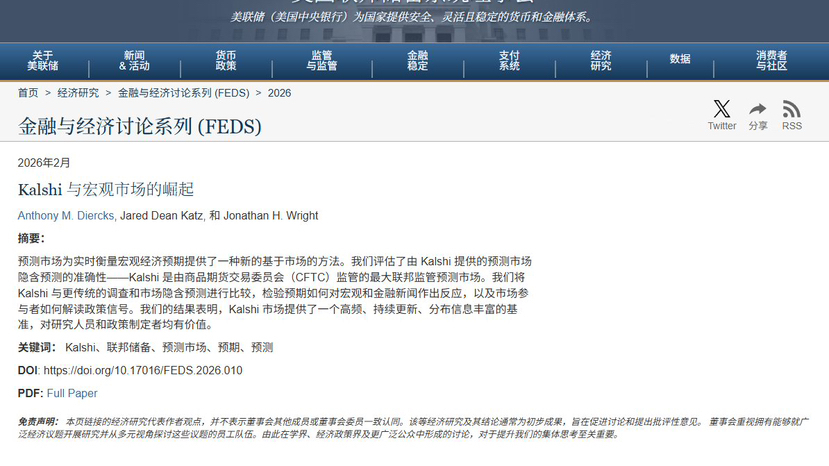

Yesterday, I noticed the CFTC talking about prediction markets, but I didn’t pay much attention, after all, the CFTC is the supervisory body for prediction markets. However, when I looked at the Federal Reserve's meeting minutes in the early morning, I suddenly saw comments from the Federal Reserve about Kalshi and prediction markets, which piqued my interest.
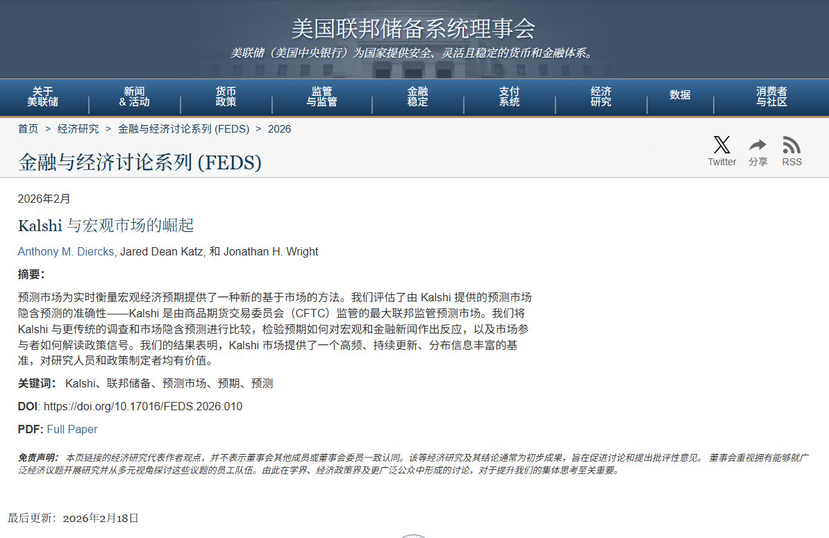
First, the Federal Reserve believes that prediction markets are becoming a new tool for measuring macro expectations, compressing participants' judgments into prices using real funds, and able to do so in high frequency, real-time, and continuously updated, which is very rare in traditional macro expectation frameworks.
More critically, the Federal Reserve emphasizes that the value of macro prediction markets like Kalshi lies not in having another point prediction, but in offering a distributional approach to predictions.
Users can not only know whether the market bets on CPI being 3.1% or 3.2%, but also see the probability weights for each segment, such as 3.0–3.1, 3.1–3.2, 3.2–3.3, and understand how tail risks are priced. For policymakers, distribution is more important than point estimates because the essence of policy is to manage the tail and uncertainty.
PS: This statement from the Federal Reserve is very important, even indicating that policymakers will look at the distribution in the prediction markets to determine tail risks.
Second, the Federal Reserve believes that one killer advantage of Kalshi is its ability to turn 'how expectations are rewritten by news' into observable intraday data.
The biggest issue with surveys is their low frequency; often, what is seen is merely the 'outcome from the last meeting,' while Kalshi allows users to directly see a statement from officials, how the market adjusts the probability of rate cuts for the next meeting, how an employment report re-prices the market, and even how expectations oscillate and ultimately converge within the same day.
This is very useful for understanding the transmission chain of 'communication—expectation—asset prices.'
Third, the Federal Reserve believes that Kalshi's prediction accuracy is not poor and can even match traditional tools on some dimensions, and is better on certain indicators.
Especially concerning predictions of the Federal Reserve's interest rate path, Kalshi's error performance is very close to that of professional forecasts, with little difference in errors for core CPI, unemployment rate, and consensus expectations from Bloomberg, while Kalshi's performance is even better for overall inflation predictions.
In plain language, the Federal Reserve believes that prediction markets are not sentiment-driven but are close to being a reliable macro expectation data source in terms of availability.
Fourth, the Federal Reserve emphasizes that Kalshi allows researchers and policymakers to systematically study how macro data affects the shape of the policy interest rate distribution for the first time.
For example, after inflation data is released, uncertainty (distribution variance) usually decreases, but the impacts of inflation's 'positive surprises' and 'negative surprises' on the mean interest rate are not symmetrical. Inflation exceeding expectations often pushes the mean interest rate higher, while a 'dovish benefit' from inflation falling short of expectations does not pull it back as symmetrically.
In plain language, this means the market is more sensitive to pricing 'bad inflation' and is more stingy in rewarding 'good inflation.'
At the same time, the Federal Reserve also reminds that prediction market prices represent risk-neutral probabilities, not purely real probabilities. Traders have risk preferences and risk premiums, and the participant structure tends to be retail-oriented, which may lead to systematic biases. Tail contract liquidity is relatively weak, and the probabilities of extreme outcomes may be outdated.
Thus, tools like Kalshi are more suitable as a window for real-time sentiment and risk pricing rather than as the sole truth.
Fifth, the Federal Reserve's positioning for Kalshi is to upgrade macro expectations from low-frequency point predictions to high-frequency distribution predictions.
By separating what the market believes and what it fears, the macro narrative will be closer to the true behavior of capital, rather than staying at the level of rhetoric and sentiment.
Overall, the significance of prediction markets is not to tell us whether something will happen, but to inform us of the probability the market is willing to pay for that event in real money, while for policymakers, the real challenge in determining policy often lies in that little bit of tail probability.