
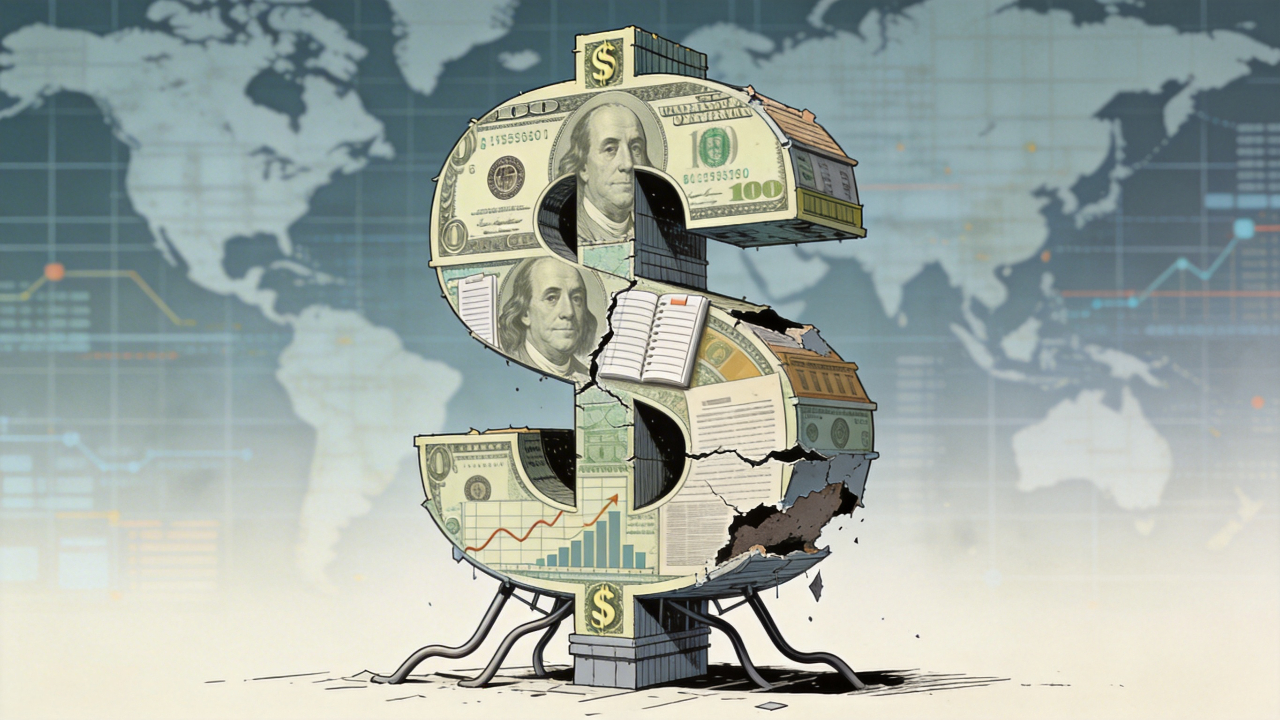
In the past decades, the voices proclaiming that 'the US dollar is finished' have intermittently surged into public discourse: from the resurgence of memories of Bretton Woods, to the ferment of global de-dollarization sentiment, and then to the psychological impact brought by fiscal deficits and inflation data. It seems that as long as there is another major crisis, the dollar will 'collapse overnight'. However, another equally true fact is: every time there is global liquidity tightening or a significant asset pullback, US Treasury bonds and dollar assets remain the first safe haven that global institutions rush back to. In other words, the dollar is not going to disappear tomorrow, but it is slowly sliding onto a track leading to systemic breakdown.
This apparent contradiction arises from two systems evolving simultaneously: one is the 'dollar' as a credit and purchasing power anchor, and the other is the 'U.S. financial system' as infrastructure and standards. The attractiveness of the former is gradually eroded by multiple pressures of credit, fiscal, and geopolitical factors; the latter continues to provide a global financial 'operating system' through the U.S. debt collateral system, clearing networks, derivatives markets, legal and accounting rules, and information standards.
More tension arises from the third clue: the next generation of financial infrastructure is likely to be built on blockchain, but currently, the only ones truly capable of institutionalizing the 'on-chain clearing layer' and integrating it with existing U.S. debt and regulatory frameworks remain primarily the U.S. Stablecoins, tokenized U.S. debt, and compliance frameworks like GENIUS are transforming 'on-chain dollars' into a new clearing layer, and this new track is also being incorporated into the U.S.-led infrastructure map.
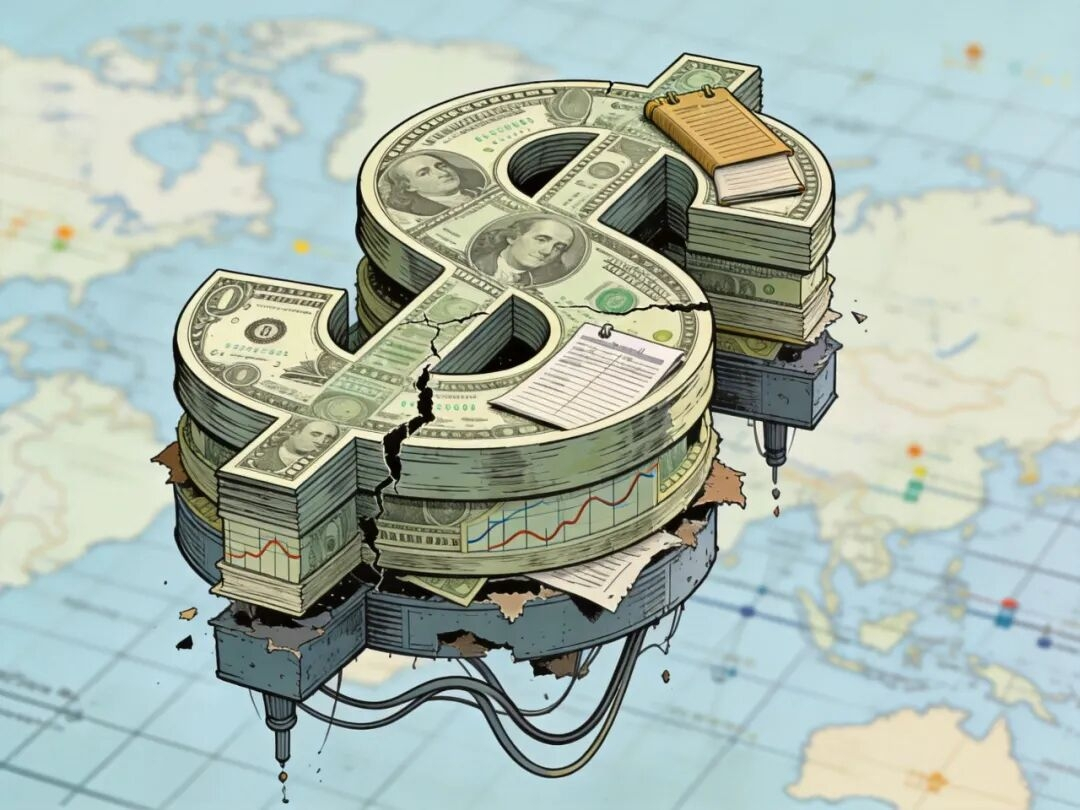
From Bretton Woods to petro-dollars: how the dollar rules have been rewritten round after round.
To understand why the 'gradually collapsing dollar' can hold on until today, and why every crisis ultimately ends with 'rule rewriting + infrastructure upgrades,' one needs to review a few key institutional inflection points of the dollar.
The first round is the Bretton Woods system. In 1944, the dollar was pegged to gold at $35 per ounce, and other major currencies were pegged to the dollar, making the dollar the 'only currency that could be exchanged for gold.' This arrangement is superficially an extension of the gold standard, but essentially outsourced the trust in gold to the U.S. Treasury and the Federal Reserve. When the U.S. faced deficits due to the Vietnam War and welfare spending, and gold reserves continued to flow out, the 'Triffin dilemma' began to take effect: to provide the world with enough dollars, the U.S. had to run trade deficits, and the larger the deficit, the more others doubted whether the gold in its possession was enough to cover it.
The 'Nixon Shock' of 1971 is regarded by many as the moment of the collapse of dollar credit, but it was actually a rewriting of rules: the U.S. unilaterally announced the closure of the gold window, and the dollar was completely detached from the metal anchor, ushering the human monetary system into the era of fiat currency. The old anchor disappeared, but it created space for the next round of anchoring.
The second round is the petro-dollar system. After the gold anchor fell, the U.S. quickly established a new anchor in energy. By reaching agreements with key oil-producing countries like Saudi Arabia, all oil exports are priced and settled in dollars, with surplus dollars flowing back to purchase U.S. debt. The result is that as long as the world needs oil, countries must hold dollars; the demand for dollars has shifted from 'domestic legal compulsion' to 'global energy necessity'; and the U.S. debt market has become a common reservoir for oil surpluses and global reserves.
The third round is financial globalization and capital account opening. In the floating exchange rate era, the U.S. promoted a dollar-centric system of capital free movement through the IMF, World Bank, and various trade finance arrangements. Countries, in order to defend against exchange rate and capital flow shocks, are forced to hold more dollars and U.S. debt on their balance sheets, thus forming the 'dollar trap': the more you want to get rid of the dollar, the more dollars you need to hold in the short term to stabilize your own financial system.
These three rounds of evolution connect to reveal a clear inertia: every time the old order reaches its limit, the U.S. reshapes the dollar system through rule rewriting + infrastructure upgrading. Today, the debate over 'on-chain dollars' and stablecoins is likely a prelude to the next round of rule rewriting.
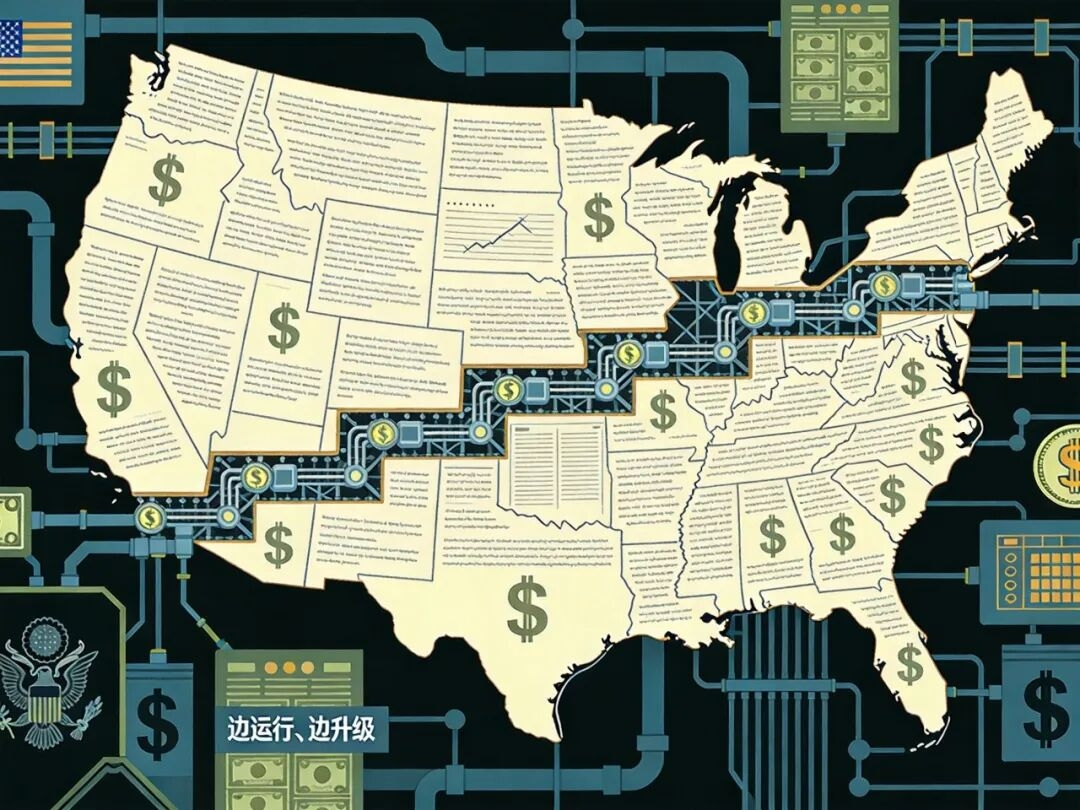
Clearly define 'collapse': a systemic break, not an apocalyptic narrative.
The 'collapse of the dollar' referred to in this article indicates a verifiable institutional state: when fiscal and geopolitical pressures continuously elevate the political/credit premium of dollar assets, the market reaches a concentrated reassessment of the consensus that 'dollars = optimal settlement and store of value combination,' and the network effects of the dollar in reserves, settlements, and pricing begin to be diverted by alternative tracks, leading to an accelerated decline at a certain stage.
Such breakages are usually not the endpoint of linear extrapolation, but rather a jump after the accumulation of 'fiscal fragility + credit dilution + external shocks.'
Why the dollar will inevitably head towards collapse: three lines of evidence regarding credit, fiscal, and geopolitical factors.
From a credit perspective, the most intuitive change is the dilution of reserve shares and the silent rewriting of the definition of 'safe assets.'
IMF's COFER (Composition of Official Foreign Exchange Reserves) provides the most intuitive measure: the dollar's share in global disclosed foreign exchange reserves has fallen from over 70% at the end of the 1990s to 57.74% in the first quarter of 2025; the same data also shows that the total amount of global foreign exchange reserves has risen to $12.54 trillion. This means that while the world still holds a massive amount of dollar assets, the preference for 'concentrated bets on the dollar' is marginally weakening.
More significant changes have occurred in the political attributes of 'safe assets.' After Russia's foreign exchange reserves were frozen in 2022, emerging markets began to view dollar assets as a portfolio with political risks, rather than as absolutely neutral public goods. According to the World Gold Council (WGC), global central banks are expected to net purchase 1,045 tons of gold in 2024, exceeding 1,000 tons for the third consecutive year. The act of purchasing gold is not the endpoint of de-dollarization, but it clearly reflects what central banks are doing: switching a portion of their reserves from 'dollar credit' to 'non-dollar credit assets.'
An easily overlooked detail: even if the dollar's share decreases, it does not mean an immediate collapse; it will also significantly change the behavior of 'marginal buyers.' Once marginal buyers become more dispersed, the stability of dollar credit will increasingly rely on the predictability of fiscal and geopolitical factors, rather than the historical inertia of being 'naturally risk-free.'
From the fiscal perspective, the debt curve and interest expenditures are pushing dollar credit towards an irreversible endpoint path. The CBO predicts in (The Budget and Economic Outlook: 2024 to 2034) that federal debt held by the public will rise from about 99% GDP at the end of 2024 to 116% GDP at the end of 2034; net interest expenditures will be about $1.6 trillion by 2034, continuing to rise over the longer term. Regarding deficits, the CBO predicts an annual deficit of about $2.6 trillion in 2034 (about 6.1% GDP).
When interest costs become a 'self-growing item' in the expenditure structure, monetary credit will be forced to choose one of three mechanisms:
Rising tax burden (political resistance is high)
Inflation/monetization (dilution of purchasing power)
Financial repression (regulatory and capital constraints, reducing financing costs in 'invisible ways')
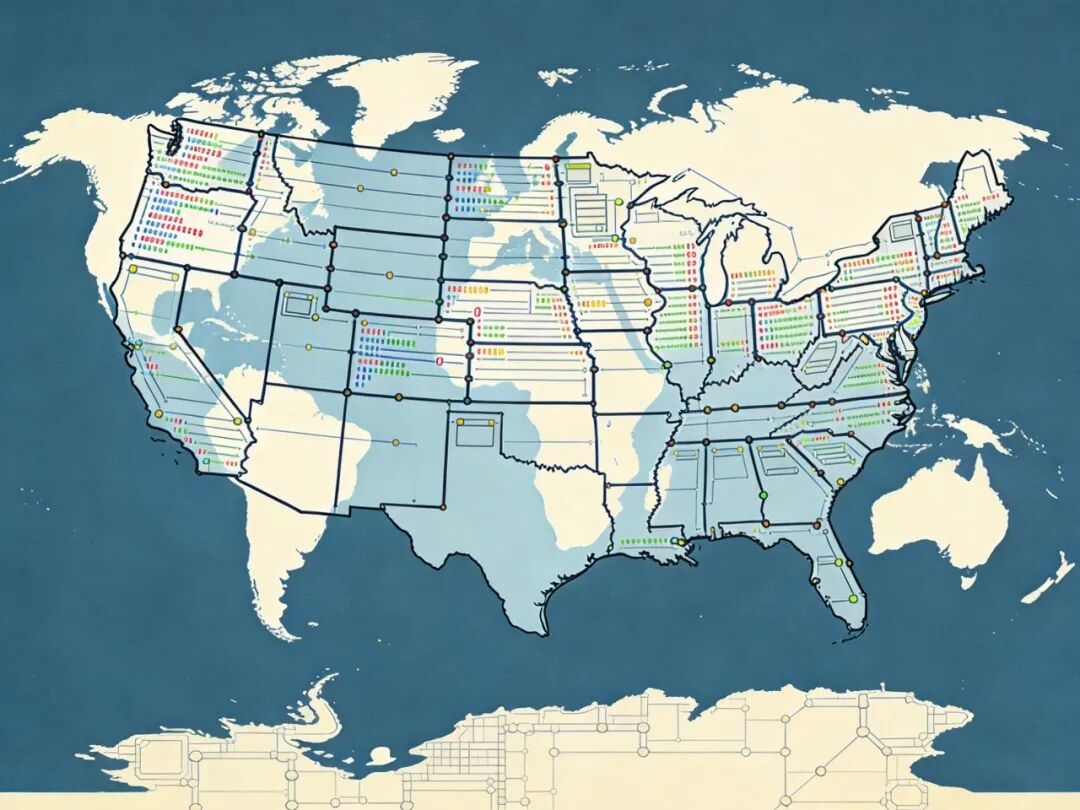
The three paths differ, but the outcome is the same: the dollar's purchasing power and credit premium are long-term diluted until the market makes a concentrated reassessment of the 'risk-free attribute' of dollar assets. In other words, if the fiscal trajectory does not reverse, the end of dollar credit is written into the budget constraints.
From a geopolitical perspective, the weaponization of finance is driving system fragmentation, allowing alternative tracks to move from 'slogans' to real 'road building.' One of the past advantages of the dollar system was 'global public goods': you didn't have to like the U.S. to use the dollar. Financial sanctions and asset freezes have changed this premise: holding dollar assets has begun to carry a political risk premium, and the motivation for de-dollarization has shifted from ideology to strategic survival.
This will push global payments and clearings towards 'parallel tracks.' On one side is the global network effect of SWIFT/CHIPS, and on the other side are the technical experiments and regional expansions of alternatives like CIPS and mBridge. Even if alternatives struggle to shake the deep liquidity of the dollar in the short term, 'system fragmentation' itself will amplify the probability of nonlinear jumps in extreme scenarios.
Why it won't collapse overnight: network effects and 'the $12 trillion reserve inertia.'
Understanding 'inevitable collapse' as 'rapid collapse' is not rigorous. The scale of foreign exchange reserves corresponding to COFER is in the range of $12 trillion, and such a massive position cannot be instantly migrated without causing severe global asset price fluctuations. The network effect of the dollar also means that as long as trade, debt, and derivatives are still largely priced in dollars, the practical function of the dollar will coexist with its relative volatility of credit.
Therefore, what this article emphasizes is not an 'immediate collapse,' but 'the endpoint is inevitable + the path is slow + the inflection point is nonlinear.'
When does collapse occur: provide a more verifiable time window.
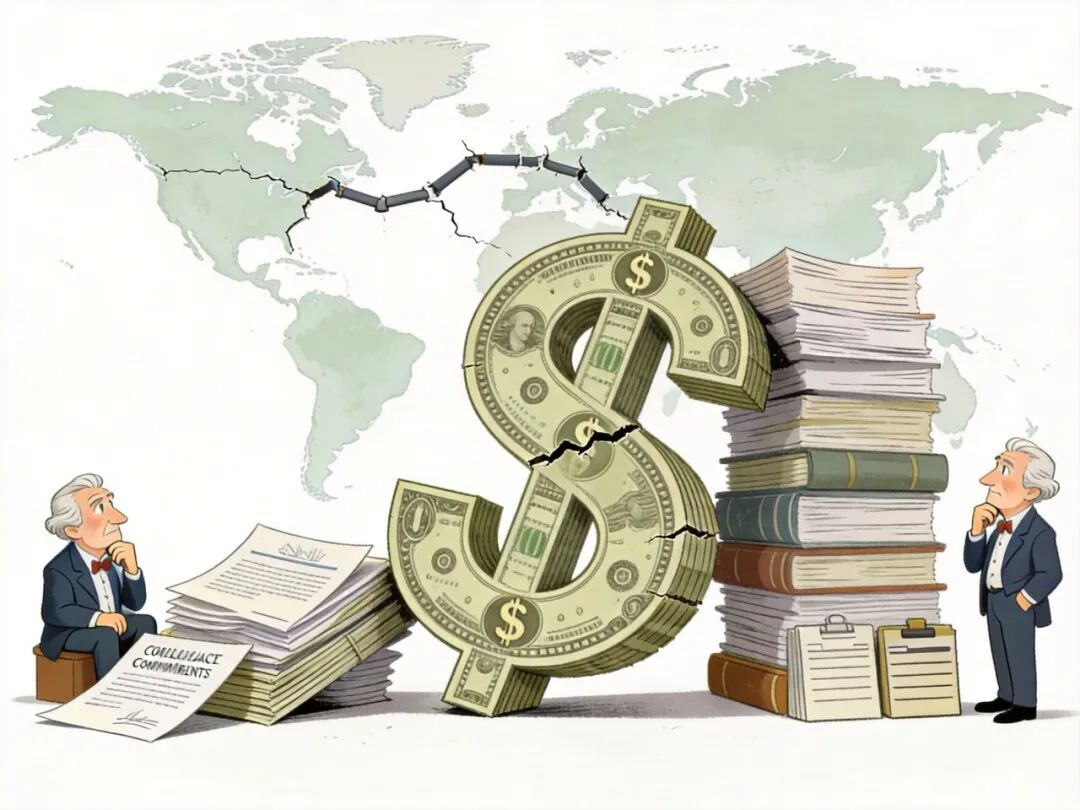
'Collapse' is usually a jump rather than a linear extrapolation. Combining the CBO fiscal curve with the COFER share trend, a more testable judgment is:
Baseline scenario: 2036-2045 is a high-risk window (debt/GDP and interest expenditures enter a sensitive range in the late 2030s, more likely to trigger credit reassessment).
Advance scenario: If a combination of 'high interest rates for longer + major geopolitical conflicts + liquidity events in U.S. debt/dollar funding markets' occurs in 2030-2035, the break may happen earlier.
Delayed scenario: If structural fiscal rebalancing occurs after 2045 and significantly reverses the debt curve, the break time can be postponed, but the cost is growth and political costs.
To make the predictions verifiable, here is a set of more specific 'trigger conditions' (the more satisfied, the closer to the break window):
The COFER dollar share is rapidly falling and approaching the psychological threshold of 50%.
U.S. net interest expenditures continue to rise, and fiscal space is being consumed by interest.
The political risk premium of dollar assets has significantly increased (central bank gold purchases and the accelerated expansion of non-dollar settlement corridors).
Alternative clearing tracks achieve scale in 'non-regional scenarios' (from experiments to standards).
Why the financial center is still in the U.S.: the five pillars of infrastructure hegemony.
Equating 'dollar credit' with 'U.S. financial center' is a significant misunderstanding. The financial center is more like an operating system: determined by collateral, clearing, liquidity, laws, and standards.
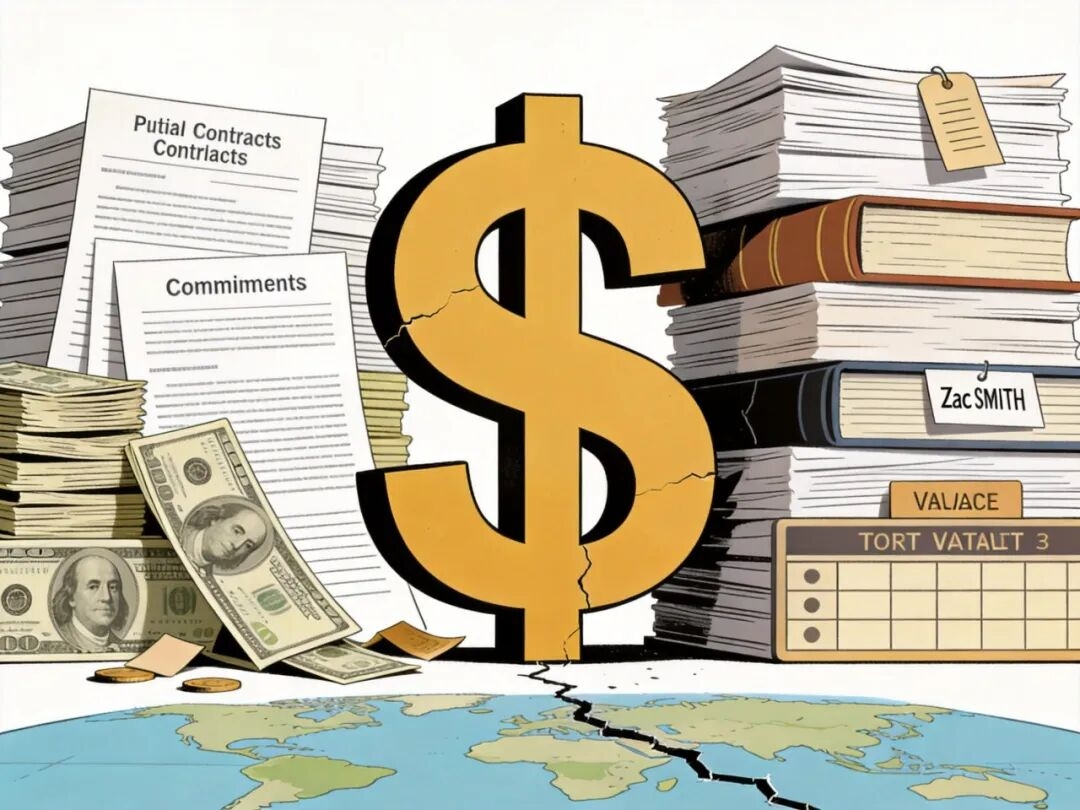
The first pillar is U.S. debt, the 'king of global collateral,' and the repurchase market behind it, which is the liquidity engine of the entire system. OFR's estimates of the U.S. repurchase market show that in the third quarter of 2025, the daily average exposure of the U.S. repurchase market was about $12.6 trillion. Global credit expansion is largely built on a structure of 'U.S. debt as collateral.' As long as U.S. debt remains the most common, deepest, and easiest collateral for risk management, the U.S. still holds the base for liquidity.
The second pillar is that the clearing total valve is still in the hands of the U.S. balance sheet; CHIPS not only has a huge scale but is also extremely 'liquidity-efficient.' CHIPS is the world's largest private net dollar settlement system, with public data and industry research commonly citing its average daily processing of about $1.9 trillion; about 95% of CHIPS payments correspond to dollar flows in cross-border funds. The information layer can be diverse (SWIFT, CIPS, etc.), but as long as final settlement still relies on the dollar clearing layer, the U.S. retains the 'total valve' of global liquidity. More importantly, efficiency: The Clearing House disclosed that CHIPS' liquidity efficiency reached 29:1 in 2024, meaning that each dollar of funds supports $29 in settlement value; its liquidity-saving algorithm brought about an economic saving of approximately $5.14 billion in 2024. Infrastructure hegemony is not only about 'scale' but also about 'cost structure': whoever can save global banks more liquidity is harder to replace.
The third pillar is that the network effect of the dollar in the payment system remains strong, as can be seen from SWIFT's data. SWIFT's disclosed payment share shows that in July 2025, the dollar accounted for approximately 47.94% of global payments; if intra-Eurozone payments are excluded, the dollar's share in international payments is about 59.59%. This means that even if reserve shares decline, the network effect of the dollar in settlement remains strong, and alternatives need to rebuild the combination of 'liquidity + clearing efficiency + legal expectations' simultaneously.
The fourth pillar is Wall Street's liquidity and derivatives pricing power; it remains the default center for global risk management. The ecosystem of derivatives such as bonds, foreign exchange, swaps, options, and CDS requires high capital density and a mature legal framework. New York is not only a trading venue but also the default center for global risk pricing and hedging. Liquidity has a self-reinforcing nature: the places with the highest liquidity attract capital, which in turn reinforces liquidity.
The fifth pillar is the 'soft infrastructure' formed by laws, accounting, custody, and information standards. The legal jurisdiction of New York, USGAAP disclosure logic, bankruptcy isolation, and custody systems, as well as data languages for indices and ratings, form the common grammar for global institutional decision-making. What capital fears most is not volatility, but uncertain rules.
Why alternative paths are difficult: it's not a lack of slogans, but a lack of 'operating systems.'
Alternatives do exist, but the bottleneck is at the structural level:
CIPS still relies heavily on SWIFT messages. Public data and research often cite that about 80% of CIPS transactions are still completed through SWIFT messages. The system can grow, but if the information and standards layers still depend on the existing network, achieving a complete alternative will be difficult.
mBridge is growing rapidly but remains highly concentrated. Public reports show that mBridge's cumulative trading volume is approximately $55.49 billion as of November 2025, of which over 95% is e-CNY. This indicates that alternative tracks can quickly gain volume in specific corridors, but to become a global standard, they still need to overcome the thresholds of 'sovereign mutual trust + asset depth + legal expectations.'
Why the next generation of financial infrastructure is more likely to be on blockchain, and still in the U.S.
A key reversal has occurred: dollar credit is weakening, yet the U.S. is accelerating the transfer of 'infrastructure hegemony' to blockchain.

Firstly, stablecoins are modularizing dollar clearing, giving rise to a new track at the payment layer. Market data and research reports show that by 2025, the stablecoin market size has entered a range of approximately $280 billion to $310 billion, with dollar stablecoins accounting for the absolute majority of the stablecoin market. Institutions like Artemis also show that as of August 2025, the annualized running rate of stablecoin payments is about $122 billion, with B2B being the largest sector (annualized at about $76 billion under different measures; earlier measures also indicate levels around $36 billion). These data do not mean that stablecoins have replaced banks, but indicate that a new track closer to the 'settlement layer' is forming, rather than just serving as tools for transporting speculative assets.
Secondly, the key is not the technology itself but how regulation assimilates it— The GENIUS Act essentially ties on-chain dollars back to U.S. debt. Web searches can verify: The GENIUS Act was signed into law on July 18, 2025, establishing a federal framework for payment stablecoins, requiring issuers to maintain sufficient, qualified reserve assets (cash, short-term U.S. debt, repurchase/reverse repurchase supported by U.S. debt, etc.), and granting holders priority in claims on reserve assets in bankruptcy. In other words: every compliant on-chain dollar is institutionally bound as a 'distributor of U.S. debt demand.' This is the key mechanism for 'infrastructure hegemony continuation': the weaker dollar credit is, the more the U.S. needs to create marginal demand for U.S. debt; stablecoins provide a more globalized, programmable method of demand distribution.
Thirdly, RWA and tokenized U.S. debt are moving the collateral itself onto the chain, completing the layer of on-chain collateral. When stablecoins become the cash layer on-chain, tokenized U.S. debt and RWA represent the on-chain collateral layer. Once both the collateral and cash layers are on-chain, blockchain will no longer just be a technical tool but will become part of the financial infrastructure. The U.S.'s advantage is that it has the king of collateral (U.S. debt) and can bind on-chain dollars to U.S. debt through rules.
Conclusion: The dollar will eventually collapse, but the U.S. remains the financial center.

If the U.S. fiscal trajectory does not undergo a structural reversal, the era of the dollar as a singular credit anchor will ultimately end, and a more concentrated, institutional credit reassessment will occur in the late 2030s to mid-2040s. Meanwhile, the affiliation of the financial center depends on collateral, clearing, liquidity, and the network of rules. The U.S.'s advantage is shifting from 'dollar credit' to 'the digital extension of dollar infrastructure': as more settlements are completed on-chain, but on-chain dollars are still locked to U.S. debt and U.S. legal frameworks, the U.S. may still be the center of the next generation of financial infrastructure.
Three observable signals (for self-verification)
Is the dollar's share in COFER accelerating towards and falling below 50%?
Are compliant stablecoin reserves further concentrated in short-term U.S. debt, and gaining higher-tier central bank channels?
Is the proportion of tokenized U.S. debt in the repurchase/collateral system significantly increasing?
Once the three occur simultaneously, the end of dollar credit and the continuation of U.S. infrastructure hegemony will become a reality closer to the same moment.
So a very important question is, if the collapse of the dollar is inevitable, who will replace the dollar?