
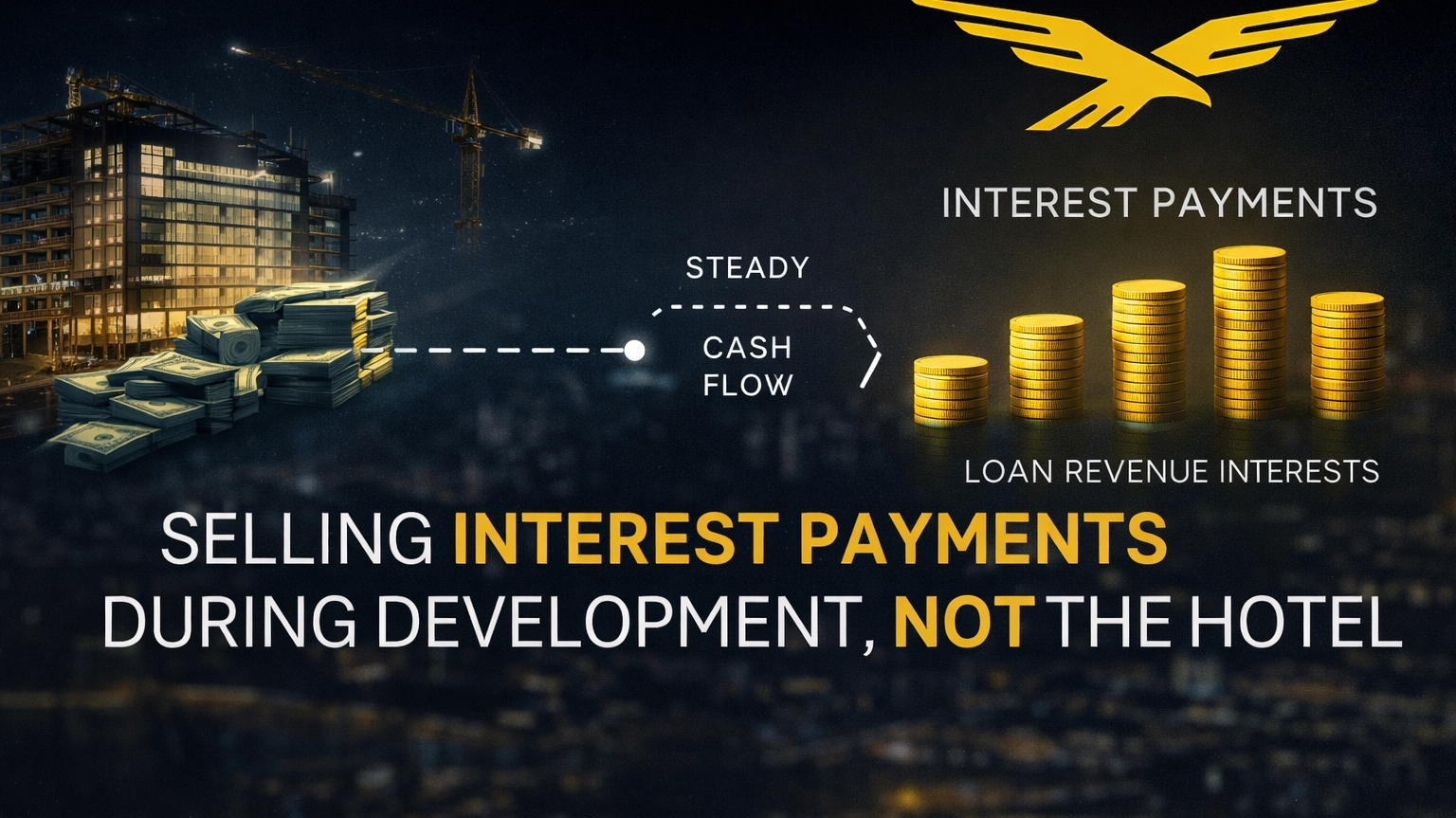
When I came across this message last night, the comments section was all about sea view rooms, hotel shares, and house prices. I was a bit confused because the official statement was very straightforward, selling the loan income rights.
Not real estate.
Not property rights.
Not a REIT.
It's during the hotel construction period, the cash flow generated from that development loan interest is just that simple.
You can understand it this way: the project first borrows money to build the hotel → the borrower pays interest according to the contract → this part of the interest is separated out → it becomes a segment of income rights that can be held.
What you got is not a room card, but a position in the interest.
Many people overlook a point: why choose interest during the development period instead of profits after the hotel opens? Because it triggers fewer variables.
Interest is written in the contract, with amounts, periods, and sequences all arranged in advance.
Not relying on occupancy rates.
Not relying on peak tourist seasons.
Not relying on operational capability.
As long as there is no default, the cash flow will follow the schedule. This is much clearer than whether the future hotel can make money.
Speaking of the issuance method, this deal goes through Reg D and Reg S, which clearly means it is not open to everyone, there will be qualification validation, and there will be transfer restrictions. So don't think of it as a hotel token that retail investors can buy; it is more like a traditional financial income structure that has been tokenized.
What I genuinely care about are only three things:
How should the order of interest distribution be arranged?
What should we do if the project is delayed or defaults?
How exactly should the exit mechanism be designed?
These three things are a hundred times more important than the yield because when RWA reaches the end, it's not about the story, but whether the cash flow can be trusted.
This deal is actually testing a very critical thing: whether we can break down the time value in a long-cycle project into a segment that can be held and understood as income. If this structure works, there will be more than just one hotel on the chain in the future. Any project with stable financing and interest structure can theoretically be replicated.
But to be honest, the long cycle means liquidity will not be very high, and regulatory and political discussions will continue; these are all realities.
What I'm more concerned about is the next step: if in the future this type of income settles in USD1, distributes, and can even be used as collateral within compliance,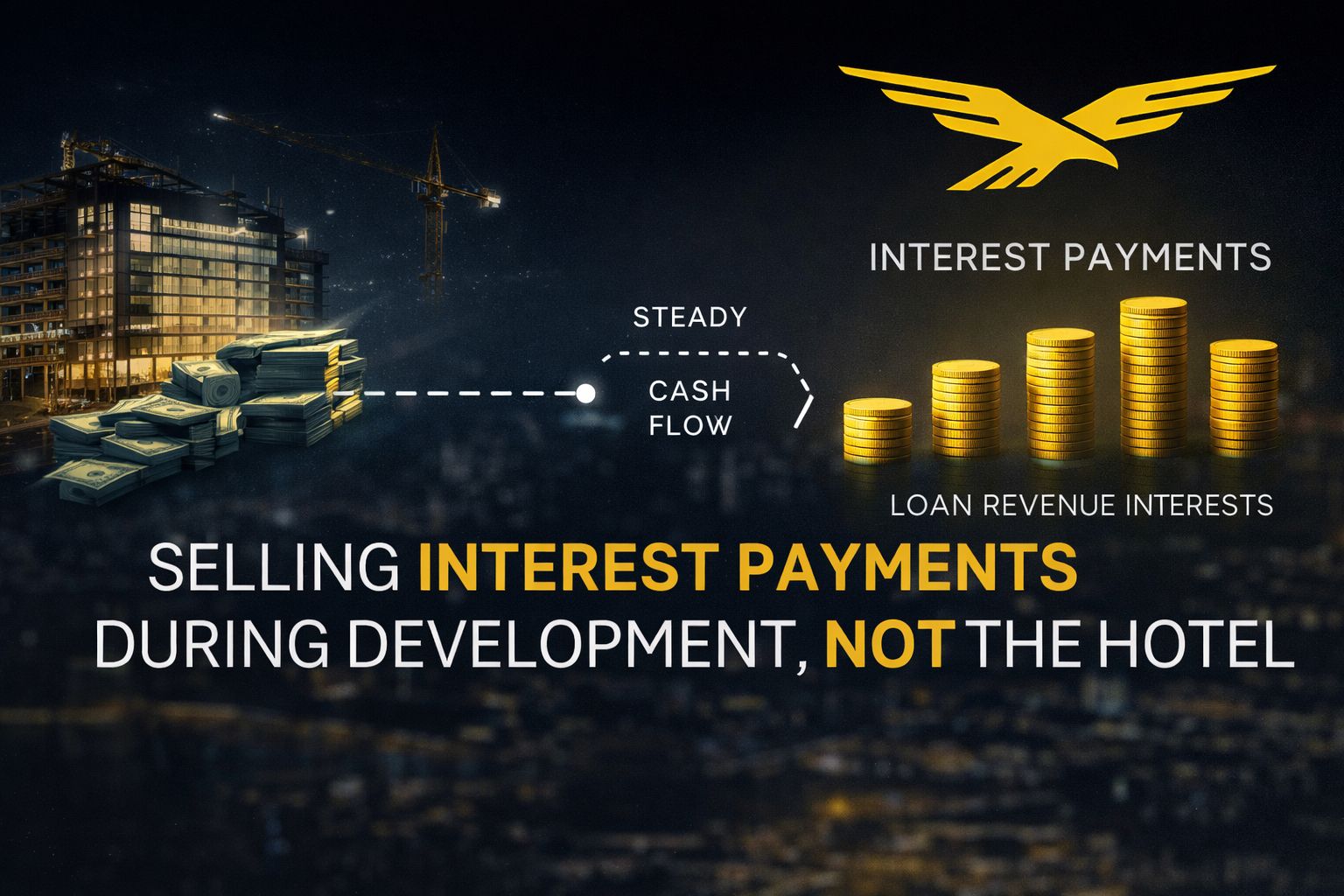 then the entire chain can be considered truly closed-loop. Financing → Interest → Distribution → Re-entering the chain to form a cycle.
I really want to hear everyone's true thoughts. If you are part of the WLFI team, what should be prioritized to clarify right now? The exit mechanism? Or the order of defaults and cash flow? Personally, I would like to see the latter first because what truly builds trust is always how risks are handled.
@worldlibertyfi #WLFI #USD1 #WorldLibertyFinancial #Remittance