
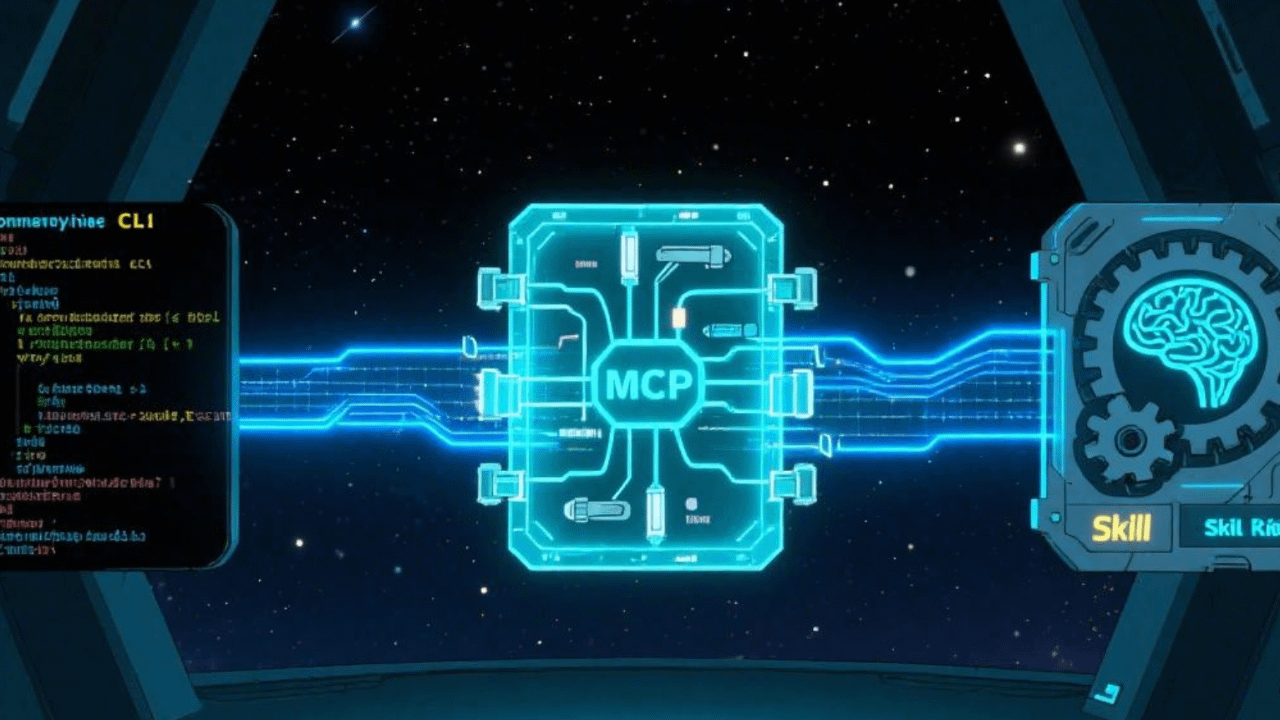
CLI, MCP and Skill represent three different levels and dimensions of capability building modules, which together form the core framework of agent perception, decision-making, and execution.
1. CLI: The classical and powerful 'hand' - the foundational execution layer
Function: Command Line Interface. It is the most basic tool for humans or agents to directly communicate with the operating system and execute low-level instructions (such as manipulating files, launching programs, and managing processes).
Role in the Agent era:
Automation scripts: Agents can break down complex tasks into a series of CLI commands, automatically executing repetitive operational, deployment, and data processing tasks.
Infrastructure control: It is the 'wrench' for agents to manage servers, networks, and local environments. The 'public chain ecosystem has cheap maintenance' mentioned in the diagram can largely rely on well-packaged CLI toolchains for its underlying automation.
2. MCP: The 'standardized power strip' connecting everything - protocol and expansion layer
Function: Model context protocol. You can understand it as the 'USB-C standard' in the field of agents. It defines a set of unified protocols that allow any tool, data source, or service to 'tell' the agent in a standardized way: 'Here are my functions, and this is how you should call me.'
Role in the Agent era:
Breaking down silos: Agents do not need to adapt to each tool separately. As long as the tool supports MCP, the agent can discover and use it instantly. This directly addresses the pain point of 'Meituan not opening APIs' mentioned in the diagram - if mainstream services support MCP in the future, this artificial blockade will be partially resolved by technological protocols.
Dynamic expansion: The capabilities of agents are no longer limited to built-in functions. Through MCP, it can dynamically access real-time data, professional computing tools, or specific API services, with capability boundaries infinitely expanded.
3. Skill: Highly specialized 'Swiss Army Knife module' - advanced application layer
Function: Skill. This is a concept that is a higher level than 'tool invocation'. A Skill is a complete capability package encapsulated to accomplish complex tasks in specific fields, integrating planning, reasoning, tool invocation (possibly via CLI or MCP), and multiple steps.
Role in the Agent era:
Specialized problem solving: For example, 'On-chain data analysis Skill' or 'Smart contract auditing Skill'. It's not just about calling a data interface, but knowing how to break down problems, which tools to use, how to interpret results, and generate reports.
Composable and evolutionary: Skills can be combined like Lego and can also evolve through experience. It is key to the embodiment of 'intelligence' and value for agents, and it is a core asset that can be traded or licensed directly in the future 'agent economy'.
The collaborative relationship of the three and future prospects
CLI is fundamental: Ensuring that agents have 'hands-on ability' even in the most primitive environments is the foundation for execution and automation.
MCP is the connector: It provides agents with a standardized way to expand without permission, allowing them to connect to an open, decentralized network of tools and services. This is precisely the technical prerequisite for building a resilient, interoperable agent ecosystem.
Skill is the value carrier: When agents gain unlimited connectivity through MCP, their true competitiveness is reflected in the Skills they possess or can invoke. A Skill that can proficiently execute DeFi strategy operations, or a Skill that can coordinate cross-chain transactions, will generate direct economic value in the 'cryptocurrency agent economy'.
In summary:
In the traditional internet, Apps are central; in the future centered on agents, CLI is its hand, MCP is its neural network connecting the world, and Skill is the specialized craft upon which it relies to make a living and create value. This architecture allows agents to break free from dependence on a single platform, enabling them to collaborate, create, and participate in the economic cycle in a new world made up of protocols and decentralized networks.