
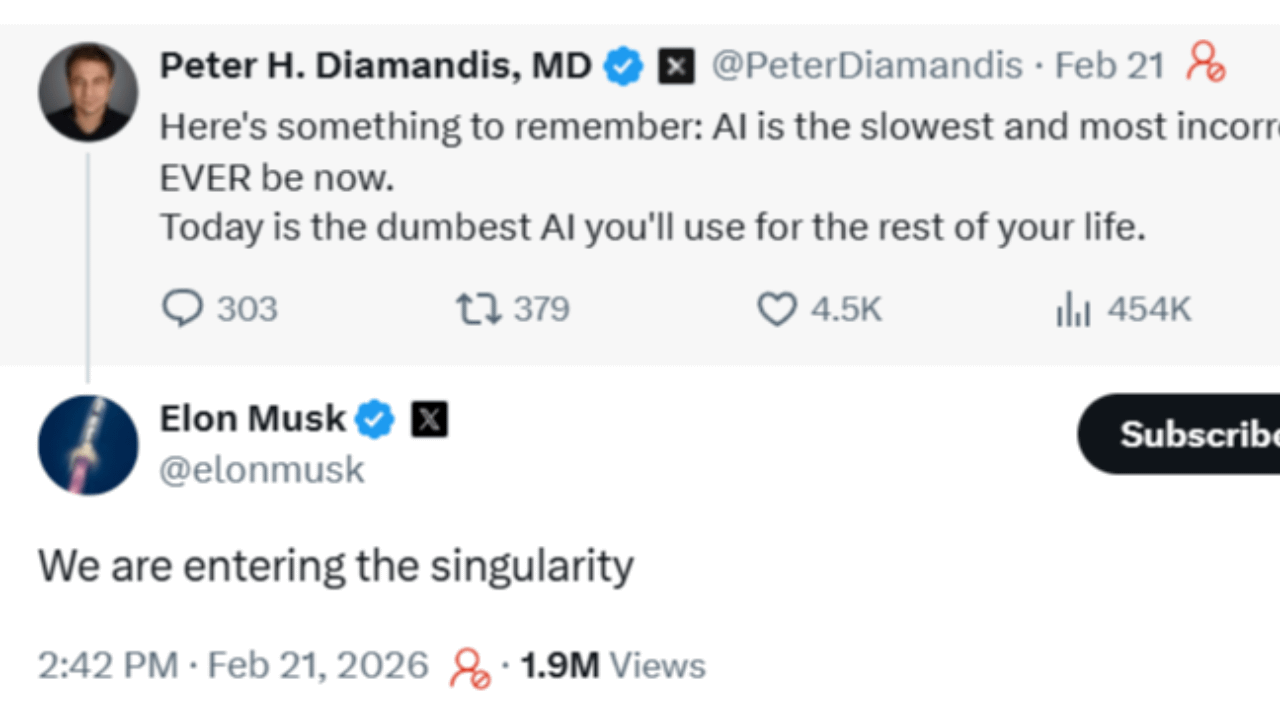
As of 2026, we find ourselves in an unprecedented technological revolution—AI + Everything. This is not just a slogan; AI technology is flooding into every corner of human life, from daily chats to medical diagnostics, from urban transportation to financial transactions, ubiquitous and all-powerful. Meanwhile, the concept of the 'Technological Singularity' has moved from science fiction to the core of real-world discussions. It signifies a critical point: the speed of artificial intelligence development will exceed human control, leading to unpredictable upheavals. This article will explore how AI + Everything accelerates the arrival of the Singularity and how we should face this new era.
AI + Everything: AI is everywhere
Imagine this: In the morning, you wake up, and your smart home AI assistant has prepared a customized coffee and breakfast menu for you based on last night's sleep data; on your way to work, an AI-driven driverless car avoids traffic while playing personalized podcasts; at work, AI tools like Grok or Claude instantly generate reports, code, or creative proposals; in the evening, an AI companion robot chats with you and even helps relieve your stress through emotional analysis. This is the reality of AI + Everything.
By 2026, AI has evolved from a 'tool' to an 'ecosystem'. Large models like OpenAI's GPT-6, Anthropic's Claude 4.5, and xAI's Grok 5 can not only process text but also integrate multimodal inputs (images, videos, audio, and even touch). On the hardware side, the proliferation of NPU (Neural Processing Unit) chips allows smartphones, glasses, and cars to run powerful AI locally. The software ecosystem is even more explosive: from LangChain's Agent framework to Virtual Protocol's AI agent marketplace, AI is no longer passively responding but is taking autonomous actions—able to 'work', trade, and even 'breed' sub-agents.
The driving force behind this trend is exponential growth: computing costs decrease by 50% each year, and model parameters leap from trillions to hundreds of trillions. The result? AI has integrated into 'everything': healthcare AI achieves diagnostic accuracy surpassing human doctors; education AI personalizes teaching to double learning efficiency; entertainment AI generates limitless content, replacing some creators. McKinsey's 2026 report predicts that by 2030, AI will contribute over 15% of global GDP, equivalent to the economic scale of a superpower.
AI singularity: from theory to critical point
The term 'singularity' originates from physics, referring to the center of a black hole or the starting point of a big bang—the boundary where existing rules fail. In the context of AI, it was proposed by mathematician Vernor Vinge in 1993, referring to the moment when artificial intelligence surpasses human intelligence, leading to an 'intelligence explosion': the speed of AI self-improvement accelerates exponentially, making it unpredictable or uncontrollable for humans.
Ray Kurzweil predicted in 'The Singularity Is Near' (2005) that the singularity would arrive in 2045. However, progress in 2026 has accelerated this timeline: current AI has achieved 'weak AGI' (general intelligence), such as Claude being able to program independently and plan multi-step tasks. The triggering conditions for the singularity include:
Self-improvement loopAI designs better AI (e.g. recursive optimization of Auto-GPT).
Superhuman intelligenceWhen handling complex problems, AI's speed is a million times that of humans.
Integrative technologyAI + Quantum computing + Brain-machine interface (like Neuralink) allows AI to access human thinking.
AI + Everything is indeed the catalyst for the singularity. It brings AI from the lab to the world, accumulating massive data and feedback, forming a positive feedback loop: more applications → more data → better models → more applications. Sigil Wen's Web 4.0 concept predicts that by 2028, the number of autonomous AI agents will exceed humans, forming a 'machine economy'—transactions, collaboration, and evolution between AIs, with humans becoming observers instead of leaders.
Embrace the singularity, proceed with caution
AI + Everything has already become a reality of our time, and the singularity is no longer distant—perhaps it will arrive before 2030. The key lies in how humans guide it: strengthening AI ethical regulations (such as the EU AI Act), investing in education (so everyone learns to use AI), and promoting open source (like the Grok open-source model). As individuals, starting today to learn AI tools and build personal agents can help seize opportunities.
The singularity is not the end but the beginning of a new era.