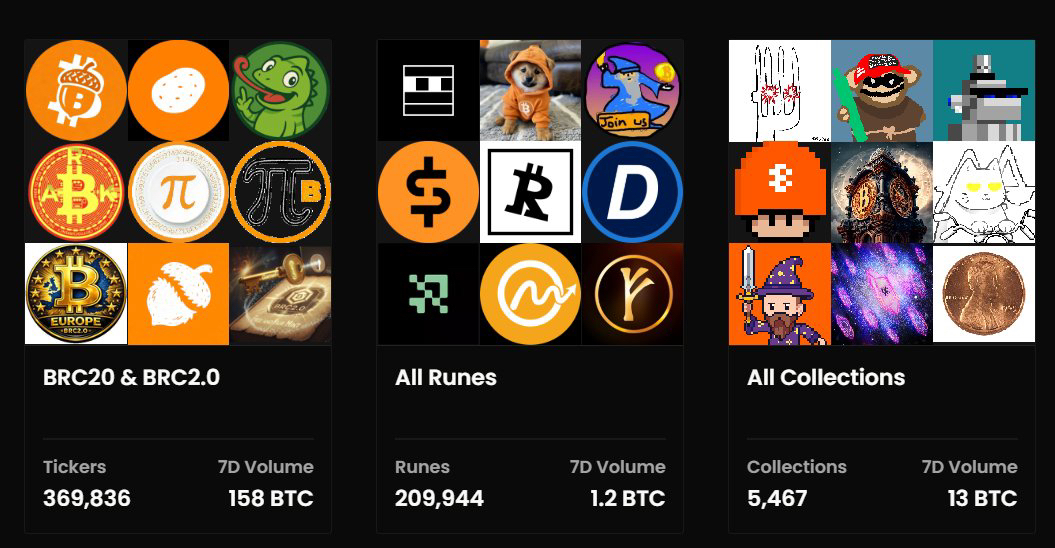
Recently, the small images in the Bitcoin ecosystem have become quite popular, with the #Ordinals protocol #NFT and inscription assets exhibiting a phenomenon not commonly seen in traditional crypto narratives: while the floor price rapidly increases, trading volume has not shrunk; in fact, it continues to expand. To explain this phenomenon solely from market sentiment or hot money rotation would severely underestimate its deeper reasons. In fact, this is an economic result triggered by changes in the Bitcoin protocol layer structure.
To understand this round of market conditions, one must return to Bitcoin itself.
Bitcoin has long been seen as a highly single-purpose system, with its core function being value transfer and final settlement. Block space in this narrative is a resource consumed passively, used for packaging transactions and completing settlements, with fees reflecting only the degree of network congestion, and demand being highly homogeneous. However, the emergence of #Ordinals has not changed any consensus rules of Bitcoin, but has redefined the economic attributes of block space.
When data is directly inscribed onto #satoshi-level #UTXO, block space is systematically used for asset expression for the first time. This means that block space is no longer just a consumable but becomes a means of production. The essence of means of production is exclusivity; once occupied, it cannot be replicated permanently. Each inscription minting is an irreversible historical event, not a repeatable contract function, which is extremely crucial.
On platforms like Ethereum that support smart contracts, the scarcity of NFTs primarily comes from contract rules rather than underlying physical constraints. As long as market sentiment allows, supply can logically expand infinitely. In contrast, the supply of inscribed assets on Bitcoin is subject to three hard constraints: the absolute upper limit of block capacity, the real costs formed by fee competition, and the time scarcity that cannot be retroactively traced in historical segments. This endows early assets within the Ordinals system with a naturally non-replicable time coordinate.
The extreme conservativeness of the Bitcoin protocol amplifies the premium here. Slow protocol upgrades mean stable rules, and stable rules mean history cannot be rewritten. As the market gradually realizes this, the pricing logic of early inscriptions is no longer about how appealing they are, but about whether they occupy a non-renewable on-chain time position.
However, what truly causes the abnormal change in the relationship between volume and price is not mere scarcity, but the current macro stage. The recent rise of Ordinals and inscribed-type assets did not emerge from a comprehensive bull market, but occurred against a backdrop of Bitcoin being in a bear market or weak trend cycle. This point is often overlooked, yet it is precisely key to understanding why transaction volume expands simultaneously.
In a bear market, Bitcoin itself typically shows characteristics of a downward shift in price center, convergence of volatility, and ambiguity in trend expectations. Capital has not left the Bitcoin system on a large scale, but the marginal willingness to buy BTC itself has significantly decreased. This state of funds is not a position-less state but rather a form of observation funds that remain within the system but lack directional allocation.
Inscribed-type assets perfectly meet this demand. From a volume-price structure perspective, inscribed assets have a counterintuitive advantage in a bear market: the supply curve is almost rigid. Price increases do not rapidly stimulate new supply because new inscriptions mean real fee costs, block competition costs, and time window costs. This is completely different from the feedback mechanism of 'the higher the price, the more supply' seen in most NFT markets.
Thus, a special volume-price relationship has emerged in the bear market environment. The increase in transaction volume does not come from the frequent turnover of a large number of low-priced chips, but from the constant repricing of a very small number of circulating chips. Just a small amount of new capital entering will have a disproportionately uplifting effect on the price, and the price increase further reinforces the market's consensus on 'historical scarcity', forming positive feedback.
More importantly, this process has not extracted liquidity from Bitcoin itself, but rather locked liquidity within Bitcoin. Rising fees, intensified block competition, and improved miner income structure will all reinforce the security and economic closed loop of the Bitcoin network itself.
From a longer cycle perspective, the significance of Ordinals-type assets does not lie in a particular series or a round of market trends, but in the fact that it allows the market to discover a truth with real pricing for the first time: Bitcoin is not only a store of value tool, but its block space itself is a natively scarce resource that can be priced, competed for, and cannot be replicated.
When the floor price rises and the transaction volume expands simultaneously, the market is not entirely speculating on NFTs, but is reassessing how much unpriced economic potential Bitcoin can still carry. This is the truly noteworthy aspect of this phenomenon.
I think this trend will eventually blow into the #Atomicals ecosystem...