

The market is engulfed in extreme fear sentiment
Bitcoin $BTC continues to face selling pressure as the cryptocurrency market falls into a state described as “extreme fear” - the highest level of fear in recent months. The world's largest cryptocurrency dropped to 62,700 USD this morning (Vietnam time), before slightly recovering to around 63,220 USD.

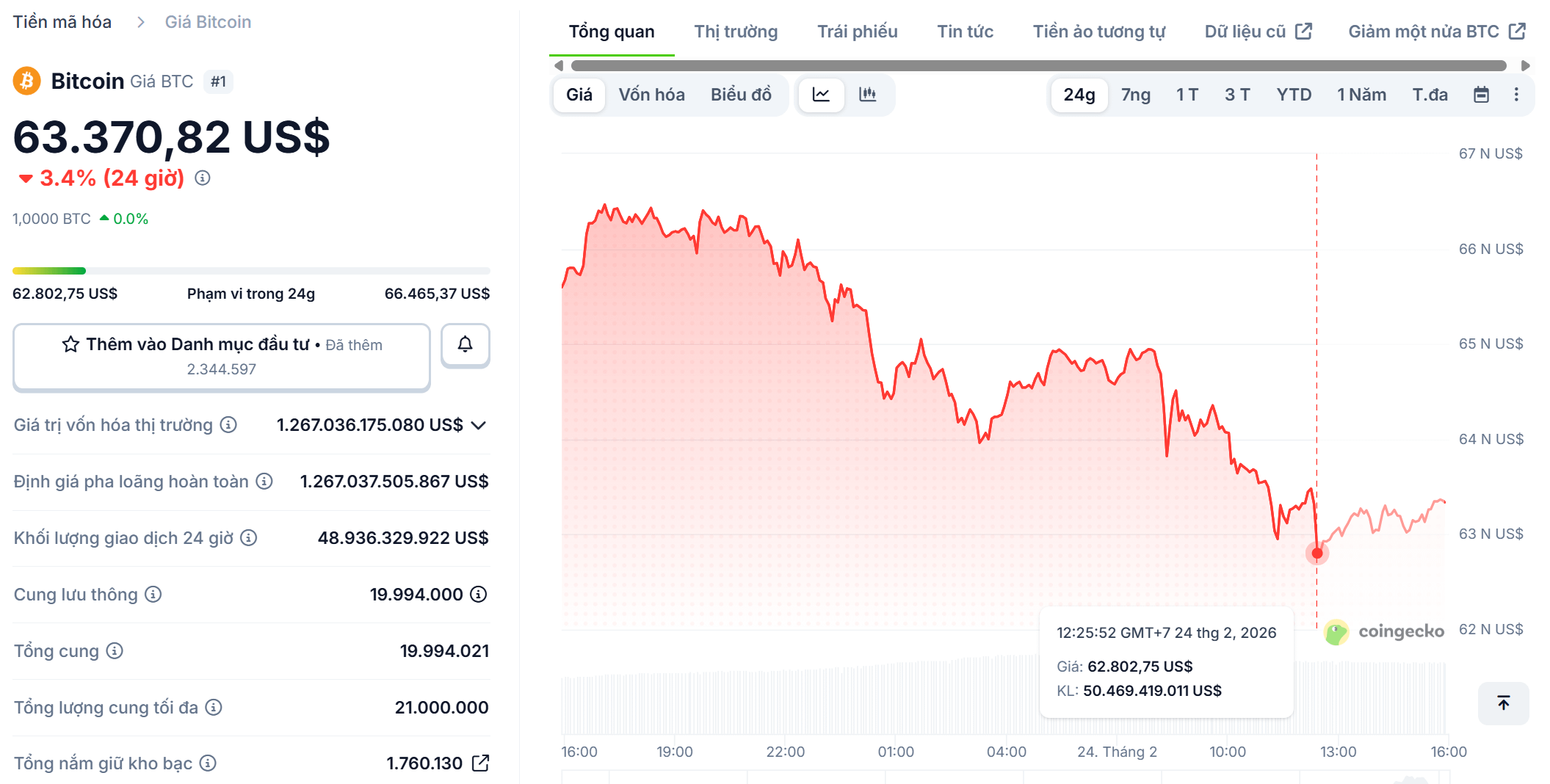
In the last 24 hours, Bitcoin has lost more than 3%, leading to a widespread adjustment wave affecting major altcoins. Ethereum $ETH decreased by 2.5% to 1,828 USD. XRP fell by 1.5% to 1.33 USD, while Solana $SOL lost 2.3% to around 76.8 USD. The total market capitalization of the crypto market has decreased to around 2.25 trillion USD, equivalent to a decline of over 3.4%.
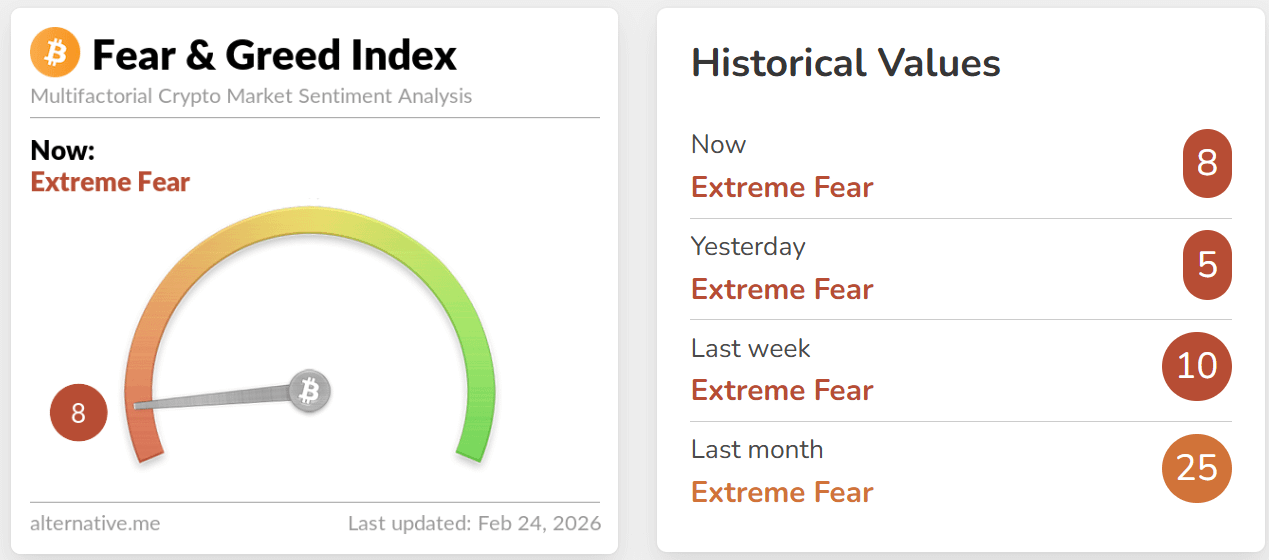
The Fear & Greed Index currently stands at 8, one of the most pessimistic levels ever recorded in the cryptocurrency market's history. This is a psychological zone that often appears when investors shift to a highly defensive state.
Not only macro: Crypto is weaker than traditional assets
According to Min Jung, an expert at Presto Research, the current decline does not stem from a single event but reflects an overall weakening of market sentiment.
Macroeconomic headlines related to tariffs, geopolitical instability, and global economic concerns are reinforcing the 'risk-off' trend. However, it is noteworthy that crypto has recently dropped more sharply compared to many traditional risk assets.
This divergence indicates that the causes do not entirely stem from external factors. Thin liquidity, weakening marginal demand, and the deleveraging process within the crypto market are playing a crucial role.
The wave of capital withdrawal from ETFs has not stopped
Another factor putting pressure on prices is the outflow of funds from cryptocurrency ETF funds in the U.S. Spot Bitcoin ETFs have recorded five consecutive weeks of net outflows, the longest streak since March 2025.
On Monday alone, Bitcoin ETF funds lost an additional 203 million USD, while Ethereum ETFs recorded 50 million USD in net outflows. With institutional capital yet to return, the market lacks the momentum to support prices amid weakening liquidity.
Reducing leverage or comprehensive capitulation?
Despite widespread selling pressure, some experts believe that the current market is primarily a process of 'flush-out' of leverage rather than a comprehensive capitulation. Andri Fauzan Adziima, Head of Research at Bitrue, points out that:
Hundreds of millions of USD in long positions have been liquidated.
The funding rate remains negative.
Open interest has decreased sharply.
Futures contracts exhibit price deviation in a bearish direction.
However, on-chain data has not shown a large-scale sell-off wave from the long-term holder group. In fact, some large wallets are still quietly accumulating amidst short-term investors being forced to exit positions.
This implies that the market may be undergoing a phase of leverage cleansing instead of immediately entering an expanded bear cycle.
The 60,000-63,000 USD zone: The death zone
According to technical analysis, the area of 60,000-63,000 USD is regarded as an important support zone for Bitcoin in the current cycle. If this level holds, a negative funding rate may create conditions for a short squeeze after the liquidation process ends.
Conversely, if the price breaks below 60,000 USD, a negative scenario may unfold: Bitcoin could slide to the 50,000 USD range, potentially even down to 47,000 USD if macro conditions worsen and forced liquidations increase.
At that time, the pressure could extend to the long-term holder group, creating a real capitulation before the market finds a new cycle bottom.
What should investors monitor?
During this sensitive period, the factors to closely monitor include:
Whether ETF capital will reverse
Fluctuations in funding rate and open interest
Developments in monetary policy and tariffs
Global market sentiment
History shows that periods of 'extreme fear' often occur near mid-term bottoms, but the exact timing of a reversal always depends on liquidity and the macroeconomic context.
At this moment, Bitcoin has not shown signs of comprehensive capitulation. However, the market is on a fragile edge where a new shock could push prices into a more negative scenario.