
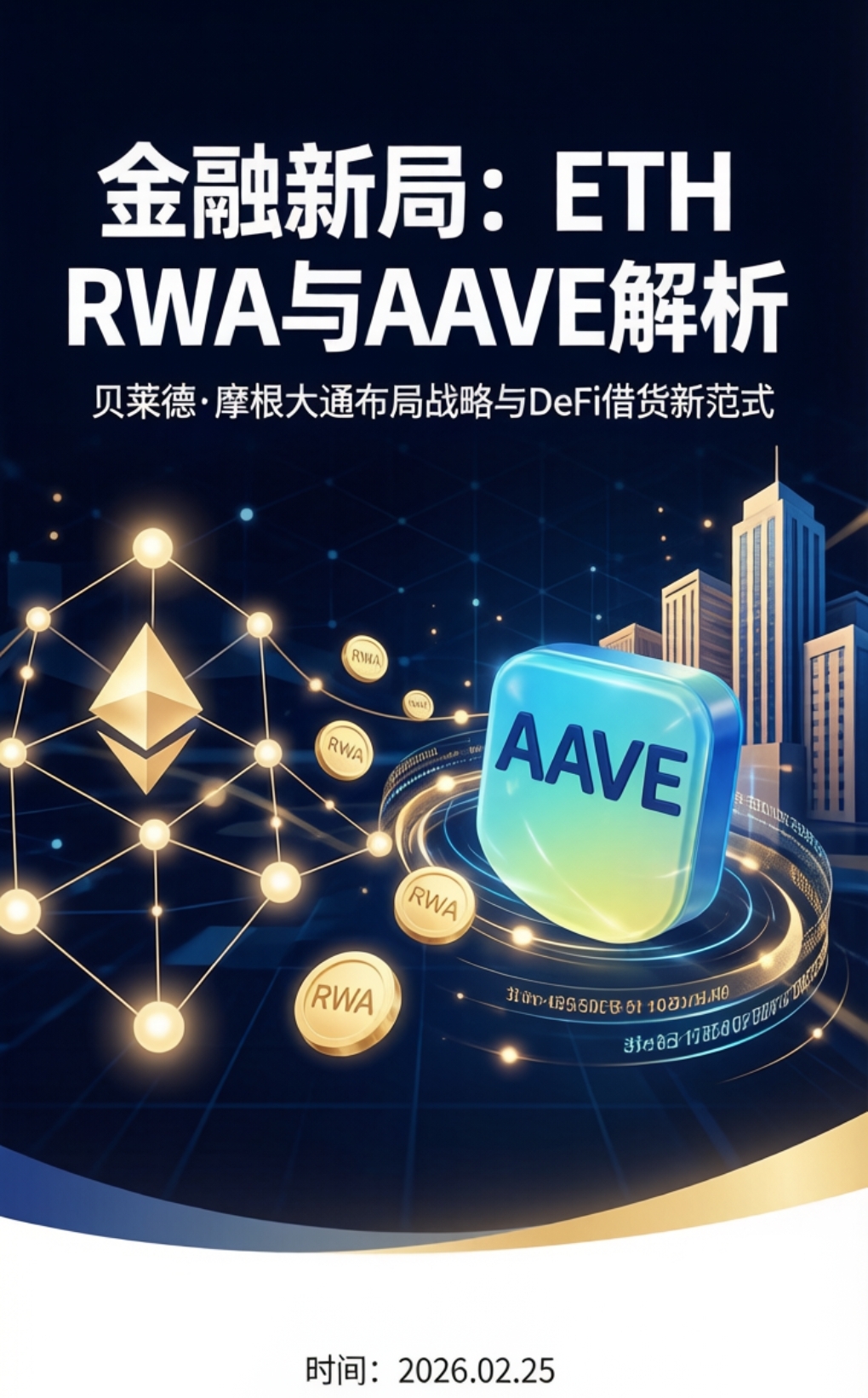
With the rise of the tokenization wave of real-world assets (RWA), traditional financial giants BlackRock and JPMorgan are actively leveraging the Ethereum (ETH) public chain to lay out their RWA business. This article aims to explore the core motivations behind the two institutions' layout of ETH RWA and to analyze in-depth the strategic positioning and growth potential of the decentralized lending protocol AAVE in the RWA wave. The research finds that BlackRock and JPMorgan seek asset digitization and efficiency improvement through RWA, while AAVE has achieved a leap from crypto-native lending to the global credit layer by introducing RWA collateral, with its potential lying in bridging the gap between traditional financial assets and on-chain liquidity.
#ETH #RWA #AAVE #defi
I. Introduction: RWA - The intersection of traditional finance and DeFi
Tokenization of real-world assets (RWA) refers to the process of converting assets from the physical world or traditional financial systems (such as government bonds, real estate, credit) into digital tokens through blockchain technology. This trend is becoming a key bridge connecting traditional finance (TradFi) with decentralized finance (DeFi). The deep involvement of the world's largest asset management company, BlackRock, and financial giant JPMorgan marks RWA's transition from the proof-of-concept stage to mainstream financial practice. Meanwhile, as a leading DeFi lending protocol, AAVE is building an on-chain credit market that connects trillion-level traditional assets by introducing RWA collateral.
II. Strategic motivations behind BlackRock and JPMorgan's layout of ETH RWA
(I) BlackRock: Building a new infrastructure for on-chain asset management
BlackRock's layout of RWA is mainly reflected in its launched tokenized fund BUIDL (BlackRock USD Institutional Digital Liquidity Fund). This fund is issued on public chains like Ethereum, aiming to combine the stable returns of traditional finance with the efficiency of blockchain.
Revolution in efficiency and transparency: The settlement cycle of traditional financial assets (such as government bonds) is long and cumbersome. By issuing BUIDL on the Ethereum public chain, BlackRock has achieved 24/7 trading and near real-time settlement of assets, significantly reducing operational costs. At the same time, the transparency of blockchain makes asset flows and yield distributions clearer, enhancing investor confidence.
Seizing the entry to digital assets: BlackRock positions itself as a provider of on-chain U.S. dollar liquidity through products like BUIDL. This is not only a digital supplement to its traditional asset management business but also aims to occupy a central hub position in the future digital asset ecosystem, extending the credit endorsement of traditional finance into the crypto world.
(II) JPMorgan: Exploring institutional-level blockchain applications
JPMorgan has long explored the blockchain space, and its Onyx digital asset network has processed hundreds of billions of dollars in short-term asset transactions. The core logic behind JPMorgan's layout of RWA is:
Reshaping financial infrastructure: JPMorgan believes that blockchain technology can reshape the operational model of financial markets. By tokenizing assets, complex clearing and settlement processes can be simplified, enabling instant transfer and division of assets, thereby enhancing capital efficiency.
Compliance and regulatory synergy: As a strictly regulated financial institution, JPMorgan's exploration in the RWA field is closely aligned with compliance frameworks. It achieves asset tokenization through permissioned blockchain networks (such as Onyx), meeting regulatory requirements while innovating technology, providing a replicable path for other traditional financial institutions.
(III) Why choose Ethereum (ETH)?
Although BlackRock and JPMorgan have also explored other public chains (such as Aptos and Solana), Ethereum remains the core territory of their RWA layout. The reasons are:
Security: Ethereum has the largest decentralized node network and the highest security budget, making security the top consideration for hosting institutional assets worth billions of dollars.
Ecosystem maturity: Ethereum has the most comprehensive DeFi ecosystem, including leading protocols like AAVE and MakerDAO, providing rich application scenarios for the circulation, lending, and yield generation of RWA assets.
III. Deep binding of AAVE and RWA: From lending protocols to the global credit layer
As the absolute leader of DeFi lending protocols, AAVE's combination with RWA is not accidental but an inevitable choice in its strategic development. By introducing RWA, AAVE addresses the bottlenecks of the DeFi native lending model and opens up a trillion-level incremental market.
(I) AAVE and BlackRock's collaboration: The anchoring of stablecoin GHO
The direct connection between AAVE and BlackRock is reflected in the stability mechanism of its stablecoin GHO. AAVE Labs has proposed to use BlackRock's BUIDL fund shares to stabilize the value of its native stablecoin GHO.
Mechanism design: The proposal suggests that users can deposit USDC to exchange for BUIDL shares and mint GHO. BUIDL, as the underlying asset, maintains a stable value of 1 USD and pays interest monthly. This design aims to link GHO with real-world income-generating assets (U.S. Treasury bonds) to enhance its stability and attractiveness.
Strategic significance: This collaboration means that AAVE is no longer solely reliant on crypto-native assets but is beginning to integrate the credit assets of traditional financial giants. Through BUIDL, AAVE has gained low-risk, high-liquidity underlying support, providing a solid credit foundation for its stablecoin business.
(II) Analysis of the potential of the AAVE RWA market
In AAVE's outlook for 2026, it clearly states that it will advance around the V4 version, RWA, and mobile App on three fronts. Among them, the RWA lending market (Horizon) is its core growth engine.
Solving the capital efficiency bottleneck: Traditional DeFi lending relies on over-collateralization (such as collateralizing 150% of ETH to lend 100% of USDC), resulting in very low capital efficiency. RWA assets (such as tokenized government bonds) have low price volatility and stable value, allowing AAVE to set lower collateral rates (even close to 100%), thus releasing huge liquidity and attracting institutional funds.
Introducing real yields: The yields of crypto-native assets mainly come from speculation and leverage, while RWA assets (such as credit and government bonds) can generate real cash flow yields. By introducing RWA, AAVE has transformed its protocol from a 'funding playground' to a 'credit factory' connecting the real economy, providing users with a more sustainable source of income.
Breaking through the market size ceiling: The total market capitalization of the crypto market is about 2-3 trillion USD, while the scale of global traditional financial assets (bonds, credit, real estate) reaches hundreds of trillions of USD. By entering this vast market through RWA, AAVE's growth potential is no longer limited by the bull and bear cycles of the crypto market but is deeply bound to the global real economy.
IV. Conclusion: Financial paradigm reconstruction driven by RWA
The layout of ETH RWA by BlackRock and JPMorgan is a strategic positioning of traditional financial giants in the wave of digitization, aiming to use blockchain technology to improve efficiency, reduce costs, and expand new business boundaries. As a representative of DeFi, AAVE has successfully integrated the off-chain credit system into on-chain through deep integration with RWA, achieving a transformation from 'crypto pawnshop' to 'global credit layer.'
In the future, with the gradual improvement of the regulatory framework and the maturation of technological infrastructure, RWA is expected to become the main channel connecting TradFi and DeFi. AAVE, leveraging its leading position in the lending field and deep collaboration with giants like BlackRock, is likely to dominate the trillion-dollar blue ocean of RWA and become a core component of the next generation of financial infrastructure.
References:
[1] Aave Labs. (2025). Aave 2026 Outlook: Advancing around V4, RWA, and Aave App on three fronts.
[2] Yuanpu Law Firm. (2025). Deconstructing BlackRock's BUIDL token fund.
[3] Cryptoslate. (2024). Aave Labs announces plans to stabilize GHO using BlackRock's BUIDL.
[4] RWA Research Institute. (2025). BlackRock, the Federal Reserve, and others suddenly bet collectively on RWA.
[5] Yuntong Chain. (2025). RWA in-depth interpretation: RWA is 'taming' DeFi.


