
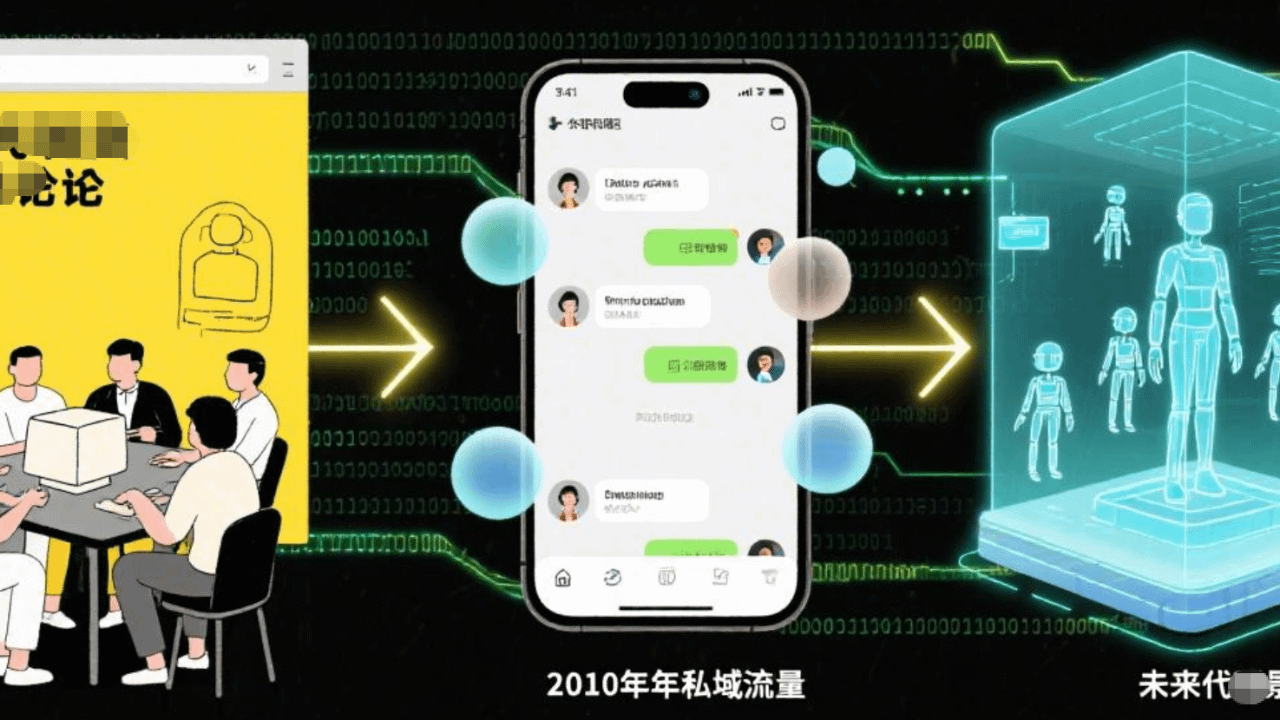
1. The Square Era: The Collective Echo of BBS
From the late 20th century to the early 21st century, the first generation of internet residents shared a common memory coordinate: BBS. It was a digital square connected by dial-up sounds, with a blinking cursor on a black screen resembling a public blackboard, where each line of text is a chalk mark.
In the "Lotus Seed Ghost Story" of Tianya Community, suspense stories are updated at midnight, and commenters hold their breath in anticipation; the "human flesh search" of Mop has yet to bear ethical controversies, still carrying the innocence of an internet detective game; the academic section of Shuimu Tsinghua sees students debating the solution to a math problem for days. Here, the ID is backed by a real personality, the moderator is an unelected community elder, and quality posts are like inscriptions on stone tablets, recording a collective thought of an era.
The essence of BBS lies in its 'plaza attribute'. Information is pinned to a public board like announcements, and everyone's attention is focused on the same place. Replies stack up layer by layer, forming a mille-feuille of thoughts—you may not remember who said it, but you will remember how that phrase 'Jia Junpeng, your mother is calling you home for dinner' swept the internet. This centralized discussion created an early internet 'collective memory'; although bandwidth was limited, attention was highly concentrated. When the 'building' reaches ten thousand floors, everyone involved feels they are part of a grand narrative.
However, the plaza's openness is also its limitation. Noise and signals coexist, and low-quality posts blend with the essence. As the number of users surges, the utopian quality of the early internet gradually dissipates, and people begin to yearn for more refined dialogue spaces—thus, the age of digital tribes quietly begins.
II. The Walled Garden: The Land Grab of Private Traffic
In the 2010s, smartphones reshaped the social landscape. WeChat notifications became the heartbeat of the nation, and the nine-grid format of Moments replaced the long posts of BBS. A phrase like 'Add me on WeChat' completed the migration from the public square to the private living room.
The essence of private traffic is 'land-grabbing'. Public accounts are personal exhibition halls for writers, fans are subscribing visitors; in WeChat groups, group owners are salon hosts, setting topics and managing order; in knowledge planets, payment is akin to buying a ticket to enter a more vertical dialogue space. Unlike traditional advertising's 'casting a wide net', private traffic seeks 'precise capture', achieving conversion based on trust. KOLs are no longer just content creators, but also owners of traffic pools, with follower numbers becoming measurable social capital.
This model changes the power structure of information distribution. Algorithms replace moderators, personalized recommendations replace public forums. The world you see is shaped by your click history, and the echo chamber effect quietly forms. In the BBS era, you would inadvertently stumble into unfamiliar sections and discover unexpected viewpoints; in the algorithmic era, you are gently wrapped in known preferences.
The business logic of private traffic has given birth to new professions: community operation, growth hacking, KOL agents. How to draw traffic from the public domain to the private domain, how to improve retention and conversion, and how to design fission mechanisms—behind these topics is the systematic toolization of interpersonal relationships. Friend lists are not just social maps, but also potential customer databases; chat records are not just emotional exchanges but also data sources for user profiling.
When the term 'traffic pool' shifts from industry jargon to a common vocabulary, a question arises: in the carefully cultivated private garden, do users genuinely enjoy the dialogue, or have they become the operated digital? This subtle unease lays the groundwork for the next evolution.
III. The Avatar Era: When AI Becomes Your Social Agent
Today, we stand at the threshold of the third evolution: the Agent era. If BBS is a plaza, and private domains are gardens, then the future will be a stage for 'avatars'—your digital agents will represent you, traversing, deciding, and interacting in different scenarios.
Imagine such a morning: your 'group purchase Agent' analyzes the purchasing data of three hundred households in the neighborhood at dawn, predicts today's fruit demand, negotiates directly with farms, and completes the group order before you wake up; the 'health Agent' synchronizes your health check data, fitness tracker information, and genetic testing report, making an appointment for badminton this weekend, with an opponent matched to your level and preferences; the 'travel Agent' generates three customized plans based on your holidays, budget, and recent interests, and negotiates with your friends' Agents to finalize a common travel schedule.
These are not science fiction scenarios. Models like GPT can already understand complex instructions, RPA (robotic process automation) can perform cross-platform operations, and smart contracts can ensure trustworthy transactions. When these technologies converge, everyone can have multiple 'avatars' to handle repetitive, time-consuming, or expertise-requiring social tasks.
This evolution will reconstruct the essence of social interaction. First, the liberation of the time dimension: your Agent can be online 24 hours a day, time zones no longer limit collaboration, and asynchronous socializing becomes the norm. Second, the expansion of the capability dimension: you do not need to be good at negotiation to get a discount, and you can receive health advice without understanding medicine; the Agent compensates for personal capability boundaries. Third, the reduction of social burdens: many relational and transactional interactions can be delegated to the Agent, allowing individuals to focus more on deep relationships and creative exchanges.
But shadows also exist. When Agents replace us in most social interactions, will real interpersonal contact decrease? When algorithms understand our preferences better, will the information cocoon thicken? When socializing turns into a game between Agents, will human emotions be enhanced or degraded? More importantly, if my shopping Agent, work Agent, and entertainment Agent are provided by different companies, will my complete personality data be fragmented and sold?
IV. The Reintegration of the Digital Self: Beyond Toolization
The three evolutions of social networks are essentially transformations in digital self-expression. In the BBS era, we shaped identities with text in public squares; in the private domain era, we used multimedia to construct personas in circles; in the Agent era, our behavior patterns and decision preferences will be encoded into the logic of avatars.
However, the real challenge is not technical, but philosophical: in the age of avatars, how do we maintain 'authenticity'? As Agents become better at mimicking our tone and predicting our choices, does the subject making the choices—ourselves—become blurred?
Perhaps the future direction is not to let Agents completely replace us, but to build 'augmented socializing'. Agents handle transactional work, while humans focus on emotional exchanges; Agents provide information and analysis, while humans make value judgments and engage in creative thinking; Agents expand our connectivity, while humans safeguard the depth and quality of relationships.
This requires new digital literacy: the ability to manage multiple Agents, an understanding of the transparency of algorithmic decisions, and the awareness to maintain a balance between virtual and real socializing. It also requires a new ethical framework: clarifying the agency permissions of Agents, protecting user data from misuse, and preventing new divides in society caused by disparities in Agent capabilities.
From the collective clamor of BBS to the low whispers of private traffic, and then to the silent collaboration of Agent avatars, the form of socializing is changing, but the core remains the same: the eternal human desire for connection, recognition, and collaboration. Technology is merely a medium; true evolution occurs in the hearts of those who use technology—when we learn to let tools expand rather than replace humanity, the next decade of digital socializing may simultaneously achieve the openness of the plaza, the delicacy of the garden, and the efficiency of avatars, without losing the warm and real touch.
In the upcoming Agent era, the best social design may not be to create the smartest avatar, but to let technology help humans become better conversationalists, truer friends, and more complete selves. After all, the ultimate value of any tool lies not in what it can replace us to do, but in what it helps us become.