

The market is bustling now. Models are upgrading, videos are going viral, robots are dancing, and everyone is talking about 'general intelligence.' But if you really want to make money in the AI cycle, one thing must be clear: most people are chasing the fireworks of the application layer, while the true determinants of wealth distribution are the underlying rules.
In the first stage, money is in computing power. Chips, servers, electricity, data centers—these are the most directly benefitted infrastructure logic, with quick performance realization and clear cash flow. In terms of stocks, prioritize looking at these 'shovel sellers' and traditional giants that can quickly complete their AI transformation, rather than the most dazzling startup companies on PPT. History has repeatedly proven that infrastructure always outlives stories.
In the second phase, money is in on-chain sentiment. The on-chain environment is the most genuine amplifier. Whether an AI concept can break through the circle does not depend on media articles, but on trading depth and capital curves. On-chain AI hotspots not only reflect sentiment but also drive technological diffusion. When capital concentrates on a certain direction on-chain, developers and users will follow the migration of liquidity. Sentiment itself is productivity.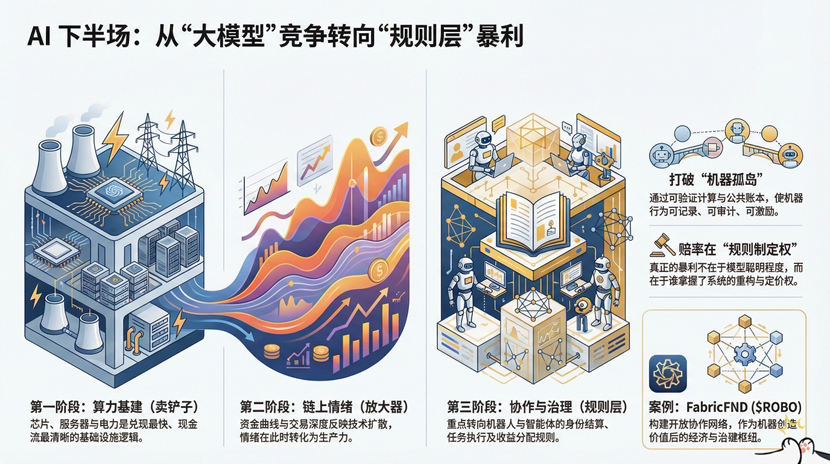
But what is truly worth betting on is the third phase—collaboration and governance. AI is leaving the screen and entering the real world. Robots can run, grasp, and execute tasks, but how do they settle? How do they allocate profits? How do they establish identity and trust? Without a unified coordination network, even the smartest machines are just islands.
This is also the reason I continue to pay attention.@Fabric Foundation It attempts to build a collaborative network of open robots and agents, making machine behavior recordable, auditable, and incentivized through verifiable computation and public ledgers.$ROBO In this context, it's not about speculative symbols, but rather the nexus of economy and governance. When machines begin to create value, there must be rules to allocate that value. Whoever controls the rules holds the leverage for the future.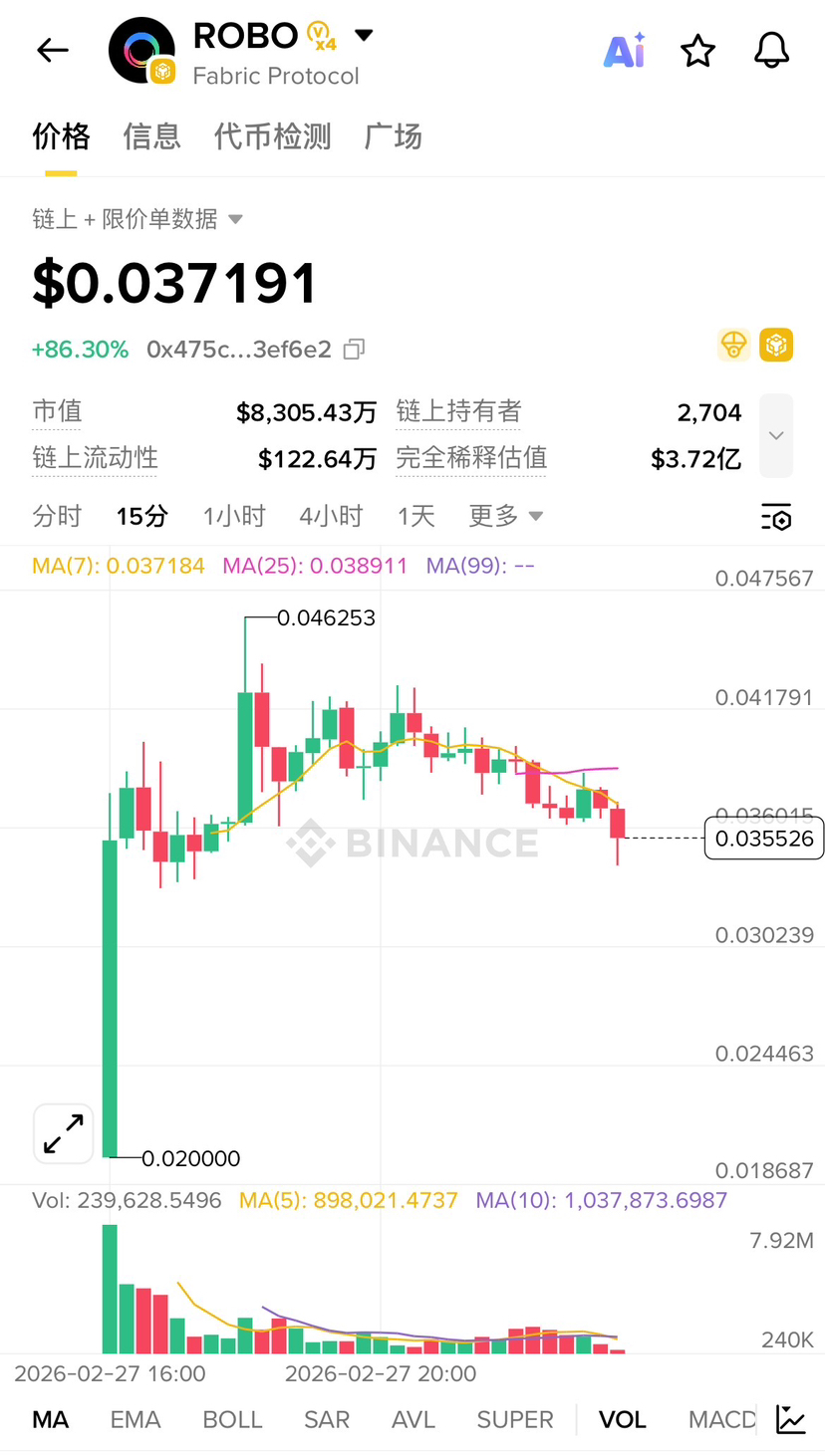
Of course, don't overlook reality. The real influx of funds and performance improvements brought by AI will support the secondary market, but the overall market is still constrained by a four-year cycle, and the long-term selling pressure and liquidity exhaustion issues of altcoins have not disappeared. Don't go all in on exponential assets too early; structural opportunities are more important than blind rushing forward.
This round of AI is not a model arms race, but a system reconstruction. The real odds do not lie in 'who is smarter,' but in 'who sets the rules.' While the market is still discussing popular applications, the underlying networks are quietly being priced.