
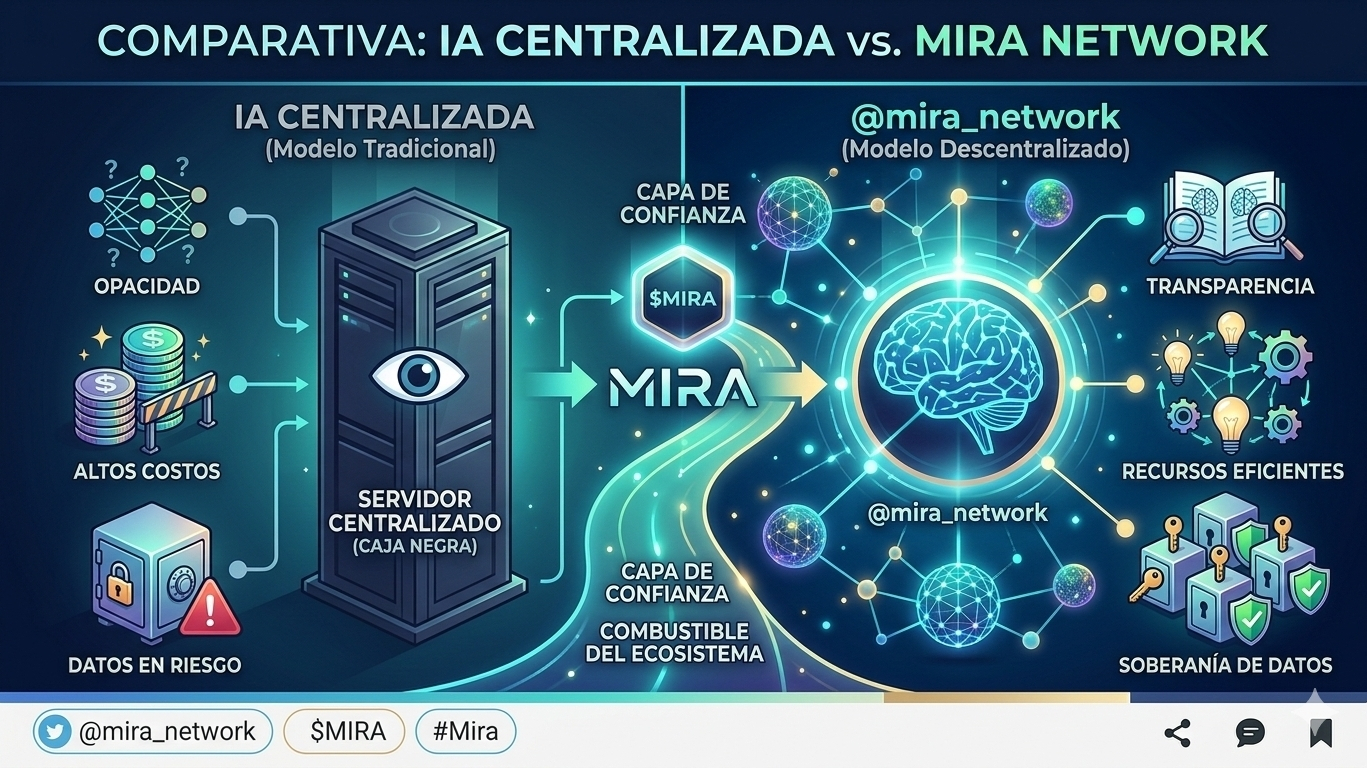
In the race for dominance in Artificial Intelligence, we find ourselves at a crossroads. On one hand, we have centralized models (C-AI) that depend on giant and opaque servers; on the other, emerges as the Web3 alternative that seeks to democratize access to this technology.
The 3 major differences:
Privacy vs. Surveillance: In traditional models, your data is the product. In the decentralized architecture, it allows processing information without a single entity having total control. Data fragmentation ensures that your privacy is the priority.
Cost and Accessibility: Maintaining AI models in private clouds is extremely costly. Mira optimizes resources through a network of nodes incentivized by the token $MIRA which reduces the entry barriers for independent developers and small businesses that want to innovate without million-dollar budgets.
Verifiability vs. "Black Box": When you use a centralized AI, you don't know how an answer was reached. Mira introduces the Trust Layer, where answers are validated by consensus in the network. If the result is verified by multiple nodes, trust in the system is absolute.
The fundamental role of $MIRA
The token $MIRA is what makes this comparison in favor of decentralization possible. It acts as the incentive for nodes to keep the network honest, fast, and secure. By choosing @Mira - Trust Layer of AI , you are not just choosing technology; you are choosing an ecosystem where value returns to those who create and maintain it.
Do you prefer a fast but opaque AI, or a verifiable and fair AI like Mira?
The AI of the future will not be locked in a corporate office; it will be free, verifiable, and decentralized.