
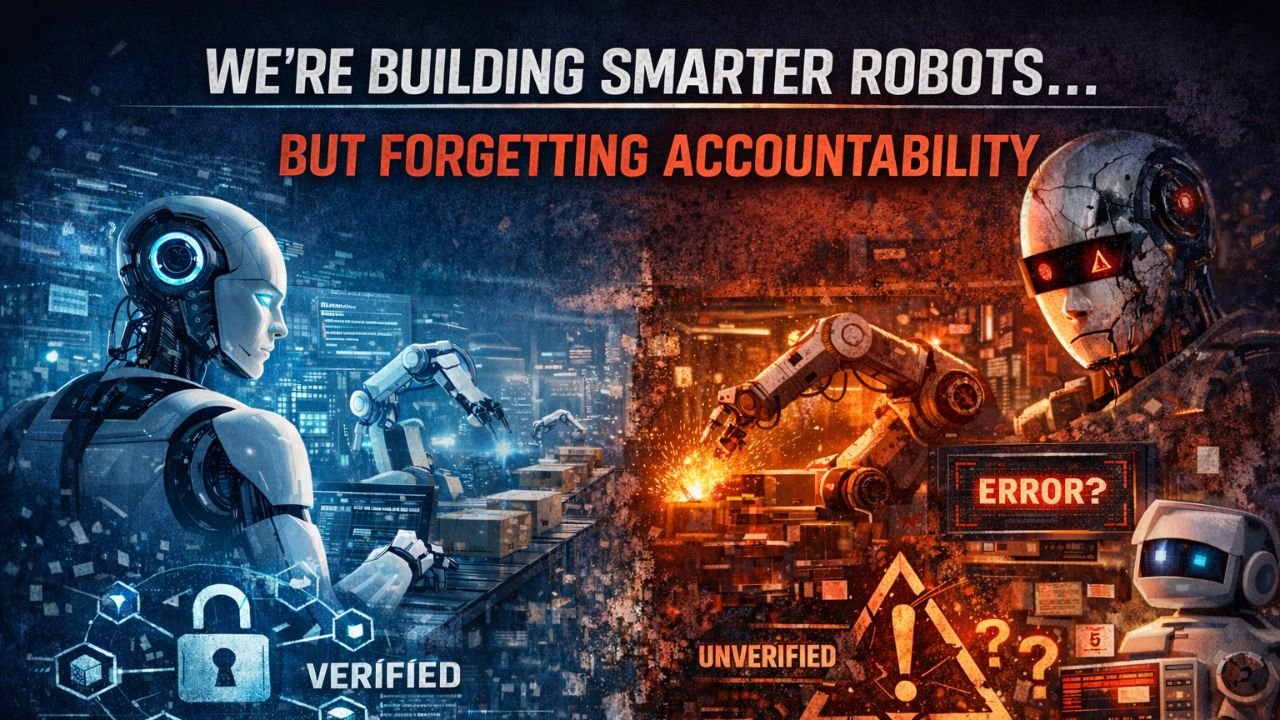
I did not turn to the Fabric Foundation out of a passion for robots.
I turned to it because I felt there was a gap in the narrative about 'the automated future'.
We talk a lot about AI, about self-operating agents, about factories without humans.
But very few people ask the question:
When machines decide for themselves, who verifies that decision?
Intelligence does not equate to being trustworthy.
What I find interesting is that Fabric does not pursue making machines 'better'.
It focuses on making them verifiable.
Every logical change leaves a trace.
Every action has computational evidence.
It's not an internal log, but a truth that can be shared and verified.
In logistics, manufacturing, healthcare — small deviations can lead to significant consequences.
If the system only self-reports to itself, then that's not transparency — that's just self-affirmation.
Fabric makes a completely different assumption:
It's not humans that are at the center of trading.
It's the machines — autonomous entities — that are the agents of action.
That's not a feature upgrade.
That's a platform change.
The non-profit model also makes it resemble an open infrastructure for long-term evolution, rather than a closed platform serving private interests.
What about $ROBO?
I see it as a mechanism for synchronizing incentives between builders, operators, and validators.
It's not just a token, but a structure for encouragement.
We are busy talking about smart robots.
But the future will actually be decided by responsible robots.
And responsibility is the scarce resource.
#robo $ROBO