
Why does blockchain often fail in enterprise environments?
Scalability issues quickly emerge.
Data privacy conflicts with transparency needs.
Hyperledger Fabric intervenes.
It provides a permissioned framework.
Channels achieve isolation.
Modular consensus improves throughput.
But constraints still exist.
This article analyzes Fabric through five cases.
We focus on bottlenecks.
Acknowledge trade-offs.
Analyze failure modes.
Comparison with alternatives.
All based on deployment in 2026.
Supply chain traceability
Walmart tracks leafy vegetables.
From farm to store.
Using Fabric since 2018.
Update to digital passport by 2025.
Metrics: query time under 5 seconds.
Takes days compared to legacy systems.
Constraints: multi-party data sharing.
Involves vendors, auditors, retailers.
Channel isolation prevents leaks.
Trade-off: privacy enhancement limits full view.
Selective sharing slows audits.
Failure mode: node degradation under high load.
If peer nodes fail, queries stop.
Throughput drops by 30% during testing.
Long-term impact: validator economic pressure increases.
More nodes mean higher costs.
Physical constraints limit scalability.
Compared to Ethereum: Fabric handles 3500 TPS.
Ethereum only 15-30.
Tensions escalate within the global chain.
An erroneous entry has ripple effects.
Healthcare interoperability
Hospitals share patient records.
Through Fabric network.
As in US clinical trials.
IBM platform integrates EHR.
Update to AI data feed by 2026.
Metrics: data access in 2-4 seconds.
Better than siloed databases.
Constraints: regulatory compliance.
HIPAA requires isolation.
Channel segments sensitive information.
Trade-off: speed versus security.
Encryption increases latency.
Risk of degradation increases.
Failure mode: consensus failure.
If sorter overloads, updates stall.
Throughput below 1000 TPS.
Long-term impact: validator incentives weaken.
High maintenance hinders small clinics.
Physical constraints: server heat, energy consumption.
Compared to public chains like Solana.
Fabric's permissioning avoids vulnerabilities.
Solana's openness invites attacks.
Tension: a single leak erodes trust.
Permanent.
Trade finance settlement
Banking coordinates exports.
Visa's B2B Connect uses Fabric.
Launched in 2019, expanded in 2026.
Reportedly processes over $50 billion annually.
Modified to cross-border rules.
Metrics: settlement hours.
Not days.
Constraints: fraud detection.
Distributed ledger verification documents.
Isolation maintains clause confidentiality.
Trade-off: efficiency reduces audit depth.
Faster means less manual checks.
Failure mode: network partition.
If region isolation, transaction fails.
Degradation impacts 40% throughput.
Long-term impact: economic shifts.
Validators require stable fees.
Physical constraints: bandwidth limits.
Compared to Corda.
Fabric's modularity wins flexibility.
Corda limited to financial segments.
Tension exacerbates in volatile markets.
A single delay costs millions.
Tokenization of real-world assets
Institutional tokenization of real estate.
Enhanced through Fabric-X.
IBM contributes in 2025.
Currently processing carbon credits.
Pilot reaches 10 million tokens by 2026.
Metrics: transaction finality in seconds.
Constraints: regulatory oversight.
Sovereign contract execution rules.
Isolation via encryption.
Trade-off: scalability versus compliance.
Advanced privacy slows processing.
Failure mode: key leakage.
If identity leaks, assets freeze.
Throughput sharply degrades.
Long-term impact: validator network costs increase.
Incentives depend on token fees.
Physical constraints: quantum threats approach.
Compared to public Ethereum.
Fabric avoids gas wars.
Ethereum volatility hinders institutions.
Tension: a hack destroys years of work.
Irreversible.
Climate ESG verification
Companies track emissions.
IoT devices feed into Fabric.
As set by Digital Climate Group.
Deployment in 2025, expansion in 2026.
Covers 500+ farms in Europe.
Metrics: real-time audit trail.
Constraints: sensor data integrity.
Isolation prevents tampering.
Trade-off: accuracy over speed.
Validation increases latency.
Failure mode: sensor failure cascade.
Degradation impacts chaincode.
Throughput halved under load.
Long-term impact: economy favors large validators.
Small participants exit.
Physical constraints: device battery life.
Compared to Polkadot.
Fabric channels fit for privacy.
Polkadot interoperability increases complexity.
Tension: false data undermines objectives.
Permanent.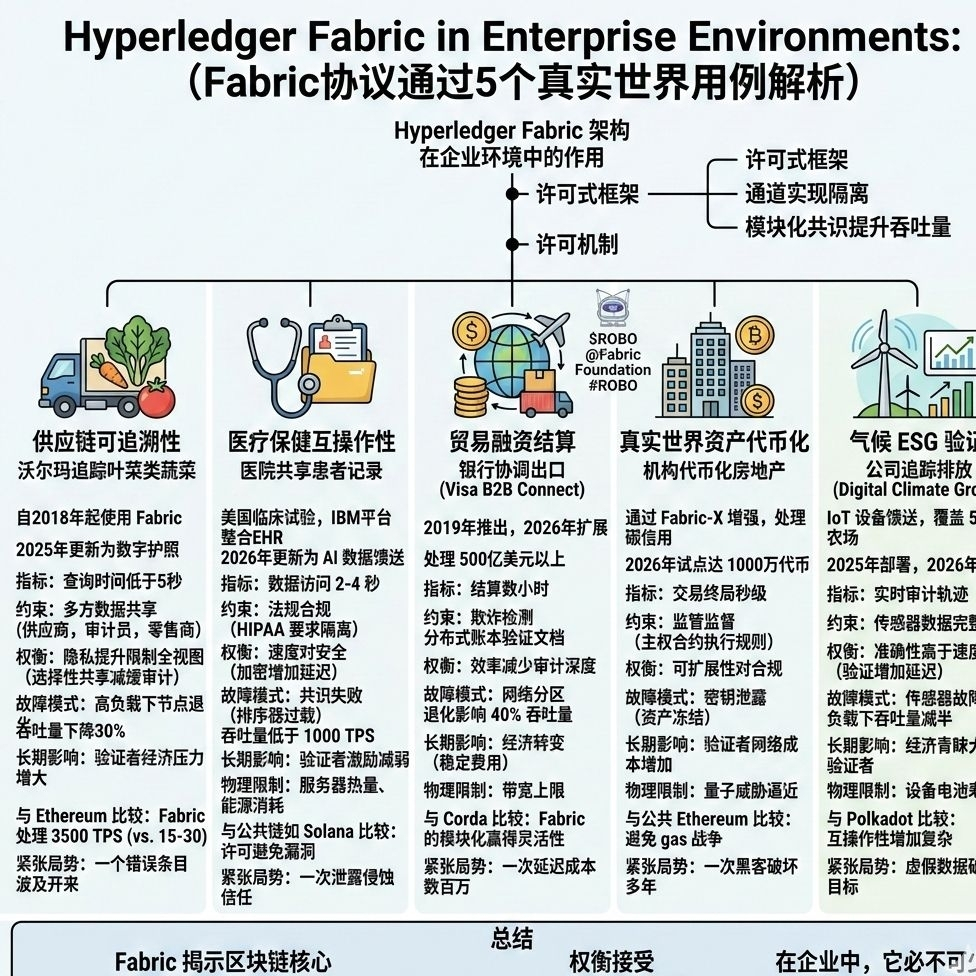
Fabric reveals blockchain core.
Bottleneck persists.
But manageable.
Accept trade-offs.
Failure mode foresight.
In enterprises, it is essential.
Non-revolutionary.
Only reliable.