
Most projects talk about "verifiable AI." Very few show you the actual pipeline. Mira's whitepaper does, and after going through it properly, I understand why this architecture is different.
Here's what's actually happening under the hood.
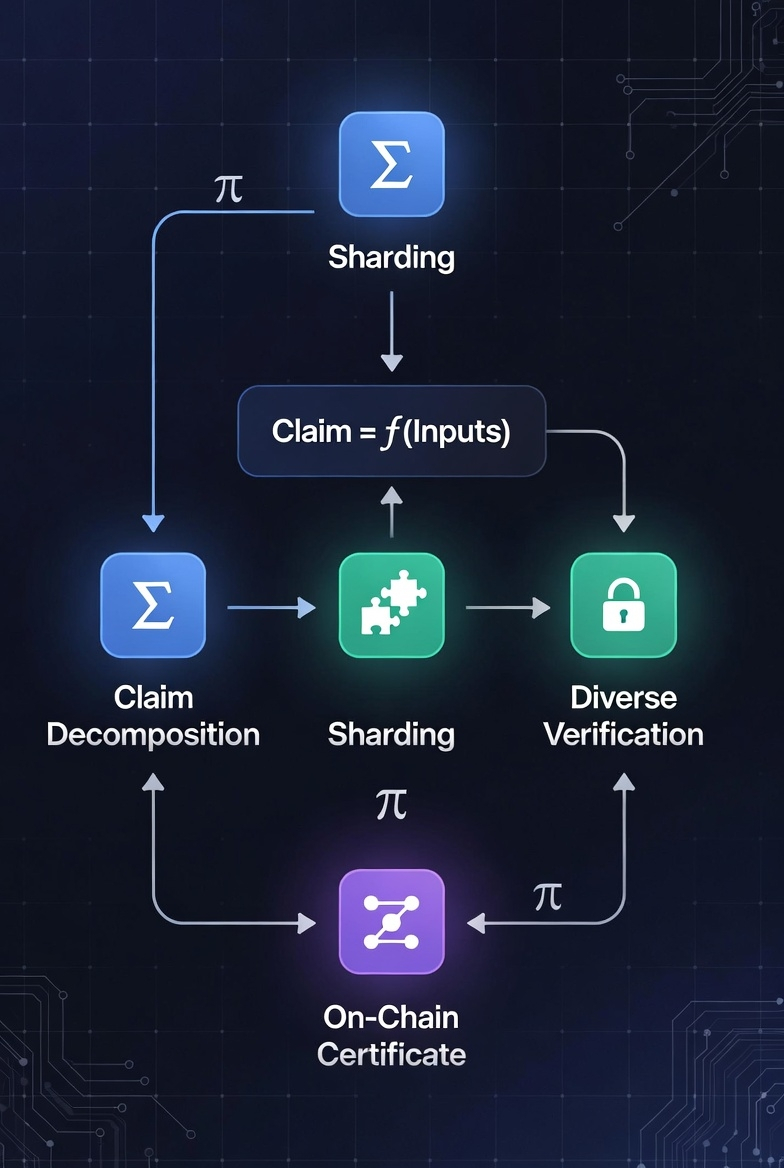
Step one: claim decomposition. Mira doesn't verify AI outputs as whole paragraphs. It breaks them into atomic, independent statements. "The Earth revolves around the Sun" becomes its own verifiable unit. This matters because mixed outputs where part is right and part is wrong stop slipping through as "mostly correct."
Step two: sharding. Claims get randomly distributed across nodes. No single node ever sees the full content. No node knows which piece belongs to which query. Collusion becomes structurally difficult, not just discouraged.
Step three: diverse verification. Each node runs different LLMs with different training data and architectures. Claims get formatted as standardized multiple-choice questions. With 4 options and 3 verifications, random guessing has a 1.56% success rate. Combine that with staking and slashing, and dishonesty becomes genuinely irrational.
Step four: on-chain certificate. When consensus is reached, Mira mints a cryptographic certificate recording which models agreed, under what threshold, with timestamp and signature. Anyone can query it. No trust required.
This is the part that stops me. Every other "AI verification" project gives you a confidence score. Mira gives you mathematical proof.
Can an AI agent execute a payment or make a medical decision autonomously without something like this underneath it?
Technically yes. Safely? Absolutely not.
The whitepaper ends with a vision: from factual verification today toward a fully autonomous AI economy. The infrastructure to get there is already running.
That's not a roadmap. That's a foundation being laid in real time.
@Mira - Trust Layer of AI #Mira $MIRA
