
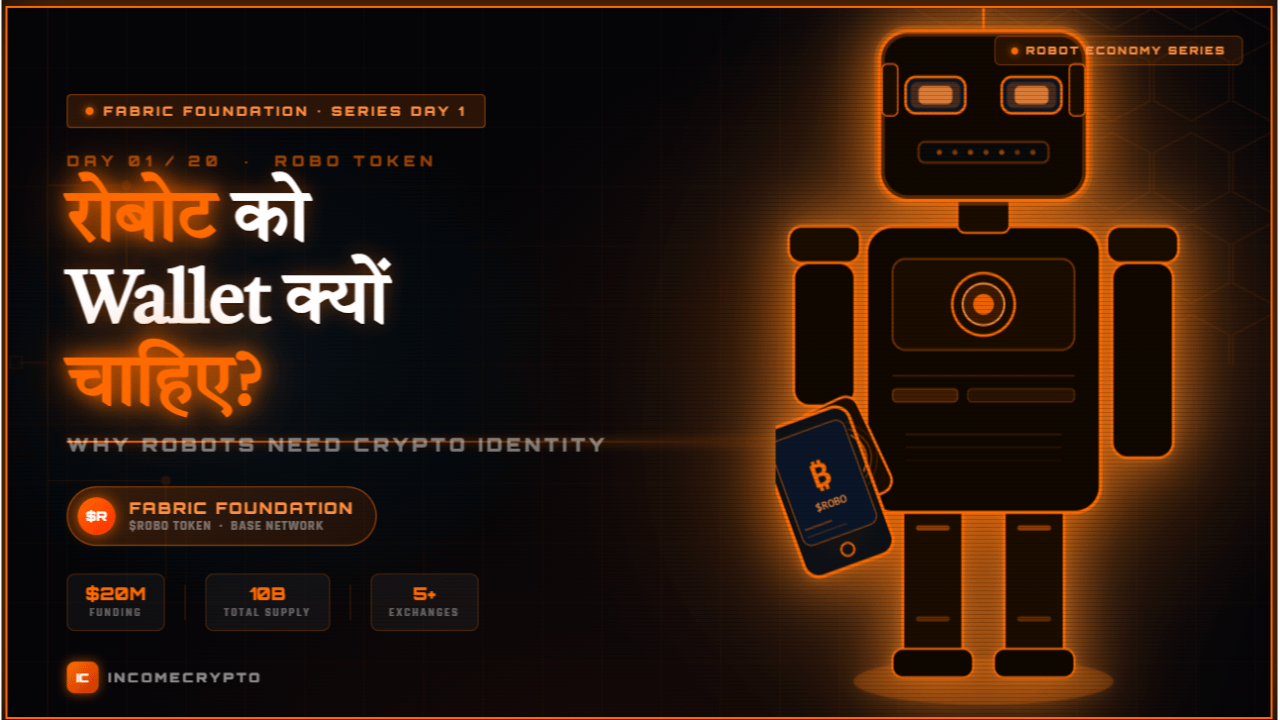
The day your home Robot pays its own EMI, remember that the Fabric Foundation dreamed of this in 2026.
Just imagine, your home Smart Robot makes your breakfast in the morning, delivers to the office, takes care of patients in the hospital. But does it have its own financial identity? Does it earn on its own, make payments, make decisions? No. This is the gap, and the Fabric Foundation has come up with a solution to this problem.
The Fabric Foundation is a decentralized protocol that provides on-chain identity, wallet, and economic existence to Robots and AI Machines. This project has been created by OpenMind, which has received 20 million dollars in funding from companies like Pantera Capital, Coinbase Ventures, and Digital Currency Group.
On February 27, 2026, Robo token was listed on Binance Alpha. This was not just a token launch but a signal for the start of the Robot Economy.
Innovation and Uniqueness
So far, most crypto projects have focused on DeFi, NFTs, or gaming.@Fabric Foundation For the first time, such a structure is being created where Machines become economic participants themselves.
Just as Android OS provided a common platform for smartphones, similarly Fabric's OM1 OS connects robots to a unified blockchain network.
Robot operators need to stake $ROBO . If the service quality is good, they receive rewards, and penalties apply for poor performance. This means accountability is recorded on the blockchain.
AI tokens like Bittensor or Fetch.ai focus on digital intelligence. The Fabric Foundation is working to connect physical robots to the economic layer of the blockchain.
Every Robot receives a unique on-chain identity. This is its digital identity, which is permanent and verifiable.
Architecture
The Fabric Foundation is built on the Base Network, which is an Ethereum Layer-2 solution. This means lower transaction fees, faster processing, and security like Ethereum. It is EVM-compatible, so developers can easily build applications.
There are three main pillars of this ecosystem.
OM1 OS – Operating system for robots.
On-Chain Robot Identity – The blockchain address of each machine.
Decentralized Skill Marketplace – Developers can create and sell robot skills.
Tokenomics
Robo has a total supply of 10 billion tokens. It has an Adaptive Emission Engine that adjusts token emission according to network usage.
When network usage increases, emissions decrease. When usage decreases, emissions increase. This creates a supply-demand balance.
Key components of token utility:
Staking as Work Bond – Operators need to stake $Robo before working.
Buyback Mechanism – A portion of the protocol revenue goes into token buyback from the market.
Governance System – Token holders participate in protocol decisions through voting.
Relevance and Trends
By 2026, the Humanoid Robot market has exceeded 38 billion dollars. Projects like Tesla's Optimus, Boston Dynamics' Atlas, and China's AgiBot are making physical robotics mainstream.
The Fabric Foundation is trying to connect these robots to a shared economic layer as an open protocol.
Recently, a liquidity injection and Titan issuance mechanism have been launched in partnership with Virtuals Protocol.
After the listing on Binance Alpha, Robo was also listed on major exchanges.
Investor Note
Robo is an early-stage project. Price volatility is high. It is essential to pay attention to the token unlock schedule and selling pressure.
Conclusion
The Fabric Foundation is not just a crypto token but an economic infrastructure for Robots. On-chain identity, decentralized governance, and an adaptive token model make it unique.
If robotics advances rapidly in the coming decade, the need for a decentralized coordination layer will become clear. The Fabric Foundation is working in that direction. Stay connected with IncomeCrypto and keep reading the Fabric Foundation Series.
