
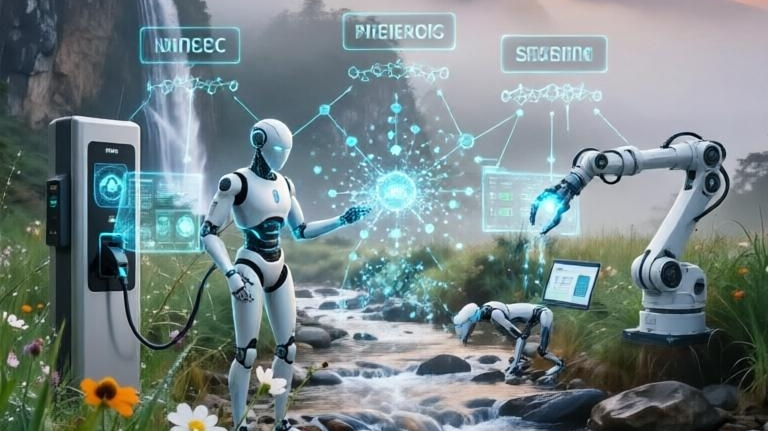
@Fabric Foundation #ROBO # Project Background
Fabric Foundation is an independent non-profit organization initiated by OpenMind at the end of 2025, focusing on building a decentralized infrastructure for safe and efficient collaboration between humans and intelligent machines. OpenMind has completed $20 million in Series A financing, led by Pantera Capital, with top institutions such as Coinbase Ventures, DCG, Ribbit Capital, and Sequoia participating.
Core Architecture: Three-Layer Stack
The Fabric protocol adopts a unique three-layer architecture aimed at addressing the fragmentation issues in the robotics industry:
```
┌─────────────────────────────────────┐
│ Third Layer: Token Layer (ROBO) │ ← Economic Incentives and Governance
│ - Payment, Staking, Governance, Rewards │
├─────────────────────────────────────┤
│ Second Layer: Coordination Layer (FABRIC Protocol) │ ← Trust and Coordination Infrastructure
│ - Machine identity authentication, location tracking, task coordination │
├─────────────────────────────────────┤
│ First Layer: AI Runtime Layer (OM1) │ ← Robot "Operating System"
│ - Perception, Memory, Planning, Execution │
└─────────────────────────────────────┘
```
1. OM1 - The "Android System" for robots
OM1 is an open-source AI runtime developed by OpenMind, positioned as the general operating system for robots:
- Hardware Agnostic: Supports various hardware platforms such as quadruped robots, humanoid robots, wheeled robots, and drones
- Natural Language Interaction: Converting sensor data into natural language through VLM (Visual Language Model) and ASR (Automatic Speech Recognition), allowing robots to understand and execute vague instructions like "go to that chair"
- Cross-Vendor Collaboration: Establishing a natural language abstraction layer that allows robots from different vendors (such as 1X Technologies' Neo and Figure) to collaborate seamlessly
- Modular Design: Supports plug-and-play AI models (OpenAI, Gemini, DeepSeek, xAI, etc.), as well as standard middleware such as ROS2, Zenoh, CycloneDDS
Technical Process:
Sensor Data (cameras, microphones, LiDAR) → Binary Format → Multimodal Recognition Models → Natural Language Data Bus → Data Fusion Module Generates Context Reports → Multiple LLM Analyze Decisions → Execute Actions
2. FABRIC Protocol - Decentralized Coordination Layer
FABRIC is a decentralized trust and coordination protocol managed by the Fabric Foundation:
- Machine Identity: Providing on-chain identity authentication for each robot
- Location Tracking: Decentralized location verification with centimeter-level accuracy
- Task Coordination: Trust layer for safe interactions between machines
- Economic Settlement: Supports machine-to-machine (M2M) automatic payments
3. ROBO Token - Economic Layer
ROBO is the native token of the Fabric Protocol, listed on major exchanges like Coinbase, Binance Alpha, Bybit, KuCoin on February 27, 2026.
Token Economics:
Allocation Category Ratio TGE Unlock Lock-up Arrangement
Ecology and Community 29.7% 30% 40-month linear release, linked to "Robot Work Proof"
Investors 24.3% 0% 12-month cliff + 36-month linear release
Team and Advisors 20.0% 0% 12-month cliff + 36-month linear release
Foundation Reserve 18.0% 30% 40-month linear release
Community Airdrop 5.0% 100% Immediate Unlock
Liquidity Provision 2.5% 100% Immediate Unlock
Public Sale 0.5% 100% Immediate Unlock
Key Parameters:
- Total Supply: 10 billion (fixed cap)
- Circulating Supply: Approximately 2.23 billion (at TGE)
- Fully Diluted Valuation (FDV): 400 million
- Initial Market Value: Approximately 890,000 USD
Token Utility:
1. Network Fees: Payment currency for transactions, identity verification, and coordination services between machines
2. Staking Requirements: Developers and enterprises must stake ROBO to build applications
3. Governance Rights: Voting to decide network parameters, fee structure, and protocol upgrades
4. Revenue Sharing: Protocol fees generate continuous buying pressure through automated market purchases
Innovative Mechanism: Proof of Robotic Work
Unlike traditional staking mining, ROBO rewards are based on verified actual work: task completion, computational contributions, maintenance records, data submissions, etc., linking token incentives with real-world robotic activities.
Practical Application Scenarios
The Fabric Foundation is promoting the following specific applications:
1. Warehousing and Logistics: Robots coordinate to complete cargo handling and inventory management, through on-chain task allocation and automatic settlement
2. Last-Mile Delivery: Decentralized scheduling and payment for last-mile delivery robots
3. Automatic Charging Stations: Based on the collaboration between OpenMind and Circle (USDC), robots can autonomously pay for charging costs
4. Home Services: For instance, 1X Technologies' Neo robot assists with household chores through OM1
5. Automation in Manufacturing: Collaborative production lines of robots from different vendors
Strategic cooperation with Circle
In February 2026, OpenMind reached a strategic partnership with Circle (the issuer of USDC stablecoin) to launch the world's first payment infrastructure designed specifically for autonomous agents and physical AI:
- Integrating Circle's USDC with OpenMind's x402 protocol module
- Enabling robots to autonomously pay for energy, services, and data costs in the physical world
- The Fabric Foundation is responsible for the complete closed loop of "birth, production, operation, evolution"
Technical Roadmap
- Current Stage: Deployed based on Base (Coinbase's Ethereum L2), supporting robot identity, payment, and skill application stores
- Future Plans: As adoption increases, migrating to a dedicated Layer 1 blockchain
Risks and Challenges
1. Overvalued: The starting valuation of 400 million FDV is higher than similar projects (Virtuals about 540 million, Sentient about 200 million)
2. Unlocking Pressure: Although investors and teams have a 12-month lock-up, 30% of the ecological and community allocation TGE unlock (approximately 90 million) may bring selling pressure
3. Adoption Dependency: Long-term value depends on real-world industrial demand and scalability
4. Market Volatility: As a newly listed token, early price fluctuations are severe
Difference from Hyperledger Fabric
Important Distinction: Fabric Foundation and Hyperledger Fabric (an enterprise-grade consortium blockchain framework hosted by the Linux Foundation) are completely different projects:
Dimension Fabric Foundation (ROBO) Hyperledger Fabric
Nature Decentralized machine economy protocol Enterprise-grade permissioned blockchain framework
Goals Robot collaboration and autonomous payment Trusted data sharing between enterprises
Token Yes (ROBO) No
Consensus Proof of Robotic Work Raft/PBFT, etc.
Management Fabric Foundation (non-profit) Linux Foundation
---
Summary: The Fabric Foundation is a cutting-edge infrastructure project at the intersection of Web3 and physical AI, attempting to build a decentralized "machine economy" network through a three-layer architecture of OM1 (operating system), FABRIC (coordination protocol), and ROBO (economic token), allowing robots to interact, collaborate, and trade autonomously in an open economy like humans.$ROBO
