
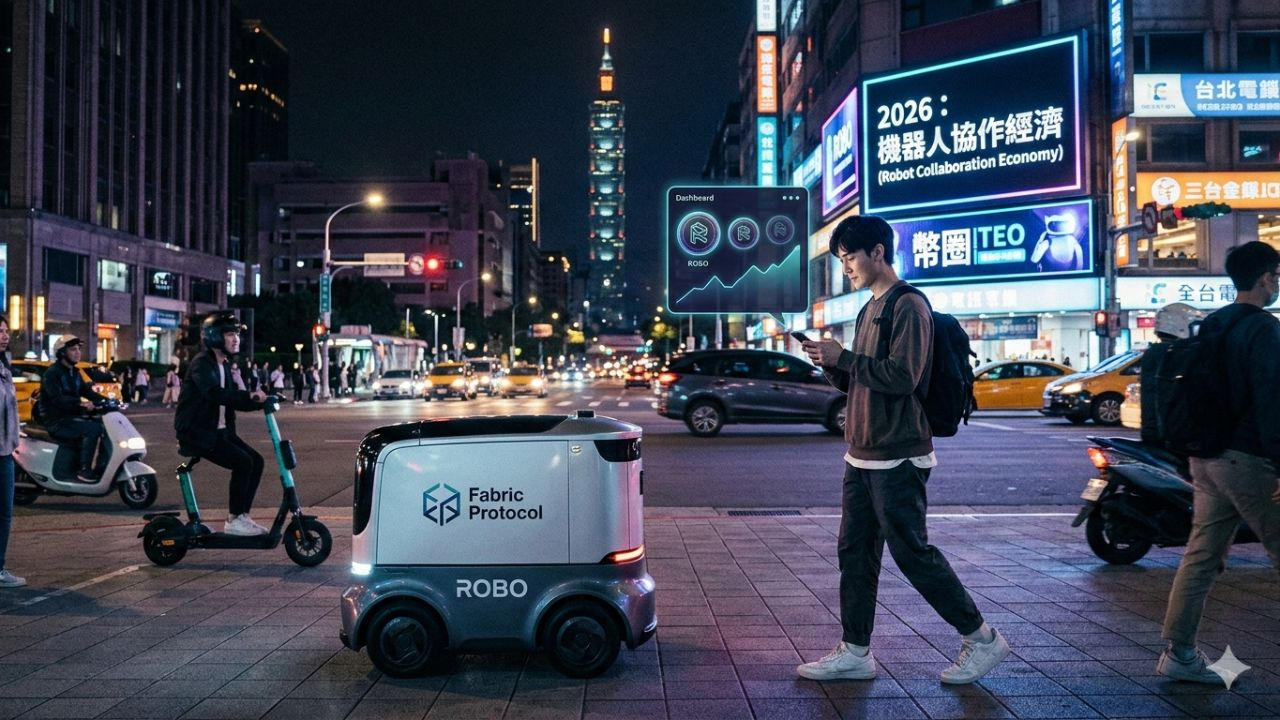
Imagine that it is now late at night in 2026, and you are walking on the streets of Taipei. An automatic delivery car smoothly glides past you; it stops in front of a shared charging station without swiping a card or scanning a QR code, and a few seconds later, power begins to transfer. At the same time, a very small transaction on the blockchain is instantly completed.
This robot is not 'consuming'; it is 'surviving.' And the blood that supports its survival is the main character we are going to discuss today: $ROBO @Fabric Foundation #ROBO
When AI finally had a 'body.'
In the past few years, we've watched ChatGPT write poetry and create art on computer screens, thinking it's cool, but it always felt like something was missing. It's like a ghost with a brain trapped in a glass bottle.
Until the Fabric protocol emerged.
It gave these AI ghosts a 'body.' Through the OM1 robot operating system, AI can enter factories, logistics, and our lives for the first time. But the question arises: how should robots collaborate? If Robot A helps Robot B move goods, how should Robot B repay it?
This is not science fiction; this is a real economic issue. Thus, ROBO was born. It is not designed for us to buy and sell in exchanges; it is to allow thousands of robots to have a common language and a shared ledger.
That grand gamble that took place in the 'top office.'
On the other end of the story, it's in the late-night offices of Silicon Valley and Wall Street.
Big shots from Pantera Capital and Coinbase Ventures are sitting together. They've seen more junk projects than we have eaten salt, but when they saw the blueprint of ROBO, they didn't see a 'coin,' but a new industrial revolution.
What they invested was not just US dollars, but a bet on productivity for the next decade. This explains why, in the past few days (at the end of February 2026), when the market was still volatile, ROBO charged into Coinbase's perpetual contracts like a waking beast. This means mainstream funds have completed the 'clearing,' ready to start writing the chapter belonging to robots.
Are you a 'speculator' or a 'pioneer'?
This is the psychological warfare I want to share with you the most.
In the crypto world, the most painful thing is not missing out but 'buying but not being able to hold.' Watching the K-line chart of ROBO hit a new high on February 27, many people began to worry: 'Will chasing now make me a farmer?' or 'Should I wait for it to pull back to the ankle before buying?'
It's like someone told you in 2010 that Bitcoin was the future's gold, but you were struggling with the fact that it rose by $2 today. The core of the ROBO story is not about its price today, but about its penetration rate in the 'robot economy.' If every AI device produced in the future must have the Fabric protocol built-in, then the current market value may just be a warm-up for this marathon.
Do you want to stay in the old world, or head towards 2030?
I have to say a truth: $ROBO is a romantic revolution with a 'professional mask.'
The technology behind it (such as Intent-centric trading) is very obscure and difficult to understand, but the goal it aims to achieve is very straightforward—allow robots to work autonomously and free humans from trivial tasks.
'What we are buying is not currency, but a sense of participation in the future.'
Now, this epic about robots has just finished the prologue. You can choose to be a bystander watching the excitement or become an early shareholder with 'robot fuel.'