
 For many years, discussions around crypto fees have almost always followed the same logic. We argue about the highs and lows of Gas fees, compare the throughput of different public chains, and discuss the pros and cons of modular versus monolithic architectures. But beneath these technical disputes lies a more fundamental question:
Does the existing fee model truly align with the sources of value creation?
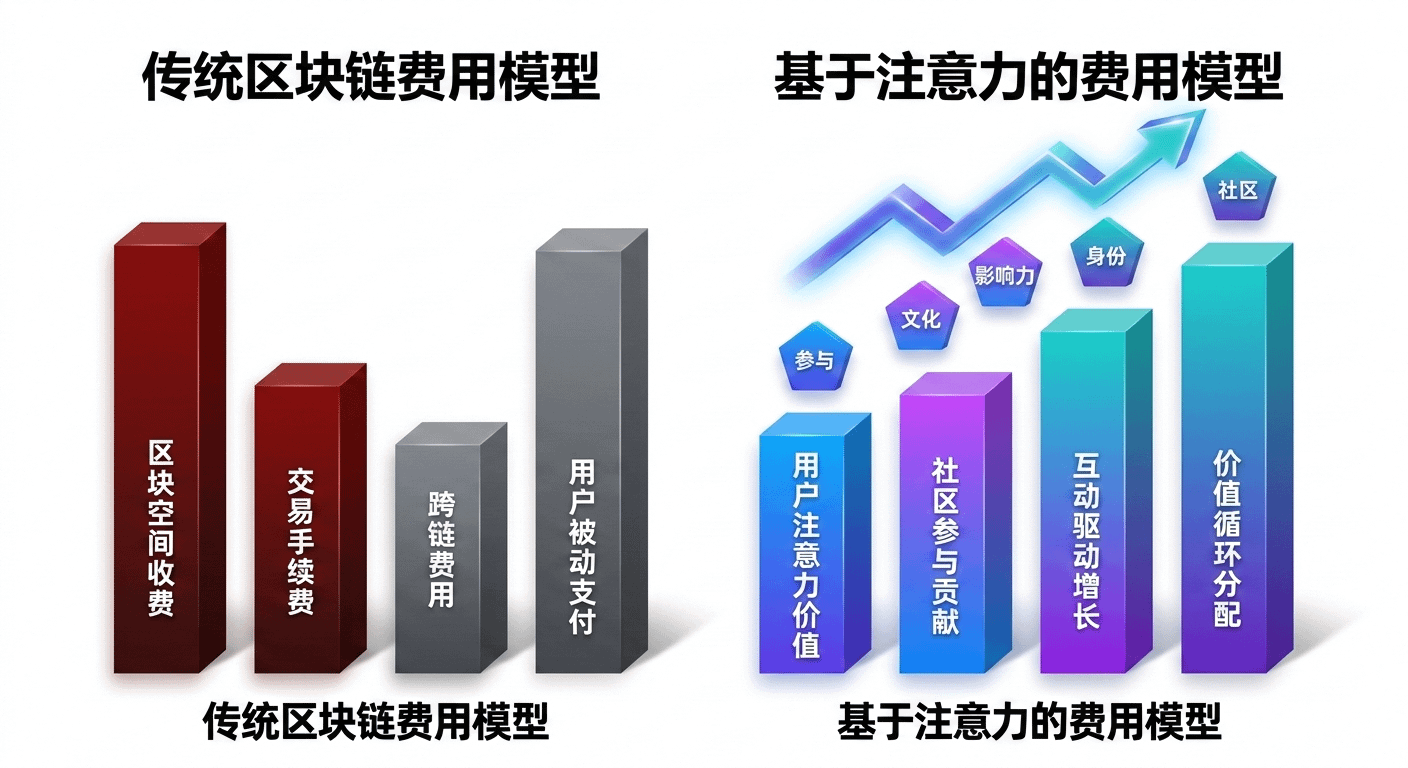
Most blockchain networks have adopted a relatively traditional logic:
Use block space, pay for it;
Execute a transaction, pay for it;
Transfer assets across chains, also pays.
From an engineering perspective, this model is clear and reasonable. But it assumes a premise — that trading behavior is the only meaningful source of value in the network.
And this premise is becoming worth re-examining.
Recently, attention has been drawn to exploring a different direction. This direction is not simply about lowering transaction fees but attempts to redefine 'contribution' itself. Fabric focuses not only on on-chain transaction activities but also on a broader and more powerful element—user attention.
Attention as economic infrastructure
If we look at the entire internet ecosystem, we will find that attention has always been the most core resource.
Social platforms build business models around attention;
Streaming platforms monetize through attention;
The value foundation of search engines is also attention.
The same goes for the crypto world.
Liquidity, total value locked (TVL), and trading volume do not often arise out of thin air; they follow narrative, culture, and trend. The NFT cycle, meme coin market, and airdrop waves do not explode solely because of technological upgrades but because attention is concentrated in a certain direction.
Capital flows to where attention is.
However, most blockchains still regard 'block space' as the only scarce resource, neglecting the social energy that attracts these transactions and liquidity itself.
Fabric's exploration is a response to this structural imbalance. If attention is the spark that ignites on-chain activities, should it be regarded as a productive input rather than merely a byproduct?
Reconstructing at the incentive level
Fee structures have never been neutral. They shape user behavior.
Rewarding liquidity will attract fast-moving capital;
Rewarding staking will encourage long-term holding;
Rewarding high yields will attract short-term participants chasing returns.
Every incentive design will change the focus of the ecosystem.
If attention is incorporated into the economic model, the logic will change. Users are no longer just payers; they become contributors who create attraction for the network through participation, dissemination, and interaction. In this framework, participation itself is not merely a consumption behavior but a form of value creation.
This is not only a technical adjustment but also a shift in philosophy.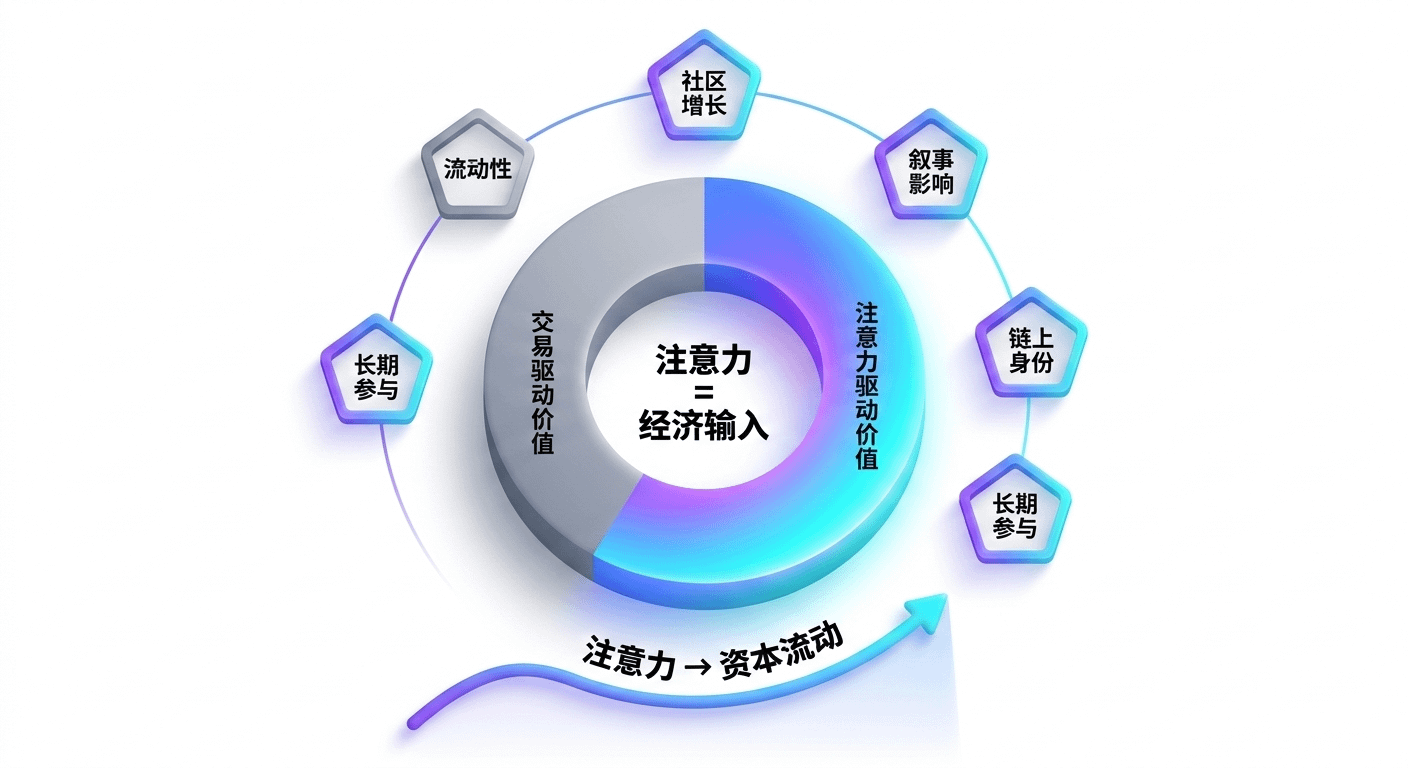
The challenge of measuring 'intangible assets'
Of course, building economic models around attention is not simple. Attention is difficult to measure accurately in a decentralized manner. Once metrics become targets, they may be manipulated. Issues like airdrop score manipulation, fake interactions, and superficial activity are not uncommon in crypto history.
Therefore, identifying genuine participation without moving towards centralization is a key challenge.
But we should also see that many economic mechanisms in the crypto field initially went through chaos. Liquidity mining was once highly imbalanced; NFT royalty mechanisms sparked intense debate; yield farming experienced bubbles and corrections. It is through continuous trial and error that mechanisms gradually mature.
Innovation at the incentive level will not be smooth sailing.
From transaction networks to socio-economic entities
The larger context is that blockchain is no longer just a financial settlement layer. It is becoming a social space.
Wallet addresses gradually form identities;
On-chain history constitutes credibility;
Community interactions shape influence.
The value of a participant is no longer merely reflected in asset balances; 'presence' itself has economic significance.
When users feel they are merely paying continuously for participation, friction will quietly accumulate; whereas when participation is recognized as contribution, psychological expectations will change. This change may lead to more sustainable community building and more stable user retention.
If the cost model reflects both execution behavior and participation levels, the competitive focus between agreements may shift from pure yield to culture, experience, and narrative ability.
This will be a mark of maturity.
Broader economic transformation
The early internet first built infrastructure, then explored monetization methods. Web2 ultimately monetized attention on a large scale through advertising and data models, but it also raised questions about platform dominance. Web3 attempts to break this structure but has not yet completely resolved how to natively monetize attention without exploiting users.
Designing fee models around attention may be an early attempt at this issue.
This does not mean that success is already determined. Incentive systems are inherently fragile, and the market will quickly test hypotheses. However, questioning the underlying economic logic is itself a healthy signal.
The core innovation in the crypto world has always been incentive mechanisms. Code can be copied, but incentive structures are harder to replicate simply, as they directly shape human behavior.
If attention ultimately becomes a type of foundational economic element on-chain and can operate under a reasonable mechanism, it may change the way value flows in decentralized networks.
Currently, this is still an experiment. But it conveys an important signal: blockchain is not just a machine for processing transactions; it is evolving into a social economic system.
And in socio-economic entities, attention has never been a secondary factor.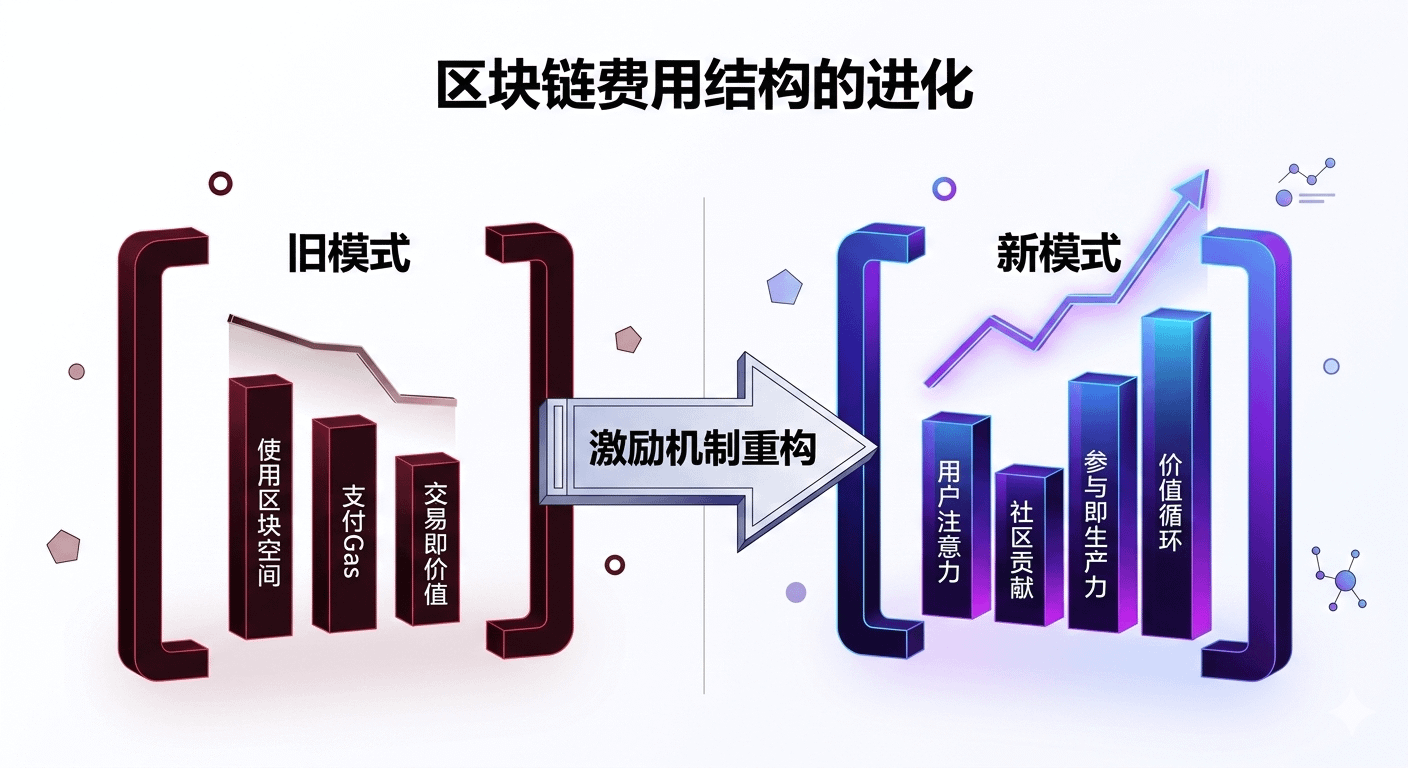
#ROBO @Fabric Foundation $ROBO
