
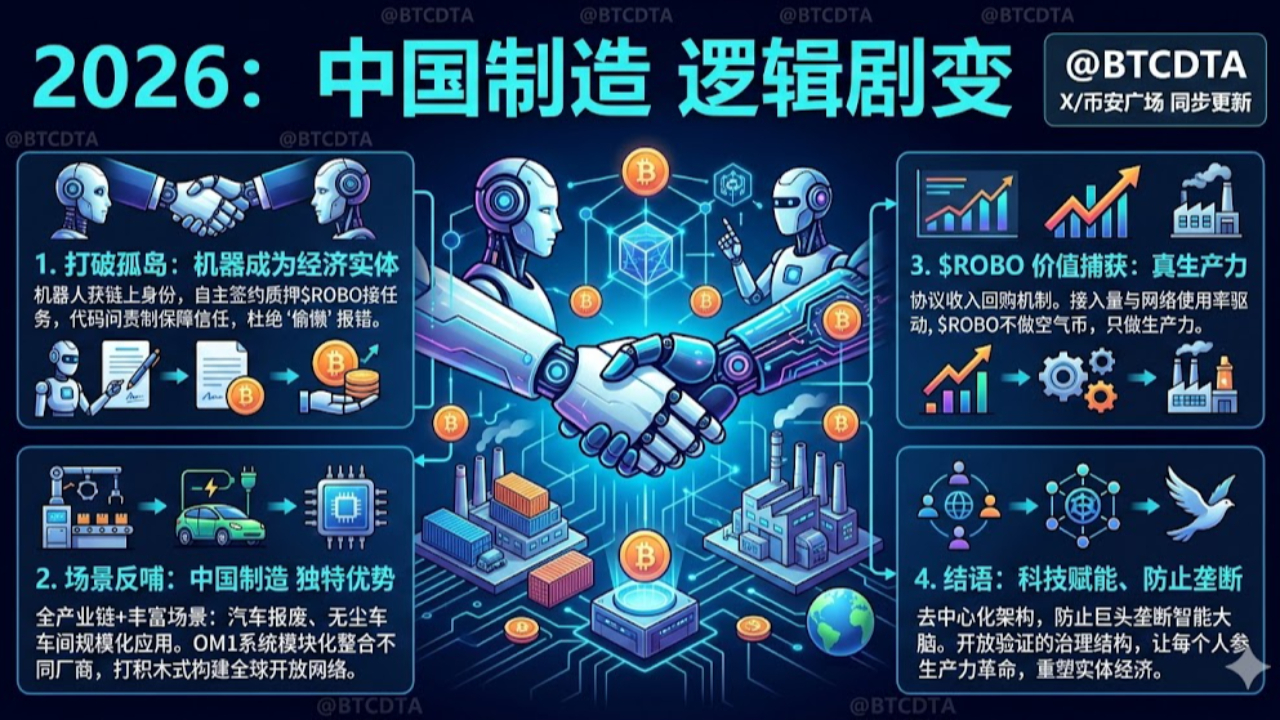
Looking back from the time node of March 2026, the logic of Chinese manufacturing has completely changed.
Today, the Ministry of Commerce released data showing that the national consumption promotion month has driven sales of over 200 billion, with a surge in the share of smart products. But behind the hustle and bustle, traditional MES and DCS systems are facing structural reorganization. In the past, we talked about automation as humans giving orders to machines; now we talk about autonomy as machines finding work on their own.
In this context, the emergence of @Fabric Foundation is like giving the embodied intelligence, which is in its adolescence, a set of fair and efficient governance rules.
1. Breaking the Islands: From Machine Tools to Economic Entities
In the past, the biggest headache for traditional factories was the collaboration of cross-brand robots. After buying a humanoid robot from Yushu, they found out it could not directly communicate with the existing Siemens production line. The Fabric Protocol proposed by @Fabric Foundation essentially gives each robot a verifiable on-chain identity.
What does this mean? It means that robots are not just assets; they become economic entities capable of autonomously signing contracts, receiving payments, and settling accounts. In the economic model of ROBO, robots need to stake tokens as collateral when taking on tasks. This mechanism directly addresses the most challenging trust issue in traditional engineering outsourcing—if a robot slacks off or a program error leads to increased defect rates, the system will automatically penalize the collateral. This code-based accountability is more effective than any contract.
2. Scene Feedback: The Unique Advantages of Chinese Manufacturing
The world is producing humanoid robots, but why do I favor ROBO rooted in the Chinese context? Because we have the most complete industrial chain and the richest application scenarios in the world.
2026 is the inaugural year for the large-scale application of humanoid robots. In the automotive scrapping and replacement workshop in Henan, and in the semiconductor cleanroom in Jiangsu, tens of thousands of robots are working intensively. The modular architecture of @FabricFoundation is very flexible; it does not require overturning existing industrial standards but, like building blocks, integrates these different manufacturers and forms of machines into a global open network through the OM1 operating system.
3. $ROBO Value Capture: No Air Coins, Only Productivity
Many people ask, what is the value of $ROBO ?
If you see it as merely a hype target, then you may underestimate the ambition of the Fabric Foundation. Its value comes from real contributions. Part of the protocol's revenue will be used to repurchase tokens, and this logic that links token value with network utilization and robot access is the true revolution in productivity relations. When robots complete verifiable tasks on-chain and receive settlements, every ROBO represents genuine industrial output.
4. Conclusion: Technology Should Not Be a Cold Monopoly
What I admire most about @FabricFoundation is its insistence on decentralization, preventing large tech giants from monopolizing robotic intelligence. In this era where everything can be AI, this open and verifiable governance structure is the ticket for ordinary people to participate in this productivity revolution.
Traditional industries do not represent backwardness; when they are empowered by $ROBO , the energy unleashed will reshape the landscape of the entire real economy.