
In the tech community, we often say that we are in the "iPhone moment" for robots. However, as an analyst who has long observed the integration path of Web3 and AI, I have been pondering a question: If the future of embodied intelligence (Embodied AI) is only in the hands of a few tech giants, are we simply jumping from the "walled garden" of the mobile internet into another algorithm-driven "steel cage"?
Recently, the concept of "skill crowdsourcing" proposed by ROBO under @Fabric Foundation caught my attention. This is not just a technical solution, but a decentralized experiment about how "productivity evolves." Today, we will deeply analyze its technical core.
1. The 'coaching shortage' of traditional AI: Why has the centralized path hit a bottleneck?
In traditional paths, training an embodied robot requires massive amounts of action data. Tesla or Boston Dynamics feeds models using expensive laboratory environments and self-built data centers. But the real world has countless scenarios: picking up a cup, fixing a pipe, navigating through a narrow factory...
Core idea: The speed of centralized data collection will never catch up with the complexity of the real world.
This model is not only costly but also suffers from serious 'data silos'. If every new skill acquisition relies on the company to collect data personally, the popularization of robots will be extremely slow.
2. ROBO's breakthrough: What is the 'skill crowdsourcing' mechanism?
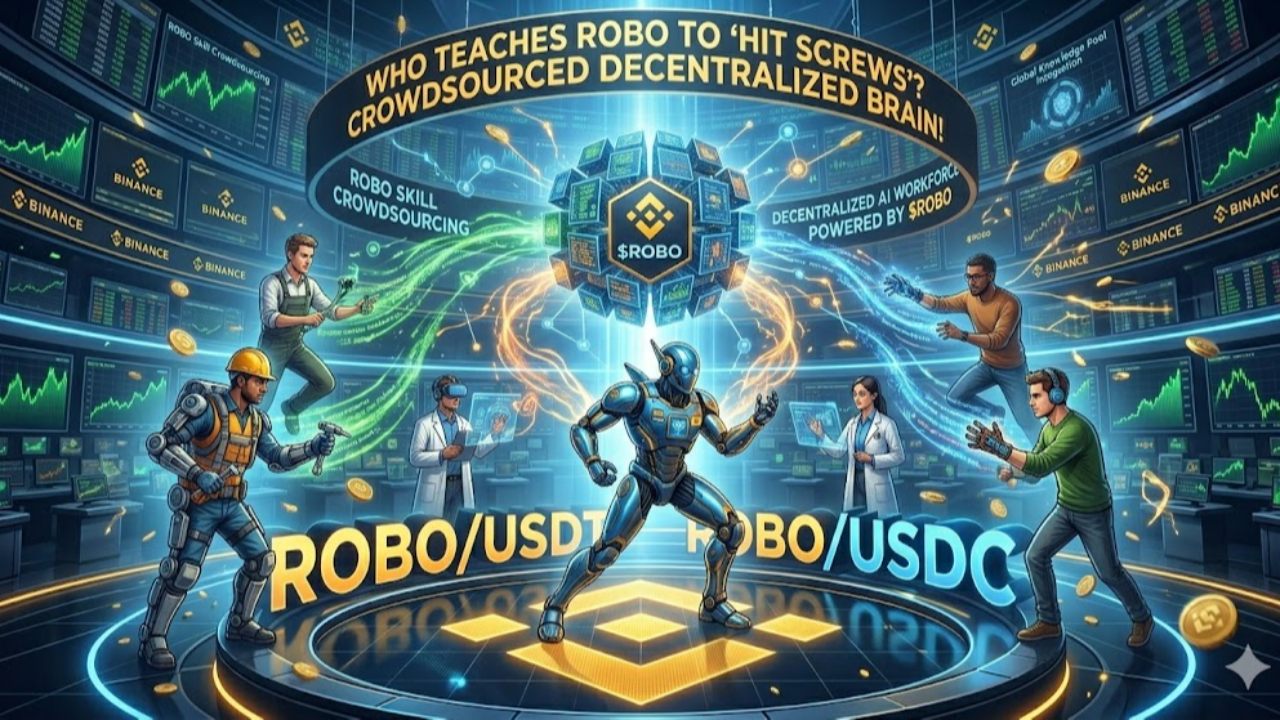
ROBO's core logic is to decentralize the 'learning process' of robots. Simply put, it builds an open protocol layer that allows global developers, geeks, and even ordinary users to become 'digital coaches' for robots.
Technical principle: Decomposition and reuse of action atoms
ROBO breaks down complex robotic behaviors into 'action atoms'. For example, 'grabbing' is one atom, 'moving' is another atom. Through crowdsourcing, different people can contribute action trajectory data in different environments.
Contribution layer: Contributors record action data through simulators or VR devices.
Verification layer: Nodes verify the validity of data through privacy machine learning (Privacy ML), ensuring that these 'skills' are safe and conform to physical logic.
Incentive layer: Once contributions are confirmed as valid, they are settled through $ROBO tokens.
It's like a 'Wikipedia for robots', where everyone writes a line of code or a piece of data, ultimately converging into an all-encompassing general brain.
3. Analogous explanation: From 'buyout software' to 'open-source skill pool'
We can imagine traditional robots as early Windows systems, where all functionalities are packaged and sold to you by Microsoft. ROBO's skill crowdsourcing is more like Linux or GitHub.
If your home ROBO robot cannot make sweet and sour spare ribs, you do not need to wait for an official update. You can go to the 'Skill Plaza' to download a 'spare rib cooking skill pack' uploaded by top chefs (or data contributors) from around the world. Due to $ROBO economic incentives, the iteration speed of these skill packs will far exceed the KPI of any company's R&D department.
4. Deep gaming: How to ensure that the skills returned from 'crowdsourcing' do not cause harm?
Many people worry that if the data is crowdsourced, what happens if malicious attackers feed robots 'incorrect actions'?
This is the core barrier of the Fabric Foundation—verification architecture. ROBO introduces game theory models commonly found in decentralized AI (DeAI). Each uploaded skill data must go through multiple rounds of virtual simulation testing. Only skills that perform stably in simulators can enter the mainnet's 'knowledge base'. This 'simulate first, implement later' closed loop is a safe foundation for skill crowdsourcing to land.
5. Summary and outlook: Co-building, rather than passively receiving
ROBO's 'skill crowdsourcing' is not just a technical means to solve data sources; it is actually redefining 'ownership'. When skills are contributed by the community and driven by tokens, robots are no longer just consumer products but assets co-owned and continually evolving by the community.
In the future, a piece of sweeping logic you contribute could be called upon by tens of thousands of robots worldwide, and you would earn continuous passive income through $ROBO .
Thinking about the problem:
If future robots could download human professional skills like downloading apps, which profession do you think would be the first to be 'skill crowdsourced'? Is it manufacturing workers or household helpers?
Feel free to leave your thoughts in the comments section, and let's discuss the sparks generated by the collision of AI and Web3! 👇
Disclaimer:
This article serves only as a technical logic analysis of the project and does not constitute any investment advice or financial consultation. The crypto market is highly risky, please conduct thorough independent research (DYOR) before making any investment decisions.