
In-Depth Analysis of TRX, USDC, UDD!, and PAXG
The New Horizon of the Crypto Market on Binance in 2026
The cryptocurrency market in 2026 presents a scenario of maturity, institutionalization, and increasing integration with the traditional financial system. Binance, the largest global exchange by volume and liquidity, leads this movement, offering a robust platform for trading, custody, and investment in hundreds of digital assets. While coins like Bitcoin (BTC), Ethereum (ETH), Binance Coin (BNB), Solana (SOL), and Dogecoin (DOGE) dominate attention and volumes, there is a universe of cryptocurrencies with solid fundamentals, relevant liquidity, and innovative use cases that remain undervalued or neglected by the average investor.
This article, prepared for strategic publication on Binance Square at 6 PM, aims to thoroughly analyze four of these assets: TRX (TRON), USDC (USD Coin), UDD! (United Stables U), and PAXG (Pax Gold). The analysis covers fundamentals, tokenomics, trading volume, liquidity, adoption, partnerships, regulatory risks, and future perspectives, providing practical insights for investors seeking opportunities beyond the most popular cryptocurrencies.
Analysis Methodology and Metrics Used
To identify opportunities in neglected cryptocurrencies, it is essential to adopt a multidimensional approach, combining fundamental analysis, liquidity metrics, volume, on-chain adoption, regulatory compliance, and risk assessment. The main metrics and tools used include:
Fundamentals and Tokenomics: Assessment of the economic model, token distribution, issuance and burning mechanisms, governance, and staking incentives.
Trading Volume and Liquidity: Analysis of spot and futures volumes, order book depth, spreads, slippage, and presence in DeFi liquidity pools.
Adoption and Use Cases: Number of active addresses, TVL (Total Value Locked) in DeFi, integration with dApps, institutional partnerships, and presence in payments and remittances.
Compliance, Audit, and Transparency: Certifications, independent audits, proof of reserves, adherence to local and international regulations.
Regulatory and Counterparty Risks: Assessment of the regulatory environment in the U.S., Brazil, and Europe, risks of centralization, token concentration, and exposure to changes in monetary policy.
Future Perspectives and Catalysts: Roadmaps, multichain integrations, ETF launches, strategic partnerships, and macroeconomic trends.
Tools such as CoinGecko, CoinMarketCap, TradingView, Dune Analytics, Glassnode, in addition to the APIs and dashboards of Binance itself, were employed for data collection and validation.
Overview of the Cryptocurrency Market on Binance
Binance maintains its position as the largest global exchange, with over 440 listed coins, 1,400 trading pairs, and a daily volume exceeding US$ 14 billion. The environment is characterized by high liquidity, narrow spreads (average of 0.26%), order book depth in the 99th percentile, and robust infrastructure for spot trading, futures, options, and DeFi.
The dominance of pairs like BTC/USDT, ETH/USDT, and BNB/USDT is evident, but assets like TRX, USDC, PAXG, and UDD! present significant volumes and sufficient liquidity for institutional and retail operations. The following table summarizes the main liquidity and volume data of the analyzed assets:
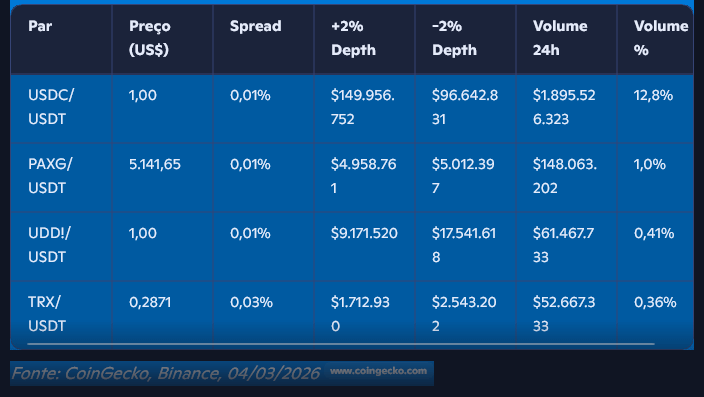
The robust liquidity of these pairs, combined with the presence in DeFi pools and futures markets, ensures favorable conditions for executing large orders, minimizing slippage and spreads.
TRX (TRON): Fundamentals, Ecosystem, and Perspectives
Fundamentals and Tokenomics
TRON (TRX) is a Layer-1 blockchain founded in 2017, focusing on decentralization of the internet, high scalability, and minimal transaction costs. Its Delegated Proof of Stake (DPoS) consensus model allows throughput of over 2,000 TPS, average fees of less than US$ 0.000005, and community governance through the election of 27 Super Representatives.
The tokenomics of TRX evolved from an inflationary model to a deflationary one, with token burn tied to resource usage (bandwidth and energy) and dynamic rewards for staking and voting. The circulating supply has stabilized around 95 billion TRX, with an initial distribution of 40% via ICO, 35% for the ecosystem, and 25% for private investors.
Trading Volume and Liquidity
The TRX/USDT pair on Binance presents daily volume above US$ 50 million, average spread of 0.03%, and order book depth exceeding US$ 4 million at ±2% of the price, ensuring liquidity for institutional and retail operations. TRX is also present in futures and options markets, expanding hedging and leverage possibilities.
Adoption, Use Cases, and DeFi/NFT Ecosystem
The TRON ecosystem is one of the most active in the world, with over 330 million accounts, 11.4 billion transactions, and TVL (Total Value Locked) of US$ 6.2 billion in DeFi. The following projects stand out:
JustLend DAO: Main lending platform, with TVL above US$ 4.5 billion.
SunSwap: Largest DEX on the network, responsible for a large part of the swap volume.
JustStables: Stablecoin protocol (USDJ) and collateralization.
NFTs and GameFi: Platforms like APENFT, Tpunks, and TronNinjas drive the NFT and play-to-earn gaming segment.
TRON dominates the stablecoin market on its network, processing more than 99% of USDT (Tether) volume and moving over US$ 50 billion daily in stablecoin transfers.
Partnerships, Developments, and Centralization Risks
The recent integration with Avail Nexus has transformed TRON into a multichain liquidity hub, allowing interoperability with other blockchains and access to global DeFi pools. Strategic partnerships with BitTorrent, exchanges, and stablecoin providers strengthen the network's position.
However, the concentration of tokens in the hands of founder Justin Sun (estimated at 60-64% of the supply) raises concerns about centralization and governance risks, although the community actively works on electing Super Representatives.
Future Perspectives
Projections for TRX in 2026 range from US$ 0.30 (pessimistic scenario) to US$ 1.30 (optimistic scenario), depending on multichain adoption, TVL growth, and the macroeconomic environment. Dominance in stablecoins, DeFi expansion, and interoperability are key catalysts for appreciation.
USDC (USD Coin): Stability, Liquidity, and Compliance
Fundamentals, Reserves, and Governance
USDC is a regulated stablecoin, issued by Circle in partnership with Coinbase, pegged 1:1 to the US dollar and fully backed by cash and U.S. Treasury securities. Circle publishes weekly reports and monthly audits conducted by a Big Four (Deloitte), ensuring transparency and institutional trust.
Governance is conducted by Circle, with mint/burn processes automated by smart contracts and integration with multiple blockchains (Ethereum, Solana, TRON, Algorand, Stellar, among others), expanding interoperability and use cases.
Volume, Liquidity, and Integration on Binance
The USDC/USDT pair on Binance trades nearly US$ 2 billion per day, with order book depth exceeding US$ 240 million at ±2% of the price and a spread of only 0.01%. USDC is widely used as a settlement currency, hedge, and store of value, being accepted at over 130 exchanges and integrated into hundreds of DeFi dApps.
The strategic partnership between Binance and Circle, announced in 2025, aims to accelerate the adoption of USDC, expanding its presence in trading, savings, payments, and corporate treasury.
Use Cases, Regulatory Risks, and Stability
USDC is used in international payments, remittances, DeFi (loans, liquidity pools), e-commerce, and humanitarian aid initiatives, thanks to its stability and transparency. The asset maintains minimal price deviations (daily fluctuation of only 0.01%) and a market capitalization exceeding US$ 30 billion.
Regulatory risks include potential decouplings in extreme market scenarios and changes in compliance rules, especially after the approval of the Genius Act in the U.S. and IN BCB No. 701/2026 in Brazil, which require proof of reserves, asset segregation, and continuous auditing.
Future Perspectives
The trend is for continuous growth of USDC as the preferred stablecoin for institutional payments, derivatives settlement, and integration with traditional banking systems. Regulatory transparency and adoption by major banks and funds reinforce its position as a defensive and highly liquid asset.
UDD! (United Stables U): Emerging Stablecoin and Specific Risks
Identification, Fundamentals, and Tokenomics
UDD! (United Stables U) is an emerging stablecoin, listed on Binance and DEXs like PancakeSwap, pegged 1:1 to the US dollar and issued on the Binance Smart Chain (BEP-20). The project uses a multiple reserve model, combining fiat stablecoins and stabilization algorithms, with a promise of decentralized governance.
The contract audit is still incomplete, with warnings for potentially dangerous functions such as blacklisting and fee modification. The number of holders is low (14 active wallets), and liquidity in pools is limited (less than US$ 1,000 in some pools).
Trading Volume, Liquidity, and Pairs on Binance
The UDD!/USDT pair trades around US$ 61 million per day on Binance, with a spread of 0.01% and reasonable order book depth for small and medium-sized trades. However, liquidity on DEXs is low, and the risk of slippage on large orders is high.
The presence in multiple pairs (USDT, BNB, WBNB) increases flexibility, but the absence of complete auditing and concentration of tokens in few wallets increases the risk of manipulation and rug pull attacks.
Adoption, Use Cases, and Specific Risks
UDD! seeks to position itself as an alternative stablecoin for payments, remittances, and DeFi liquidity pools, but still lacks institutional adoption and integration with major dApps. The low number of holders and restricted liquidity limit growth potential in the short term.
Specific risks include vulnerabilities in smart contracts, lack of independent audit, token concentration, and the possibility of manipulation by insiders. The project needs to advance in transparency, governance, and partnerships to gain traction and market trust.
Future Perspectives
UDD! may benefit from a clearer regulatory environment for stablecoins in Brazil and the U.S., but it needs to overcome challenges of auditing, liquidity, and adoption. Investors should closely monitor contract updates, listings on new exchanges, and partnership announcements before allocating significant capital.
PAXG (Pax Gold): Tokenized Gold, Liquidity, and Institutional Adoption
Fundamentals and Gold Backing
PAXG (Pax Gold) is an ERC-20 token issued by Paxos Trust Company, backed 1:1 by physical gold London Good Delivery, stored in LBMA-certified vaults in London. Each token represents one troy ounce of gold, with the right of redemption in physical bars for large holders.
Paxos publishes monthly reserve reports audited by KPMG, ensuring transparency and adherence to the standards of the American Institute of Certified Public Accountants (AICPA). The asset is regulated by NYDFS and operates under federal trust license in the U.S.
Volume, Liquidity, and Trading on Binance
The PAXG/USDT pair on Binance trades around US$ 148 million per day, with a spread of 0.01% and order book depth above US$ 10 million at ±2% of the price. PAXG is present in spot markets, futures (perpetuals), and DeFi pools, allowing trading 24/7, leverage, and use as collateral in loans.
Institutional liquidity is reinforced by record net inflows (US$ 38 billion in 2026), fragmentation among 47 global exchanges, and presence in liquidity pools such as Uniswap and Curve, with TVL exceeding US$ 7.8 million in PAXG/USDC pools.
Institutional Adoption, ETFs, and Future Perspectives
PAXG is widely adopted by institutional investors, hedge funds, and DeFi platforms as a hedge against volatility, protection against inflation, and portfolio diversification. Integration with Mastercard for payments, partnerships with banks, and use as collateral in DeFi loans expand use cases.
The market for tokenized gold has exceeded US$ 5 billion in capitalization, with PAXG and XAUT dominating 90% of the sector. PAXG has outperformed traditional gold ETFs in the last 6 months, benefiting from 24/7 liquidity, absence of custody fees, and integration with DeFi protocols.
Risks, Open Interest, and Compliance
Open interest in PAXG futures reached US$ 412 million, indicating high leverage and potential risk of cascading liquidations during periods of volatility. The fragmentation of liquidity among exchanges can hinder the execution of large orders, but regulatory transparency and monthly audits mitigate counterparty risks.
Paxos maintains strict compliance, asset segregation, and independent auditing, positioning PAXG as a safe and reliable asset for institutional and retail investors.
Future Perspectives
Projections for PAXG in 2026 are optimistic, with a price target between US$ 5,600 and US$ 6,100 by the end of the year, driven by central bank purchases, global inflation, and institutional adoption. The asset tends to appreciate in risk-averse scenarios, acting as a digital safe haven during geopolitical and macroeconomic crises.
Advanced Liquidity Analysis: Order Book Depth, Spreads, and Slippage
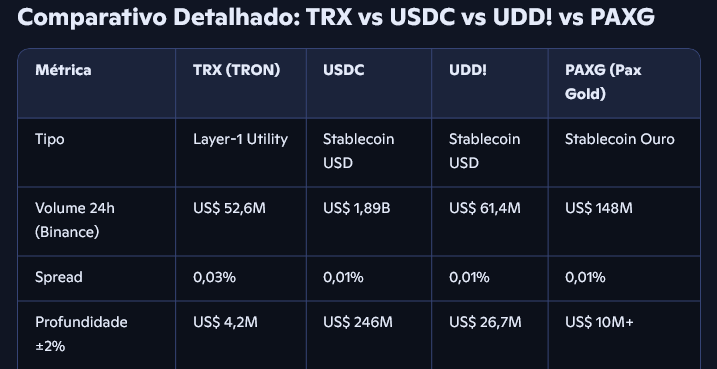
Liquidity is one of the most critical factors for institutional and retail investors, directly impacting execution costs and the efficiency of trading strategies. On Binance, the analyzed assets exhibit the following characteristics:
TRX/USDT: Depth of US$ 4.2 million at ±2%, spread of 0.03%, low slippage for orders up to US$ 500 thousand.
USDC/USDT: Depth exceeding US$ 240 million, spread of 0.01%, virtually zero slippage for institutional orders.
PAXG/USDT: Depth above US$ 10 million, spread of 0.01%, robust liquidity even during low volume hours.
UDD!/USDT: Reasonable depth, but concentrated liquidity and high slippage risk in orders above US$ 100 thousand.
Presence in DeFi liquidity pools (Uniswap, Curve, PancakeSwap) enhances off-chain liquidity, enabling arbitrage, farming, and hedge strategies. Institutional providers like Galaxy Digital, Cumberland, and Wintermute act as market makers, ensuring narrow spreads and efficient execution.
Derivatives, Open Interest, and Market Signals
The derivatives market on Binance offers futures and options contracts for TRX, USDC, and PAXG, expanding hedging, leverage, and structured strategies. Open interest in PAXG reached US$ 412 million, reflecting institutional participation and potential risk of cascading liquidations during periods of volatility.
The trading volume in USDC and TRX futures is also significant, with perpetual contracts and margins in stablecoins, allowing directional exposure and protection against sharp price movements.
On-Chain Analytics and Adoption Metrics
On-chain analysis reveals the accelerated growth of the TRON ecosystem, with over 10 million active addresses, daily peaks of 12.6 million transactions, and volume exceeding US$ 50 billion in stablecoin transfers. The TVL in DeFi on TRON exceeds US$ 6 billion, consolidating the network as one of the main ones for stablecoins and decentralized applications.
In the case of USDC, the number of active addresses, mint/burn volume, and integration with multiple blockchains strengthen global adoption and institutional trust. PAXG, in turn, stands out for on-chain transparency, public audits, and traceability of physical gold reserves.
Regulatory Risks, Compliance, and Transparency
The regulatory environment for stablecoins and tokenized assets has evolved significantly in 2025-2026, with the approval of the Genius Act in the U.S., IN BCB No. 701/2026 in Brazil, and guidelines from NYDFS for digital assets. Key points of attention include:
Proof of Reserves: Requirement for independent auditing, asset segregation, and public disclosure of reserves for stablecoins and tokenized assets.
Governance and Compliance: KYC/AML requirements, internal controls, key redundancy, and continuous monitoring of operations.
Listing and Delisting: Clear criteria for the inclusion and exclusion of assets on exchanges, focusing on transparency and investor protection.
Counterparty Risks: Assessment of smart contracts, token concentration, and exposure to operational failures.
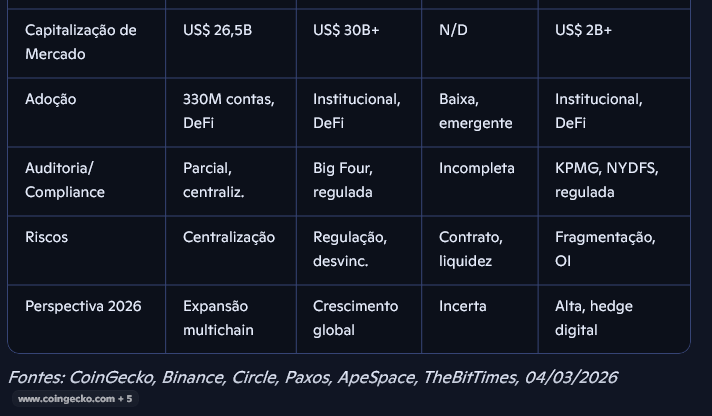
USDC and PAXG meet the highest compliance standards, with Big Four audits and regulatory oversight. TRX advances in governance but faces centralization challenges. UDD! still lacks complete auditing and transparency, representing high risk for conservative investors.
Investment Strategies and Allocation for Neglected Coins
Investing in neglected cryptocurrencies requires discipline, diversification, and careful analysis of fundamentals and risks. The main recommended strategies include:
Portfolio Diversification: Allocate part of capital to alternative assets such as TRX, USDC, PAXG, and emerging stablecoins, reducing exposure to extreme volatility of BTC, ETH, and SOL.
Fundamental Analysis: Prioritize projects with real use cases, growing adoption, transparent governance, and regulatory compliance.
Liquidity Utilization: Use DeFi pools, staking, and farming to generate passive income with assets like PAXG/USDC and TRX/USDT.
Risk Management: Define entry and exit plans, exposure limits, and monitor market signals (volume, open interest, on-chain flows).
Monitoring Roadmaps and Partnerships: Anticipate catalysts such as multichain integrations, ETF launches, institutional partnerships, and protocol updates.
Buy Signals and Future Catalysts
The main catalysts for appreciation and adoption of the analyzed assets include:
TRX: Expansion of the DeFi ecosystem, multichain integration via Avail Nexus, TVL growth, and institutional adoption.
USDC: Partnerships with banks and fintechs, integration with traditional payment systems, regulatory advances, and increasing demand for transparent stablecoins.
PAXG: Rise of physical gold, adoption by funds and DeFi platforms, integration with payment cards, and growth of the tokenized RWA market.
UDD!: Independent auditing, increased liquidity, listings on new exchanges, and strategic partnerships can boost confidence and adoption.
Investors should monitor official announcements, roadmap updates, and on-chain metrics to identify entry points and appreciation opportunities.
Final Message:
In 2026, liquidity, transparency, and solid fundamentals are the pillars for identifying opportunities beyond the hype. TRX, USDC, UDD!, and PAXG exemplify how neglected assets can become protagonists in a strategic portfolio, as long as they are analyzed rigorously and accompanied by disciplined risk management. Invest wisely, diversify, and always stay alert to market signals — the future of cryptocurrencies is beyond the obvious.
#TRX #USDC #UDD #PAXG #NeglectedOpportunities #DeFi #Stablecoins #TokenizedGold #InvestimentoEstratégico

