You all know that for some time now I have said that it is a good time to buy $XRP , and now that the price is going down a bit, I take this opportunity to make the reminder. At the same time, I come to talk a little about the project. As you may know, the digital asset designed by Ripple Labs for global payment settlement has a design and utility focused on financial institutions (banks, remittance companies), which places it in contrast to the common denominator of the crypto world and makes it prone to persistent criticism about its centralization, about breaking the ideals of pure cryptocurrencies like Bitcoin. However, this "contradiction" is not a flaw but the source of its unique value proposition, providing investors with regulatory clarity and real-world utility that distinguishes it from most digital assets.
Deconstructing the XRP Ecosystem
The Genesis Story: From Bitcoin Without Mining to Ripple Labs
The development of the XRP Ledger (XRPL) began in 2011, conceived by a trio of visionary engineers: Jed McCaleb, Arthur Britto, and David Schwartz. The project emerged from the motivation to create a global transaction system that overcame the limitations of Bitcoin, specifically its energy-intensive mining process and slowness. The original idea, discussed in public forums, was titled "Bitcoin without mining," a clear indication that XRP was not born as a simple copy but as an alternative solution to the perceived inefficiencies in the original design of cryptocurrencies. This focus on efficiency and speed from the outset laid the groundwork for the utility model that defines XRP today, fundamentally differentiating it from the "digital gold" store of value attributed to Bitcoin.
On the other hand, in 2012, the project came to life with the founding of the company OpenCoin by McCaleb, Britto, and Chris Larsen. The company, which would later be renamed Ripple Labs, was created to operate on the XRP Ledger, with the goal of facilitating faster and cheaper international money transfers. This close relationship from the beginning between the company, the ledger, and the digital asset has been a point of contention, but also a pillar of its development. Ripple's ability to direct development and strategic alliances has allowed the technology to mature quickly and adapt to the needs of the global financial market.
The Indivisible Triad: XRP, Ripple, and the XRPL
A common source of confusion in the digital asset ecosystem lies in the distinction between XRP, Ripple, and the XRP Ledger. Although they are intrinsically connected, they are completely separate entities.
XRP: The native digital asset of the XRP Ledger. Its fundamental purpose is to be a "bridge currency" to facilitate fast and efficient cross-border payments. Unlike Bitcoin or Ethereum, the total supply of XRP was pre-mined at launch, with 100 billion tokens created in total.
XRP Ledger (XRPL): The open-source and decentralized blockchain network on which XRP operates. Launched in 2012, it serves as the fundamental platform for recording and verifying all XRP transactions. The XRPL is an open-source project that any developer can use and contribute to, and is not directly controlled by Ripple as a company.
Ripple: The technology company that develops solutions for the financial industry, using the XRPL and XRP as key components. Ripple maintains a significant portion of the total XRP supply in an escrow account, periodically releasing tokens to the market to fund its operations and manage supply dynamics.
It could be said that the confusion between these three entities is the origin of the division of opinions about XRP. While advocates focus on the open-source and intermediary-free nature of the XRPL, critics direct their attention to Ripple's control over a considerable portion of the XRP supply and the fact that the company is the public face of the project. The existence of a CEO and other visible leaders at Ripple contrasts with the anonymous and decentralized nature of other projects like Bitcoin, generating skepticism about the actual level of decentralization.
The Technology Driving Instant Payments
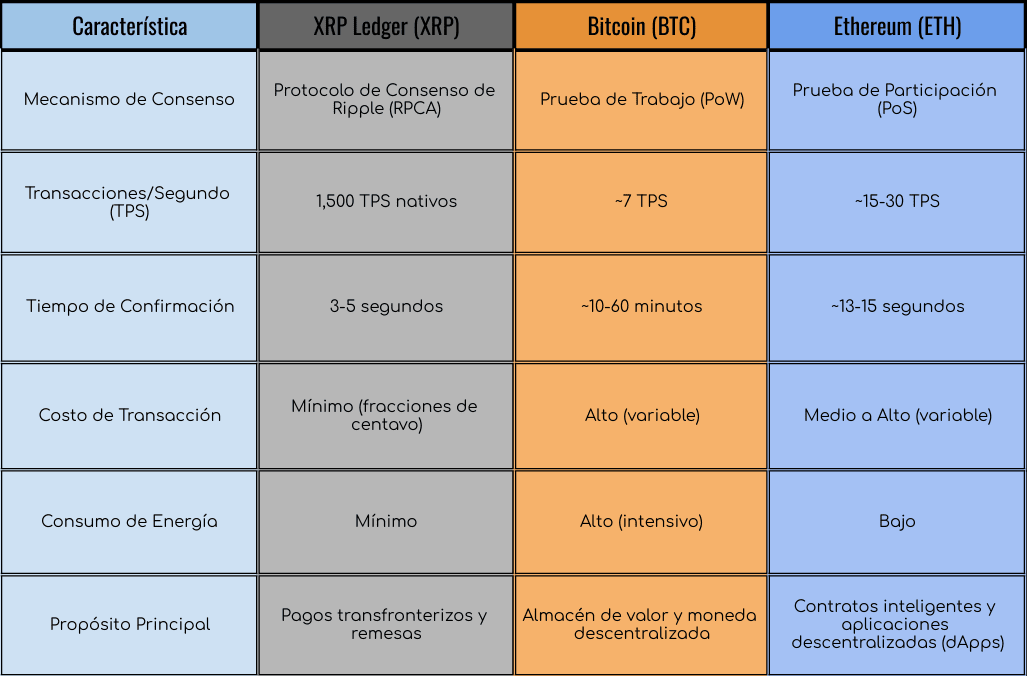
The XRP Ledger operates with a fundamentally different consensus mechanism than its predecessors and competitors. Unlike Bitcoin's Proof of Work (PoW) systems or Ethereum's Proof of Stake (PoS) systems, the XRPL uses a federated consensus protocol known as the Ripple Consensus Protocol (RPCA). This system is based on a network of independent and trusted validators that synchronize to confirm transactions. The network validators propose transactions for a new ledger and require a consensus of at least 80% of a subset of trusted nodes for transactions to be validated and added to the ledger.
It is important to highlight that this design has direct implications for the efficiency of the network. Transactions on the XRP Ledger are confirmed in just 3 to 5 seconds, with the capacity to handle up to 1,500 transactions per second (TPS). In comparison, Bitcoin processes approximately 7 TPS. This speed, combined with minimal transaction fees, makes the XRPL an ideal platform for high-volume global payments. Energy efficiency is another key advantage of the RPCA, as it consumes "much less energy than Bitcoin."
The choice of a federated consensus with a group of trusted validators is not an accident, but a design decision optimized for its main purpose. Traditional financial transfers are slow and costly, and any alternative system seeking institutional adoption must be fast, predictable, and economically viable. PoW consensus mechanisms, by design, are slow and expensive. Therefore, the design of XRP, often perceived as "centralized" by purists, is actually an intentional feature that prioritizes speed and low cost, which are the most important factors for its target market.
The Centralization Paradox: A Critical Analysis
The Pre-mined Supply and the Escrow Controversy
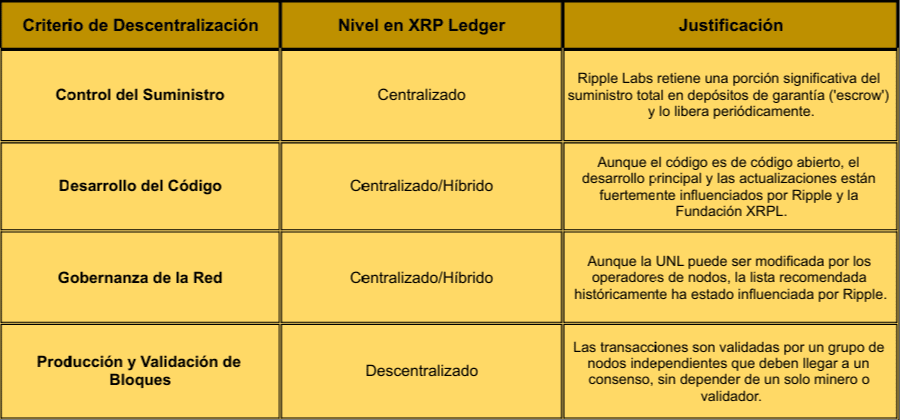
Undoubtedly, one of the most persistent criticisms against XRP is its token supply model. Unlike Bitcoin, which is progressively mined through a decentralized mining process, the total of 100 billion XRP tokens was pre-mined at launch. Of this total, the founders of the XRPL gifted 80 billion tokens to Ripple Labs. This initial control over a massive portion of the supply has led to accusations that Ripple may manipulate the market.
Therefore, to mitigate the perception of an uncontrolled release of tokens, Ripple has kept a significant portion of the supply in escrow accounts, with an estimated 35.9 billion XRP locked. The company has committed to periodically releasing a portion of these tokens to the market, often up to one billion XRP per month. While advocates see this mechanism as a transparent strategy to ensure a "measured and stable flow of tokens" and maintain market stability, critics perceive it as a tool to exert undue influence on the price of XRP. The accusation that Ripple "throws them to retail investors for profit" encapsulates the more cynical view of this model, placing it in an uncomfortable position for investors who value supply decentralization.
The Decentralization Debate: Theater or Reality?
Now we arrive at the topic that most concerns some "crypto experts", which is the perception of decentralization. Taking into account all of the above, it could be said that the decentralization of XRP is a spectrum, not a binary concept. In its defense, supporters point out that the XRP Ledger is an open-source platform and that anyone can run a validator node and choose their own Unique Node List (UNL) of trusted validators, which in theory gives the network a permissionless nature. However, the criticism focuses on Ripple's strong historical dependence on the network. During its early stages, Ripple operated a majority of the trusted validators, a decision made to prioritize security and scalability over initial decentralization. Although the company has articulated a strategy to gradually reduce its presence and promote validator diversification, the perception of control persists.
However, the confusion is exacerbated by Ripple's public leadership. The fact that CEO Brad Garlinghouse and other executives are the "faces" of XRP creates an apparent contradiction with the ideal of a digital asset without a centralized control point. From an analyst's perspective, the decentralization of XRP is a nuanced issue: while block production and validation are technically decentralized, code development, governance, and control over the token supply are perceived as highly centralized in the hands of Ripple. The term "decentralization theater" is often used to describe this dynamic, where it is argued that the network presents itself as decentralized while control remains in the hands of the company.
The Lack of a Robust Crypto-Native Ecosystem
A notable contrast between XRP and other layer 1 networks is its ecosystem. Critics point out that the XRPL has a "dead DeFi scene" and lacks significant development in cutting-edge areas like Real World Assets (RWA) or a vibrant dApp ecosystem. They argue that while real innovation occurs on other chains like Ethereum, Solana, or Avalanche, the XRP Ledger remains stagnant in its original use case.
This criticism, however, reveals a fundamental difference in how different stakeholders value the asset. For pure cryptocurrency enthusiasts, the value of a network is measured by the number of dApps, DeFi innovation, and the number of developers it attracts. For them, the lack of a flourishing ecosystem is a failure. However, for advocates of institutional utility, these metrics are secondary. The value of XRP does not reside in being a testing ground for decentralized innovation, but in its utility function as a tool for traditional finance. From a bank's perspective, a predictable, fast, and low-cost ledger that reduces operational expenses is much more valuable than a network with thousands of dApps and high volatility, highlighting that XRP critics and advocates are using fundamentally different evaluation frameworks.
The Institutional Catalyst: The Growth Case
Solving a Multi-Million Dollar Problem: The Inefficiency of SWIFT
The main value proposition of XRP is based on its ability to solve the inefficiencies of the traditional global payment system. Legacy systems like SWIFT, although ubiquitous, are notoriously slow, costly, and opaque. The need for banks to maintain pre-funded accounts in different foreign currencies (nostro/vostro accounts) around the world immobilizes billions of dollars in capital, leading to significant opportunity costs.
Therefore, Ripple's technology and the XRP asset are designed to eliminate these frictions. The ability to drastically reduce infrastructure and human resource costs for financial institutions is a massive growth factor. The remittance market, particularly in emerging markets, is a trillion-dollar sector that directly benefits from a solution that offers more affordable and faster transactions. This real-world need is the main driver behind the institutional adoption of Ripple's technology.
Ripple's Strategic Solutions: From RippleNet to ODL
Ripple offers two main products to address the cross-border payment problem:
RippleNet: It is a global payment network that acts as a modern alternative to legacy systems. It allows financial institutions to track and settle international payments in real-time. Unlike SWIFT, RippleNet connects its partners through simple APIs and is hosted in the cloud, reducing technical complexity and facilitating the onboarding of institutions.
On-Demand Liquidity (ODL): This is the solution that uses XRP as a "bridge currency" to eliminate the need for pre-funded accounts. The process works smoothly: a bank or financial institution converts its local currency to XRP in real-time, sends it through the XRP Ledger network in seconds, and the receiver instantly sells the XRP for their local currency at the destination. This process occurs without the sender or receiver holding XRP directly, reducing capital costs and improving efficiency. The upcoming RLUSD stablecoin, whose launch was approved by the New York financial regulator, will complement this ecosystem, providing a more stable and predictable liquidity solution that could further reduce transaction volatility.
The Partner List: A Parade of Heavyweights
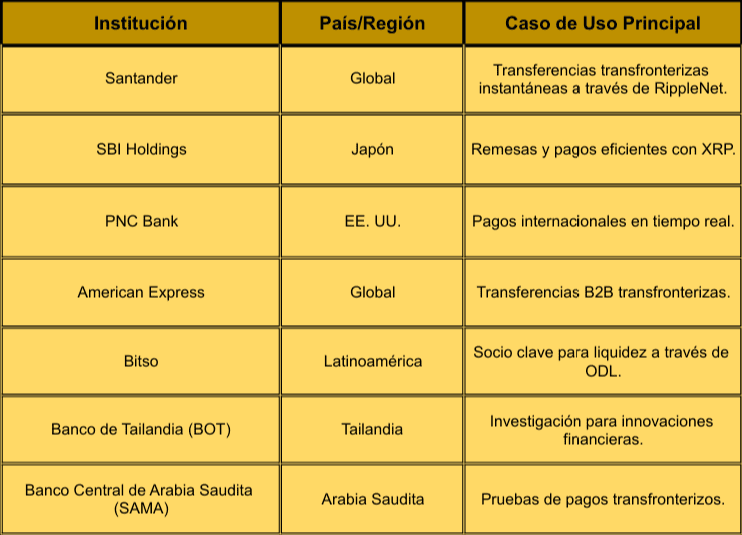
Despite the skepticism of the crypto community, Ripple has forged alliances with top-tier financial institutions globally, demonstrating a tangible use case and growing adoption. Notable partners include:
Santander: Facilitates international transfers based on RippleNet technology.
SBI Holdings: A financial conglomerate using technology for remittances.
PNC Bank: A U.S. commercial bank that uses Ripple's solutions for real-time international payments.
American Express: Uses RippleNet for fast global B2B transactions.
Furthermore, Ripple has collaborated with central banks, such as the Bank of Thailand (BOT) and the Central Bank of Saudi Arabia (SAMA), to test its solutions in cross-border payment projects and promote financial inclusion. This growing list of alliances with big names in traditional finance not only validates the technology but also generates trust in the market, contributing to a "relative stability" in the price of XRP compared to other smaller altcoins.
It is worth noting that a recent and significant development is the interest of massive asset managers like BlackRock in exploring exchange-traded funds (ETFs) centered on XRP. This interest suggests a shift in the perception of XRP, moving from being a technological tool to being an investment asset in itself, which could attract massive liquidity and institutional interest.
The Legal Crucible: The SEC vs. Ripple
The Beginning of the Battle: The SEC's Accusations
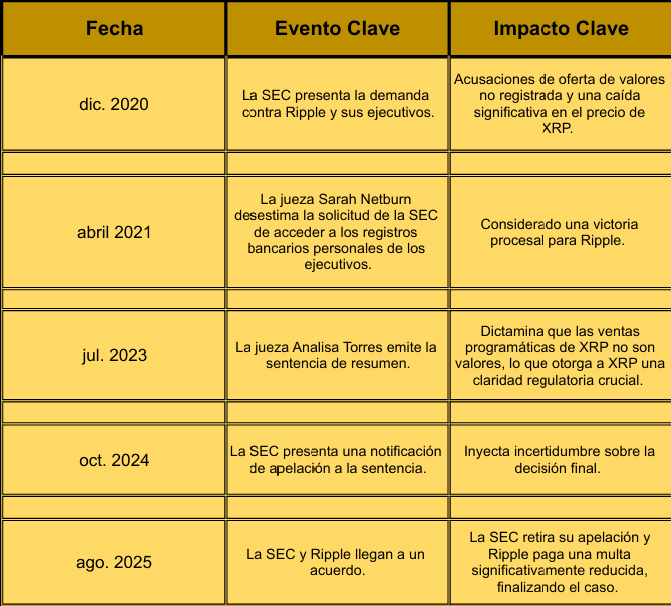
On December 22, 2020, the U.S. Securities and Exchange Commission (SEC) filed a lawsuit against Ripple Labs and two of its executives, Christian Larsen and Bradley Garlinghouse. The SEC alleged that Ripple had conducted an "unregistered securities offering" worth over $1.3 billion through the sale of XRP to investors worldwide since 2013. The main accusation was based on the premise that XRP met the criteria of the "Howey test," a legal standard for determining whether an asset is an "investment contract" and thus a security. The SEC argued that the company had deprived potential investors of essential information disclosures to which they were entitled under federal securities laws. This case became the primary example of the SEC's "regulation by enforcement" approach in the digital asset space.
The Historic Ruling and Regulatory Clarity
After almost three years of litigation, Judge Analisa Torres of the U.S. District Court for the Southern District of New York issued a ruling of great importance in July 2023. The decision represented a "partial victory" for Ripple, as the judge ruled a crucial distinction that changed the regulatory landscape of cryptocurrencies in the U.S. The court concluded that:
Institutional Sales: Direct XRP sales by Ripple to institutional investors, conducted through structured agreements, were considered unregistered securities offerings, constituting a violation of securities law.
Programmatic Sales: Secondary XRP sales on cryptocurrency exchanges did not constitute investment contracts and therefore were not securities. The court reasoned that retail buyers acquiring XRP on these exchanges did not have a "reasonable expectation of profit based on Ripple's efforts," a central piece of the Howey test.
This ruling was a turning point for XRP. Not only did it unclassify the asset for most retail investors in the secondary market, but it also set a precedent that could apply to other digital assets. The ruling established that the classification of a digital asset depends on "how it is sold" rather than the inherent nature of the asset itself. This legal development provided XRP with regulatory clarity that many of its competitors lacked, which drove the asset's reintegration into several major exchange platforms and a significant surge in its price.
The Outcome and Legal Finality
The nearly five-year legal case concluded in August 2025 with an agreement between the parties. The SEC withdrew its appeal, and Ripple agreed to pay a penalty of $125 million, a figure significantly lower than the $2 billion that the SEC had initially requested. In a dissenting statement, an SEC commissioner criticized the settlement, arguing that it undermined the court's ruling and created a regulatory vacuum. However, the outcome legally cemented XRP's status in the secondary market as a non-security asset, providing a stamp of approval that few other digital assets in the space can claim. This unprecedented regulatory clarity has become one of XRP's greatest competitive advantages in the market.
Synthesis and Conclusion: A Nuanced Perspective
Reconciling the Division: A Bivalent Asset
Basically, the division of opinions about XRP is based on two conflicting narratives. On one hand, the pure crypto community evaluates it with metrics of decentralization and growth of the native ecosystem and concludes that it does not meet the ideals of a digital asset. On the other hand, the traditional finance community evaluates it with metrics of utility, efficiency, and regulatory compliance and sees massive potential. The central "contradiction" of XRP (centralized yet useful for institutions) is its value proposition. The centralization and control of Ripple over the supply and development, often criticized, are the same characteristics that provide institutions with the stability, predictability, and point of contact they seek. For banks, a predictable and trusted technology partner is much more valuable than a completely anonymous and permissionless network.
The Way Forward: Future Opportunities and Risks
The path forward for XRP is marked by a series of interrelated opportunities and risks.
Opportunities:
Greater Institutional Adoption: The regulatory clarity obtained from the victory against the SEC opens the door for greater integration with global financial institutions.
New Products: The launch of the RLUSD stablecoin and the potential for ETFs could attract massive institutional capital to the ecosystem.
Emerging Markets: The ODL technology remains a cutting-edge solution for remittances in developing economies, where efficiency and low cost are paramount.
Risks:
Market Volatility: Despite its focus on stability, the price of XRP remains susceptible to the overall volatility of the cryptocurrency market, and rapid swings can increase the likelihood of unexpected losses for investors.
Technological Competition: Other networks, such as Solana or Avalanche, offer higher TPS and a more robust DeFi ecosystem, which could become a long-term technological alternative for certain applications.
Remaining Regulatory Risk: Although the SEC case has been resolved, global regulation of cryptocurrencies remains an evolving landscape that could affect its trajectory in different jurisdictions.
Final Verdict: It's not "Bitcoin 2.0", it's a "Financial Instrument 2.0"
It can finally be said that XRP should not be judged under the same criteria as Bitcoin or Ethereum. It is a niche digital asset, designed with a singular purpose: to be an instrument for solving the inefficiencies of global finance. Its success will not be measured by the number of decentralized applications or by innovation in DeFi, but by its adoption and use in banking systems. For investors, the value of XRP lies in its ability to bridge the gap between the world of cryptocurrencies and traditional financial infrastructure. It is an asset that, by accepting its own contradictions, has found its unique path to utility and growth. Its use case, the regulatory clarity it now possesses, and its strong alliances position it as a unique player in the crypto space, one that has opted for collaboration with traditional finance rather than complete disruption.