
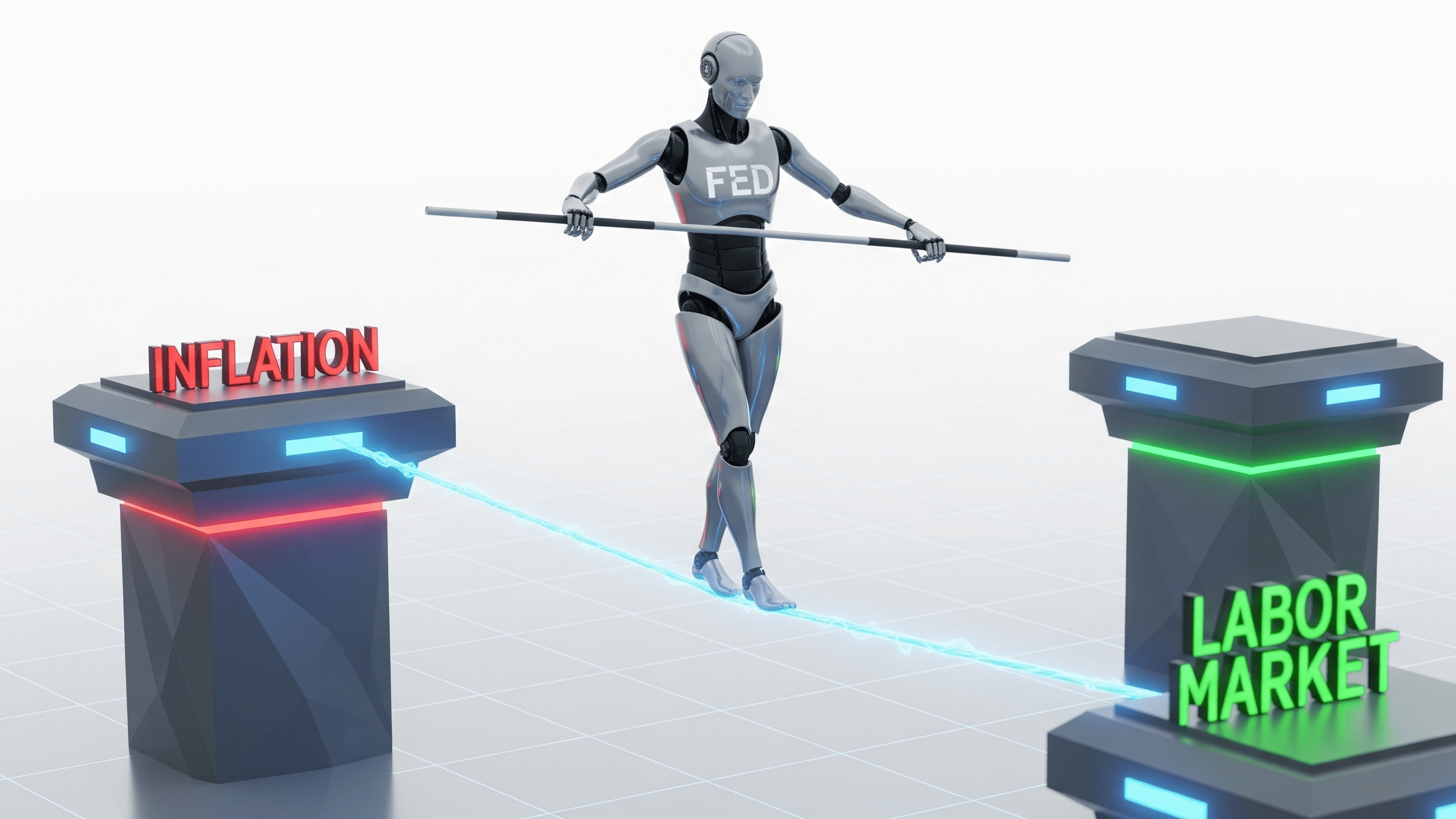
In the ever-unfolding narrative of global finance, there are moments when the clear waters of economic certainty give way to a foggy, unpredictable ocean. We've seen projects and products launch with the kind of fanfare that suggests a new dawn, only to fizzle out like fireworks on a rainy night. These are the ventures built on the thin air of speculation and hype. But there are other, more enduring forces at play. They are the builders who work with purpose, guided not by the fickle whims of a crowd but by the bedrock principles of their mission. In the world of central banking, this is the story of the U.S. Federal Reserve, a monolithic institution tasked with a singular, purpose-driven mandate: to find a stable path through the currents of inflation and employment. Its latest decision to cut interest rates is not a victory lap, but a calculated, cautious maneuver in a high-stakes game where every move is scrutinized and every ripple has a consequence.
The Conductor and the Orchestra: A Dual Mandate's Delicate Harmony
To understand the Federal Reserve's recent actions, one must first grasp the core of its purpose. It's an institution governed by a "dual mandate" handed down by Congress: to achieve both maximum employment and stable prices. Think of it as a conductor leading a vast and complex orchestra. One section, the violins, represents the labor market, their collective sound a measure of the nation's economic vitality. The other, the brass, is inflation, whose volume can either add richness to the composition or overwhelm it with a jarring dissonance. The conductor's job is to keep both sections in perfect harmony.
For the past several years, the brass section had been playing far too loudly. Inflation, a ghost from decades past, returned with an unsettling force, prompting the Fed to raise interest rates aggressively to cool the economy and tame rising prices. This tightening of monetary policy was a necessary, if painful, course correction. But like any good conductor, the Fed must also listen to the violins. Recent data has shown a different, more concerning tune emerging from the labor market. Job growth has slowed, and while the unemployment rate remains historically low, it has begun to tick up, creating a rising note of unease. The Fed’s latest rate cut is a response to this shift, an acknowledgment that the risks to employment have risen to a point where they demand attention. It is a subtle but significant signal that the focus is now broadening from just battling inflation to actively managing the health of the job market.

The Unfolding Tapestry of Economic Indicators
The Fed's decisions are never made in a vacuum. They are a response to a complex tapestry of data, woven together from countless threads of economic activity. The most recent thread to catch the Fed's eye was the slowing pace of job gains and the subtle but undeniable rise in unemployment. This is not a sudden collapse, but a gradual weakening, akin to a runner slowing their pace after a long sprint. The Fed has taken note of this moderation, recognizing that a weakening labor market can be a precursor to broader economic stagnation.
However, the picture is not entirely clear. While the job market shows signs of softening, inflation remains a persistent shadow. The Fed’s preferred gauge, the personal consumption expenditures (PCE) price index, has shown that prices, particularly for services, are still rising faster than the Fed's 2% target. This creates an "unusual" and difficult situation. A traditional playbook would suggest that when inflation is high, you raise rates. But when employment is faltering, you cut them. The current environment forces the Fed to make a difficult choice, weighing the immediate risks to employment against the long-term threat of entrenched inflation. Their decision to cut rates indicates that, at least for now, they see the potential for a weakening labor market as the more pressing concern, a risk to be managed preemptively.
A Ripple Effect Across the Financial Landscape
The Fed's actions don't just stay within the hallowed halls of the central bank. They send ripples across the entire financial system, touching the lives of ordinary people in ways both subtle and profound. For consumers, a rate cut can feel like a gentle loosening of the financial reins. Interest rates on variable-rate loans, such as some credit cards and adjustable-rate mortgages, may see a gradual decline. This can provide a small measure of relief to households carrying debt, easing the burden of monthly payments. However, the impact on fixed-rate loans like long-term mortgages is less direct and more muted, as these rates are more influenced by the broader bond market.
On the flip side, savers may see a decline in the returns on their high-yield savings accounts and certificates of deposit (CDs). The attractive yields that have been a silver lining for cash holders during the high-interest-rate environment may slowly begin to recede. For businesses, a lower federal funds rate can make it cheaper to borrow money, potentially stimulating investment and expansion. This is the very mechanism by which the Fed aims to boost economic activity and, in turn, support the job market. The hope is that this cheaper credit will encourage companies to hire more, helping to reverse the recent slowdown in job creation.
The Path Ahead: A Data-Dependent Journey
The recent rate cut is not a definitive end to the Fed’s policy cycle. It is more accurately described as a turning point, a new chapter in the ongoing economic story. The Fed has made it clear that its future actions will be "data-dependent," a phrase that emphasizes the institution's commitment to flexibility and responsiveness. They are essentially saying that the course of monetary policy from this point forward will be dictated by the incoming data on inflation, employment, and overall economic growth.
The road ahead is filled with uncertainty. Will the rate cut be enough to stabilize the labor market without reigniting inflation? Will the tariffs and other geopolitical factors that are currently pushing up prices prove to be a "one-time shift" as the Fed hopes, or will their effects be more persistent? The answers to these questions will shape the next few moves of the central bank. The market is currently pricing in the possibility of additional cuts in the coming months, but this is an expectation, not a guarantee. The Fed’s decisions will be a delicate dance, balancing the two pillars of its dual mandate and navigating a world where the old economic rules seem to be constantly challenged.
A Return to Fundamentals and a Look to the Horizon
In a world often swept up in the latest trend and fleeting excitement, the Federal Reserve's work stands as a testament to the importance of foundational principles. Its focus on its dual mandate of maximum employment and stable prices is a reminder that true value is built on a solid base, not a precarious one. The current economic situation, with its complex mix of slowing job growth and elevated inflation, underscores the resilience required of both institutions and individuals. The Fed’s recent action is a reflection of a long-term vision, a commitment to steering the economy through a period of uncertainty while keeping its ultimate goals in sight. It's a journey not for the faint of heart, but for those who understand that progress is often a slow, deliberate process, not a sudden, explosive event.
As the central bank signals a new phase of its monetary policy, the world watches. The future of a stable, prosperous economy is not about overnight gains or fleeting headlines. It's about the steady hand that guides the ship, ensuring that the engine of progress is fueled by purpose and resilience, not just fleeting gusts of wind. The journey continues, one data point at a time, toward a horizon where both employment and price stability can coexist in a new, hard-won harmony.