

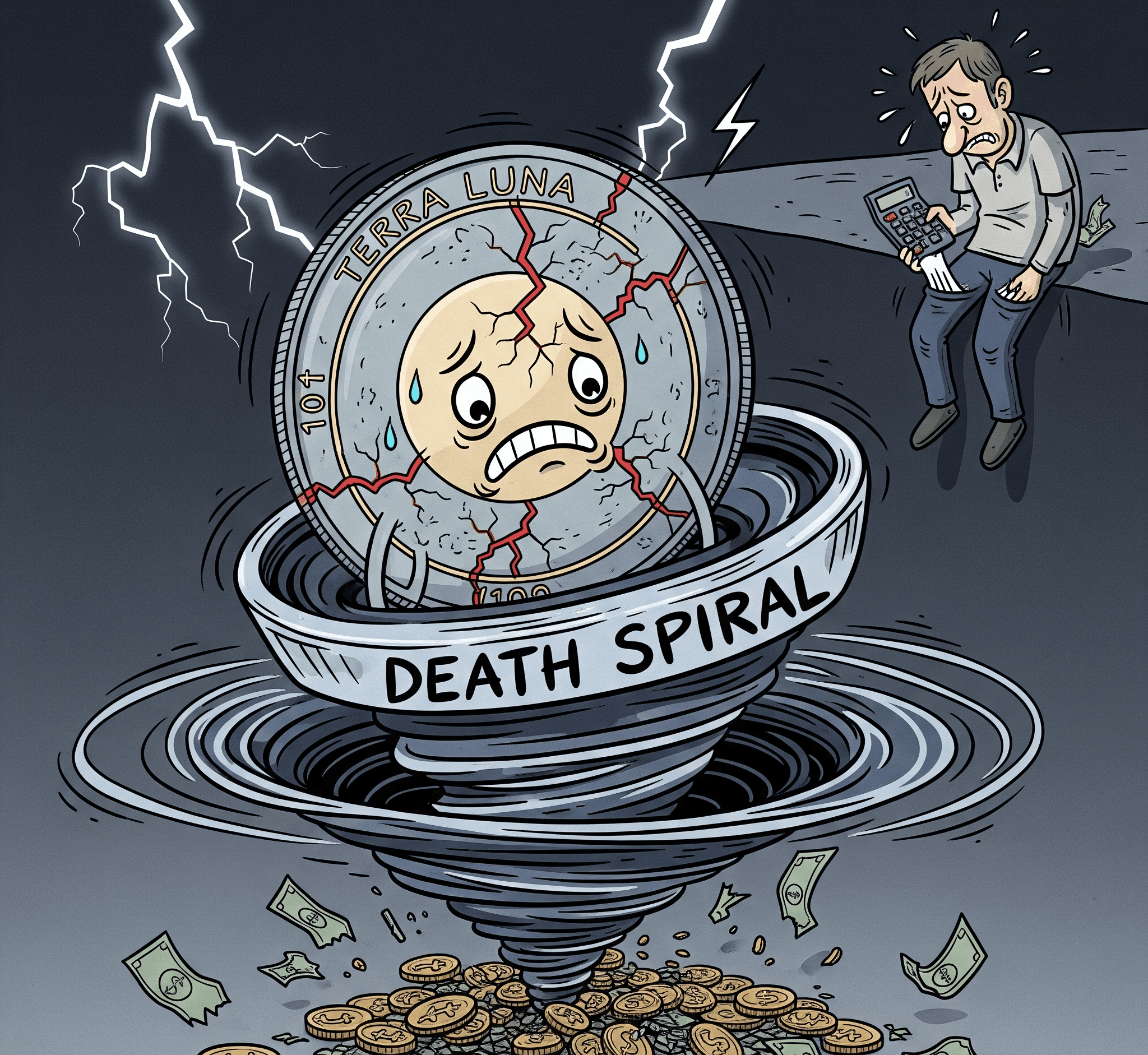
In 2022, the price of a crypto coin was $199. However, within a few days, it plummeted to $0.0006. This is a significant disaster in the history of crypto. This event happened to Terra Luna and its stablecoin UST. It is now referred to as Terra Classic (Terra Classic – LUNC).
What is Terra Classic?
The Terra blockchain, created by Do Kwon and Daniel Shin in 2018, was introduced in 2019. Its main goal is to facilitate global monetary transactions through a stablecoin called UST.
The algorithm was designed to ensure that the value of UST would always be equal to $1.
A token called LUNA was used to support UST.
How did it operate?
This system worked in an interesting manner.
If the price of UST rises above $1: new UST will be created, and LUNA tokens will be burned.
If the price of UST falls below $1: UST will be burned, and new LUNA tokens will be created in its place.
Investors capitalized on this price discrepancy, earning profits through high interest. This led to the expectation that UST would always remain pegged at $1.
How did the catastrophe occur?
In May 2022, a major investor began to sell UST in large quantities. As a result, its price suddenly dropped below $1.
To correct this decline, the algorithm created billions of new LUNA tokens.
Due to excessive LUNA creation, its value plummeted rapidly.
As a result, hyperinflation occurred, and the price of LUNA fell from $199 to $0.00001 in a few days. Investments worth approximately $40 billion went missing.
This decline caused panic among investors. As a result, they started selling their LUNA tokens. This led to a disastrous situation known as a 'death spiral.'
After this decline, the Terra blockchain split into two. The new one is called Terra 2.0 (LUNA 2.0) and the old one is called Terra Classic (LUNC).

Why did it fail?
Here are the reasons for the Terra Luna crash:
Peg Break: The value of UST could not be maintained at $1 due to market pressures.
Anchor Protocol: It attracted many investors by offering a 20% interest rate. However, this interest rate was unsustainable and excessively high.
Loss of confidence: Once the price of UST began to decline, investors lost their confidence and attempted to exit quickly. This further drove the price down.
Excessive LUNA supply: The algorithm endlessly created new LUNA tokens, leading its value to approach zero.
What are the consequences?
UST is currently called USTC, but it is no longer a stablecoin. As of September 2025, the price of USTC is only $0.013.
This event undermined global confidence in algorithmic stablecoins.
Other stablecoin projects like DAI and FRAX have started to stabilize their value by incorporating real assets (collateral) rather than relying solely on algorithmic methods.
Regulatory bodies like the SEC and EU have started to monitor stablecoins more closely.
The lessons we need to learn
Algorithmic stablecoins are highly complex and risky.
These are not backed by real assets, relying solely on investor confidence.
"Peg" breaking means the entire system collapses.
Investors must always adhere to risk management in their investments.
This event highlights the volatility of the crypto market and how crucial the foundational structure of a project is.


