
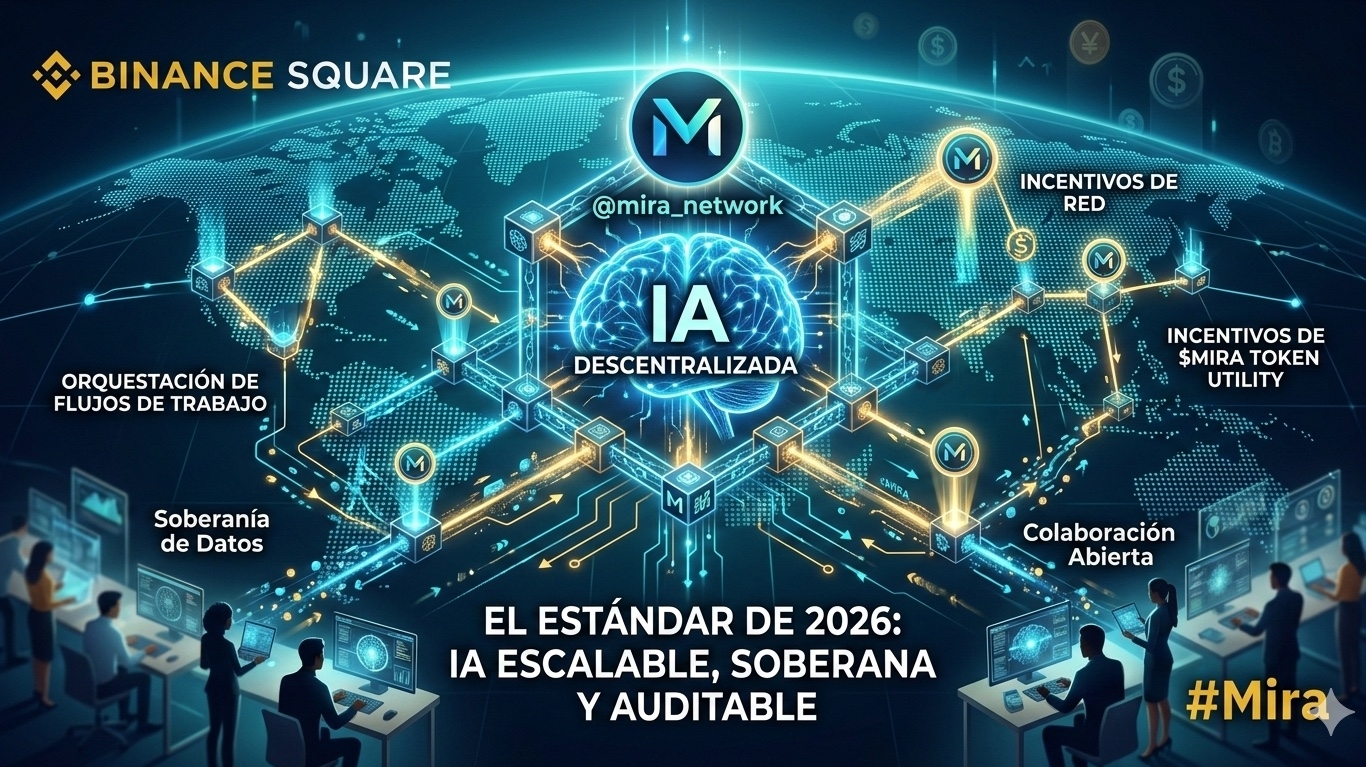
In a world saturated with technological promises, the difference between success and oblivion lies in real utility. During this 2026, we have seen how many Artificial Intelligence (AI) platforms have failed when trying to scale under centralized models that compromise privacy. In contrast, #Mira has demonstrated that decentralization is not an obstacle, but the greatest competitive advantage in the sector.
Orchestration: The secret ingredient of #Mira
Most users think of AI as a simple answer to a question, but behind it are massive workflows. The infrastructure of @Mira - Trust Layer of AI allows these flows to be orchestrated sovereignly. By using the token $MIRA , developers can connect various models and data sources without a single entity having total control or access to sensitive information.
This capability of "real-time auditing" is what is attracting major Web3 developers looking to integrate intelligent processes into their applications without sacrificing the principles of blockchain.
The Organic Growth of the Token $MIRA
The strength of the network is reflected in the economy of the token $MIRA . Unlike other purely speculative assets, its value is anchored to:
Computing Demand: Every time a company optimizes an AI workflow on the network, the utility of the token increases.
Node Security: Validators are incentivized to maintain data integrity, creating a zero trust environment but with high fidelity.
Active Governance: The community decides where development resources go, ensuring that the network evolves with the market.
Conclusion: A Step Forward in Web3
We are witnessing an evolution where intelligence becomes a common good. With $MIRA , we are not only facing a technical advance but a standard of digital ethics. If you are an investor or builder in the crypto space, understanding the role of @Mira - Trust Layer of AI is essential to comprehend the dominant narrative of this year.