
It was a little after midnight when I reopened the dashboard.
The market had already quieted down for $ROBO on Binance. Price was hovering around the 0.04 range, far calmer than the sharp move toward 0.062 earlier in the week.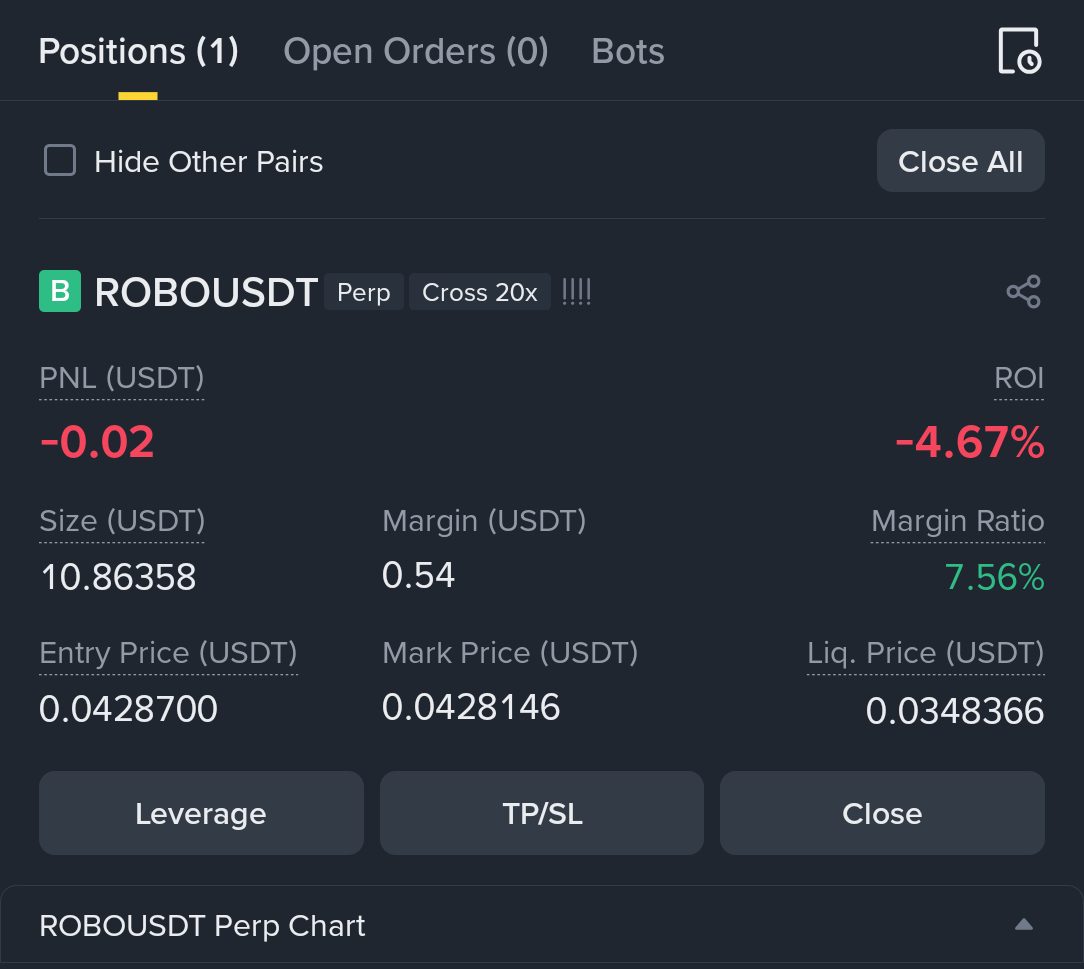
On the surface, it looked like a typical cooldown.
But charts rarely tell the full story.
The candles had slowed into that familiar pattern traders call hesitation. Volume faded. Momentum indicators that were loud just days earlier had gone silent.
The kind of calm that appears when a market is trying to decide something simple:
Is this real value — or just another narrative?
And that’s when another thought started to form.
If Fabric actually succeeds, the real shift won’t appear first on the chart.
It will appear in the machines.
Most people still think of robots as tools. Expensive ones, maybe, but still tools — devices that execute instructions sent by companies, servers, or human operators.
The authority always sits somewhere above the machine.
Fabric challenges that model with a different idea:
A robot that can prove its own integrity.
At first it sounds abstract. But it becomes clearer when you imagine machines interacting across multiple systems.
A logistics robot reporting delivery data.
An inspection device scanning infrastructure owned by another company.
A manufacturing unit receiving remote firmware updates.
In those moments, trust becomes complicated.
Who verifies the robot’s software hasn’t been altered?
Who confirms the data actually came from an authentic device?
Traditionally that responsibility lives inside the manufacturer’s infrastructure.
Fabric adds another layer — one where the machine itself can generate proof from within its processor.
That’s where Trusted Execution Environments come in.
Inside the hardware, a protected enclave isolates sensitive code and produces an attestation signal confirming the system hasn’t been modified.
If firmware changes or the device is tampered with, the signal fails.
The mechanism is simple.
The implications are not.
For the first time, a robot could provide cryptographic proof that its internal state matches what the manufacturer intended.
I remember a logistics project last year where we learned how fragile device trust can be. Everything looked correct in the software layer — until we realized the physical sensors had been spoofed.
The blockchain records were accurate.
They were just recording bad hardware data.
That experience changed how I think about machine verification.
Data alone isn’t enough.
You need proof from the device itself.
When you step back, Fabric starts to look like a system built on three pillars:
Machine identity — every device carries a unique cryptographic fingerprint.
Verifiable integrity — secure environments prove firmware and operating state.
Network accountability — machine actions can be verified across the network.
If those pieces work together, the robot stops being just a tool.
It becomes an active participant in digital infrastructure.
Tonight the chart still moves slowly around 0.04. Traders see support levels, resistance zones, and possible momentum shifts.
But sometimes the chart feels like the least interesting part of the story.
Because the real experiment here isn’t about price discovery.
It’s about whether industries will accept a future where machines join the trust network — where robots don’t just execute tasks, but prove their authenticity to the systems around them.
And if that shift actually happens, these quiet hours watching the chart might one day feel like the early chapters of something much bigger.