
Recently, I have deliberately reduced the frequency of watching the market and even muted those market alert apps on my phone that ring incessantly every day. After years of struggling in the cryptocurrency market, I have witnessed too many concepts rise and fall, from the early payment revolution, to the later public chain wars, and then to the frenzy of decentralized finance and the burst of the bubble of non-fungible tokens. However, as time has moved to today, when the entire market and even the whole tech world is engulfed in the frenzy of artificial intelligence, I feel an unprecedented fatigue and vigilance amidst the noise.
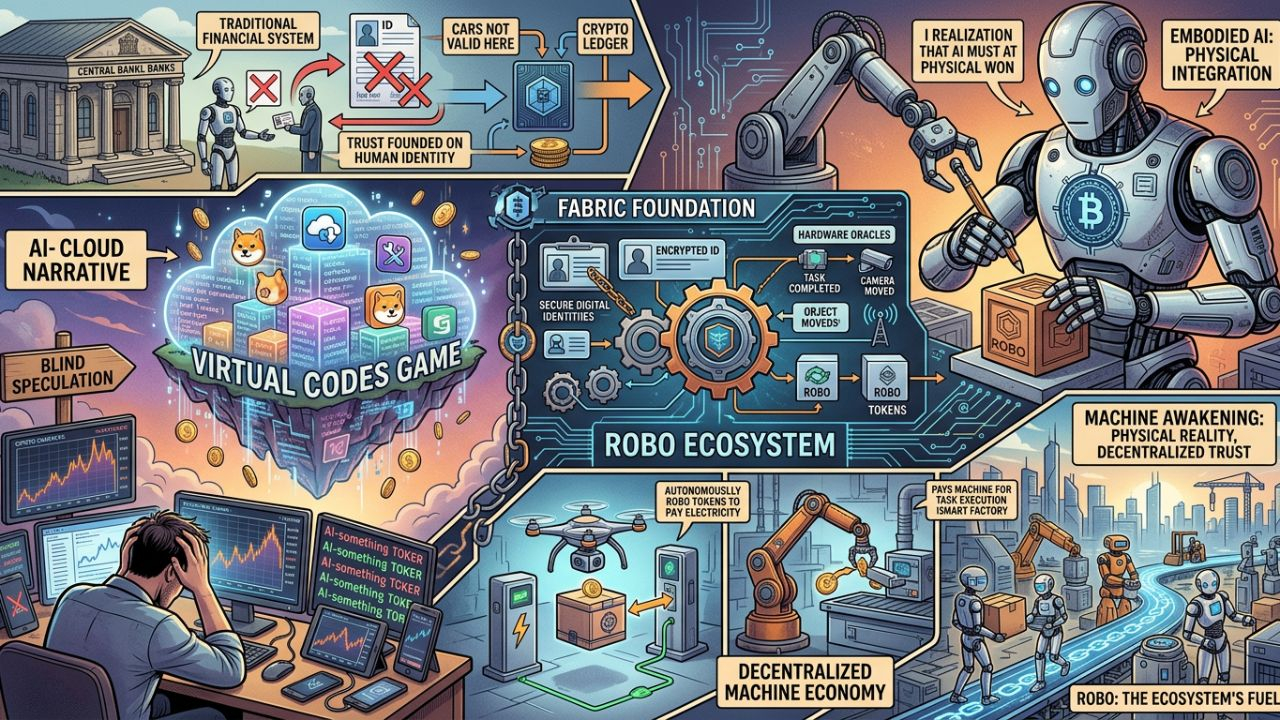
During this cycle, we witnessed an extremely distorted and crazy scene: countless funds rushed blindly into any project related to artificial intelligence, like wild horses. Every day new tokens are born, packaged with extremely gorgeous rhetoric, claiming to be the next decentralized computing network or a super agent capable of disrupting human creativity. But if you truly settle down and penetrate through those fancy web pages and obscure white papers to explore their underlying logic, you will despairingly discover that ninety-nine percent of these projects are just digital games of crazy nesting on cloud servers. Everyone is calling each other fools in the ethereal world of code, speculating with real money on those invisible, untouchable, and even incapable of closing a real business loop pure software concepts. It is like a group of people building a mirage in the desert, where the competition is not about who has a solid foundation, but who can paint a more realistic illusion.
It is this extreme weariness of pure cloud narratives that has led me to shift my gaze to another direction, a heavy, slow, and even in the eyes of many old players in the crypto space, utterly unsexy track, but one that can truly change the operating laws of the physical world. This is also why, when I deeply researched Fabric Foundation and the ROBO ecosystem behind it, I felt a long-lost, scalp-tingling shock. This shock does not stem from a short-term stimulus of a sudden price surge, but from a profound realization of the underlying form of human-machine symbiosis in the next decade.
We need to ponder a very fundamental philosophical question: what is the ultimate form of artificial intelligence? Is it really just a super brain forever imprisoned in server rooms, only able to interact with humans through screens and keyboards? Absolutely not. Any great technology, if it cannot ultimately act on the physical world, cannot change the arrangement of atoms, cannot practically move objects or create tangible value, can at most be regarded as a high-level entertainment tool. The second half of artificial intelligence must walk out of server rooms, grow steel skeletons, and deeply integrate with the physical entities of the real world. This is what we call embodied intelligence, the ultimate fusion of robotics and artificial intelligence.
As models become smarter and able to understand the common sense of the physical world and plan complex movement trajectories, a severe bottleneck emerges that most people completely ignore: how should these entities, which are about to possess autonomous behavioral capabilities, participate in human economic society?
Close your eyes and imagine such a scenario: in the not-so-distant future, you have a fully automated home service robot. When it detects that the floor in your home is dirty, it needs to activate its vacuum mode. However, when its battery runs low, it needs to walk to the charging station to recharge itself. If this charging station belongs to a third-party operator, how should the robot pay for the electricity? If one of its mechanical joints shows signs of wear, and it discovers the issue through its diagnostic system, then autonomously orders a replacement part online, how should it settle the payment with the supplier? Furthermore, if in a large unmanned factory, hundreds of different models of logistics robots and manufacturing mechanical arms need to collaborate, how should they perform real-time settlements of small values to ensure the efficient operation of the assembly line?
In the traditional financial system, this is almost an unsolvable deadlock. You cannot have a robot with its factory qualification certificate queue up in the bank's lobby, submit its identification to the teller, and then complete a cumbersome review process to open a bank account. The traditional financial network is designed for humans who have carbon-based bodies and legal identities, and its trust foundation is established on centralized government credit and legal contracts. For the cold machines composed of silicon chips and metal gears, they are the unregistered entities that do not exist in the traditional financial system. They lack identity, lack credit, and cannot own private property.
This is why I am extremely certain that the true killer application of blockchain technology and crypto assets is definitely not to hype those meaningless animal emoji, but to serve as the underlying infrastructure of the machine economy era. Only in a permissionless, decentralized, cryptographically proven ledger network can machines truly obtain their economic sovereignty.
And this is precisely the grand narrative that Fabric Foundation is secretly and solidly advancing. When you deeply understand its vision, you will realize how narrow-minded those who shout for purely software artificial intelligence tokens on Twitter are. Fabric Foundation is not just a token joining the hype; it is building a settlement protocol for the hundreds of billions of autonomous robots that can genuinely operate in the physical world.
The core of this protocol is to solve the trust and value transfer issues between machines and between machines and the human world. In the architectural concept of Fabric Foundation, every robot connected to the network, whether it is a drone flying in the sky, an autonomous vehicle running on the ground, or a mechanical arm in a factory, will have a unique digital identity based on asymmetric encryption technology. This identity does not require approval from any centralized institution; the moment a machine is manufactured or activated, it inherently possesses the right to participate in the decentralized network.
More importantly, Fabric Foundation is dedicated to solving an extremely hardcore technical problem: how to verify real state changes in the physical world. In the purely software blockchain world, everything is transparent code, and smart contracts can easily verify whether a transfer has occurred. However, when a smart contract needs to execute based on events in the physical world, such as verifying whether a robot has indeed completed the weeding or whether it has truly delivered goods to the designated location, a highly rigorous hardware oracle and cryptographic verification mechanism is needed. Fabric Foundation is ensuring that the sensor data collected by machines and the physical actions performed can be reliably put on the chain, allowing smart contracts on the chain to seamlessly direct the steel behemoths in the real world.
In such a vast and intricate machine economy operation system, ROBO plays a crucial role. It is not just a medium of transaction; it is the blood, fuel, and trust certificate of this new ecosystem.
Many players in the crypto space, accustomed to making quick profits, always scoff at this track involving physical hardware and complex physical verification. Their logic is simple: hardware is too heavy and the cycle too long. Developing a model, writing a few lines of code, and forking a new project overnight can push its market value to the sky through viral marketing in just a few days. How exciting! But when you try to work on robotic protocols, wrestling with sensors, communication modules, and complex interdisciplinary integration, when will you see returns?
This shortsighted thinking is precisely the most fatal trap in this market. Because the threshold for pure software projects is extremely low, their protective moats are actually as thin as a cicada's wings. You can attract all the attention with a new concept today, and tomorrow another team that tells a better story will ruthlessly replace you. Funds frantically gamble in these cloud illusions, and in the end, what remains is often just a mess and countless trapped retail investors.
However, ecosystems built on physical reality and machine interconnection are completely different. This is a muddy road that requires real tools to lay infrastructure in the physical world, to wrestle with countless hardware manufacturers over protocol standards, and to solve communication delays between hardware and blockchain line by line of code. This road is extremely difficult and slow, but once its network effect begins to manifest in the real world, and once the first batch of autonomous robots completes their first commercial closed loop without human intervention on this network, the barriers it establishes will be an insurmountable chasm that no purely fictional concept project can ever cross.
Imagine a future business scenario: you are walking down the street and see an automatic vending robot paying a small fee to a cleaning robot because the cleaning robot has just cleaned the area around the vending machine, improving its business environment. The entire process is completed without Alipay, WeChat Pay, or bank card networks; only the underlying protocol instantly achieves consensus and settlement. Robots earn their own tokens by contributing labor, and then use these tokens to purchase electricity, bandwidth, computing power, or services from other robots. They become independent economic entities that spontaneously form an efficient, transparent, and tireless microeconomic ecology under the macro rules set by humans.
This is definitely not a science fiction novel, but an industrial revolution quietly happening right under our noses. While we are still amazed by a funny dialogue generated by a large language model, and celebrating a crude generative video, the real disruptors are already using cryptography and blockchain technology to forge the economic soul of these soon-to-awaken steel bodies.
At this critical juncture of paradigm shift, we need to re-examine our definition of value. In this era of information explosion and extremely scattered attention, what can truly solidify value is no longer those virtual experiences that can be copied at any time, but those infrastructures that can genuinely reduce the operating costs of the physical world and improve collaboration efficiency in the physical world. The rise of the machine economy means that humanity will be completely liberated from the heavy repetitive physical labor, and the cornerstone that supports the orderly operation of this vast machine empire is the decentralized network that enables machines to establish trust and complete transactions.
Looking back at history, every major technological revolution is often accompanied by the generation and bursting of huge bubbles. In the early days of the internet, people crazily speculated on various domain names and web pages, but overlooked that what truly changed the world were later e-commerce, mobile payments, and local life services. In the early days of the crypto market, people frantically speculated on various payment coins and air chains, but ignored that what had real vitality were those foundational protocols that could support decentralized finance and digital asset ownership.
Today's artificial intelligence track is going through the same stage. A large amount of capital has lost its direction in the illusions of the cloud, but the real undercurrents have already gathered at the foundation of the physical world. When I look at the current market's blind worship of purely artificial intelligence software concepts and compare it with hardcore projects like Fabric Foundation, which are dedicated to bridging the physical and digital, machines and economic veins, I feel a clarity that others may be intoxicated while I remain sober.
The hundredfold or even thousandfold alpha returns over the next decade will definitely not emerge from those cloud programs that can only write poetry and paint. They will surely arise from those capable of enabling machines to automatically plant trees in deserts, allowing drones to autonomously deliver goods across the global network, and enabling all these physical entities to autonomously settle through decentralized ledgers within massive protocols. This is a grand project that forcibly stitches the virtual encrypted world to the real physical world, where the pain, friction, and challenges will be unprecedented, but the value space it nurtures will also be immeasurable.
So, when the countdown ends, and I watch the numbers on the screen jump, I did not choose to press the buy or sell button for short-term speculation. I chose to close the trading interface because I know that what I am witnessing is not simply the launch of a new token, but the prologue of a great transformation that will reconstruct the foundational economy of the entire Earth over the next decade. In the face of the upcoming tidal wave of the machine economy, short-term price fluctuations seem so pale and powerless. What we need to do is to find and hold onto those infrastructures that can truly bear the future machine civilization at that inevitable pass. This is an extremely long but destined glorious vigil.
This article is written by Real Insights and was first published on Binance Square. Any form of unauthorized reproduction is prohibited. In this noisy market, maintaining independent thinking and seeing through the physical essence behind technology is the only rule for us to survive through cyclical changes. Let us look forward to the great era when machines awaken and possess their economic sovereignty.